Israel News
Latest news
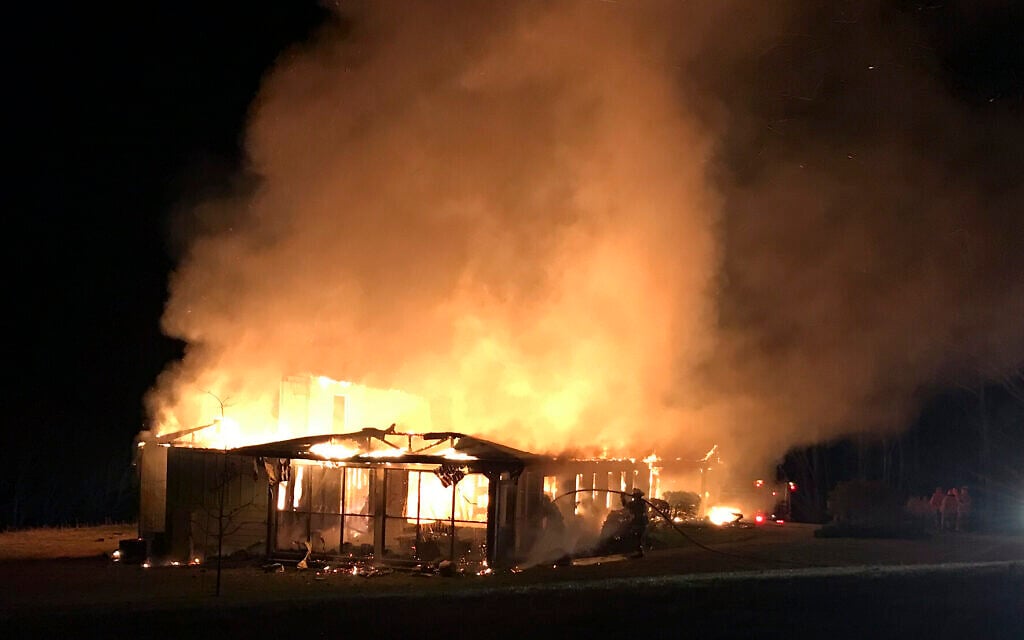
Alleged US arsonist accused of giving list of Israel-linked individuals to Hezbollah
Regan Prater, charged last year over 2019 fire that destroyed historic Tennessee civil rights center, also indicted for terror over alleged support to Iran-backed terror group
The post Alleged US arsonist accused of giving list of Israel-linked individuals to Hezbollah appeared first on The Times of Israel.
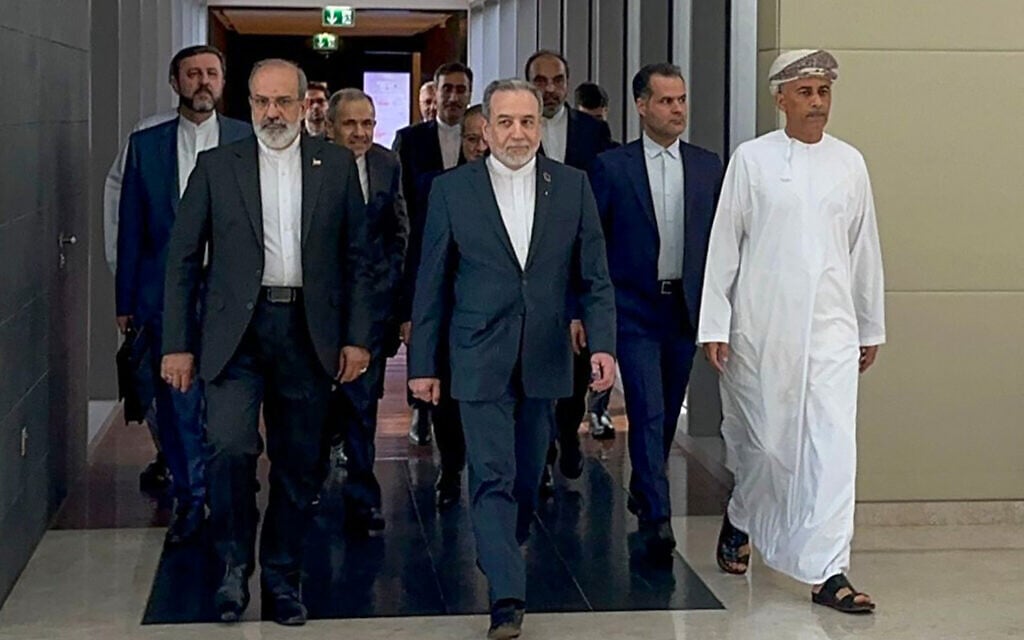
Trump imposes tariffs on countries that import from Iran as nuclear talks resume
Italy’s president declares opening of 2026 Winter Olympics * French prosecutors to probe ex-minister over Epstein revelations
The post Trump imposes tariffs on countries that import from Iran as nuclear talks resume appeared first on The Times of Israel.

Diplomat: At talks with US, Iran refuses to end enrichment; missile capabilities not discussed
Iran said flexible on matter of uranium purity; US said to want Tehran to show up to next meeting, expected in next few days, with tangible concessions; Israeli official sees deal unlikely
The post Diplomat: At talks with US, Iran refuses to end enrichment; missile capabilities not discussed appeared first on The Times of Israel.
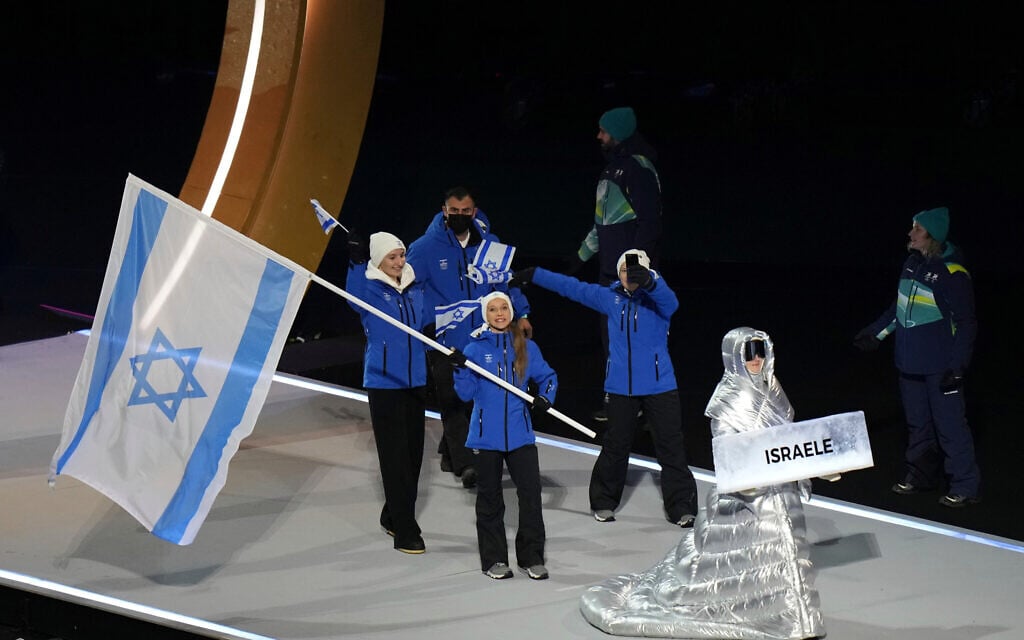
Israel team marches to smattering of boos at Milan Winter Olympics opening ceremony
'I'm prepared, they can do whatever they want,' says Israeli skier Barnabas Szollos; hundreds protest against ICE, which is helping secure US delegation; Vance jeered at ceremony
The post Israel team marches to smattering of boos at Milan Winter Olympics opening ceremony appeared first on The Times of Israel.
Super Bowl ad against antisemitism slammed as ‘disconnected’ from Jewish teens’ reality
Commentators say $15 million clip funded by Robert Kraft is cliched portrayal of Jewish weakness, with teenagers more frequently encountering hatred online and in context of anti-Israel activism
The post Super Bowl ad against antisemitism slammed as ‘disconnected’ from Jewish teens’ reality appeared first on The Times of Israel.

UK police raid two properties linked to Mandelson as part of Epstein probe
Search follows release of documents suggesting former minster and US ambassador passed confidential economic plans to sex offender while serving as business secretary
The post UK police raid two properties linked to Mandelson as part of Epstein probe appeared first on The Times of Israel.

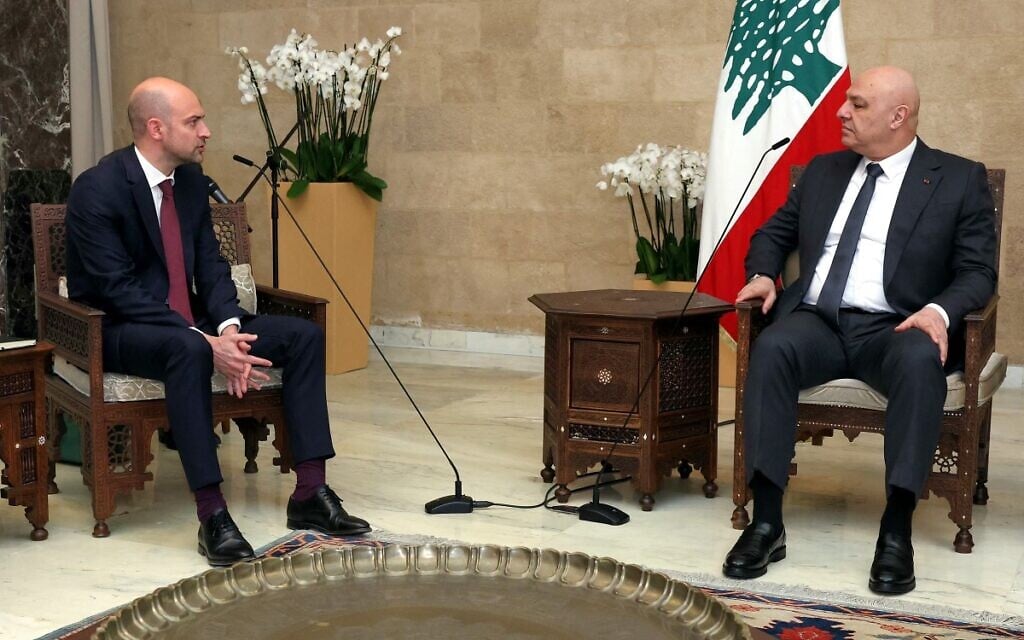
French FM says Lebanese army must be given ‘means’ to disarm Hezbollah
Barrot says Lebanese army should replace UN peacekeepers; French source sees window for progress with 'weakening of Iranian regime'; Hezbollah’s senior security chief resigns
The post French FM says Lebanese army must be given ‘means’ to disarm Hezbollah appeared first on The Times of Israel.
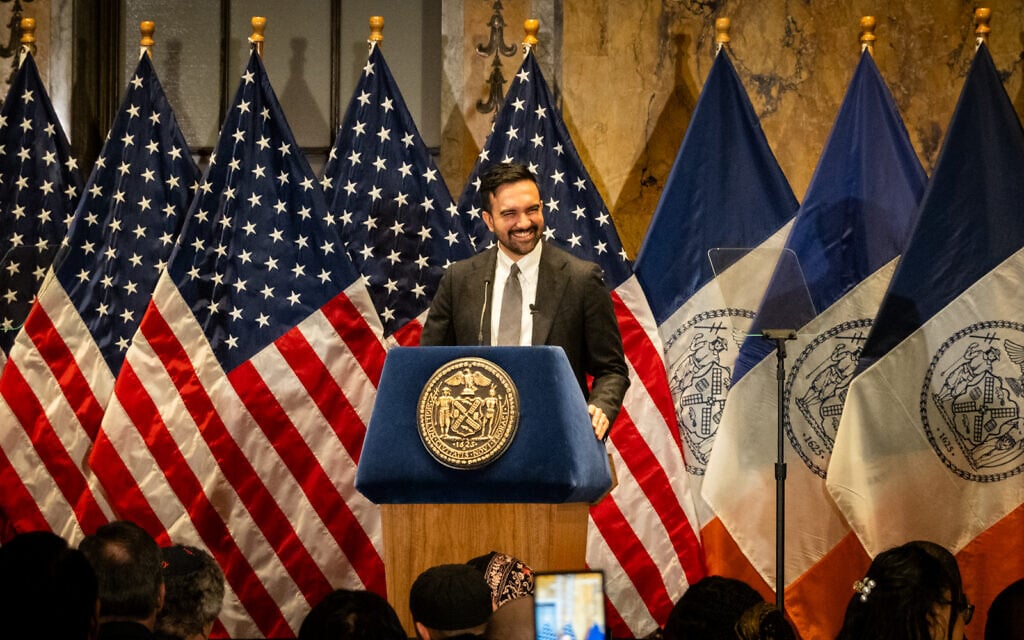
Mamdani and Jewish allies put spotlight on immigrants at annual interfaith event
Breakfast for religious leaders focuses on activism against immigration enforcement, with mayor highlighting past Jewish civil rights activists
The post Mamdani and Jewish allies put spotlight on immigrants at annual interfaith event appeared first on The Times of Israel.
Trump posts, then deletes, video that includes racist depiction of Obamas as apes
White House initially rejects 'fake outrage' over video on US president's Truth Social account, before blaming an unnamed staff member
The post Trump posts, then deletes, video that includes racist depiction of Obamas as apes appeared first on The Times of Israel.

Noam Bettan to sing Eurovision entry co-written by last year’s contestant Yuval Raphael
Set for release March 5, song features lyrics in Hebrew, English and French and is said to be 'a slightly different style' from the ballads submitted by Israel for past two years
The post Noam Bettan to sing Eurovision entry co-written by last year’s contestant Yuval Raphael appeared first on The Times of Israel.

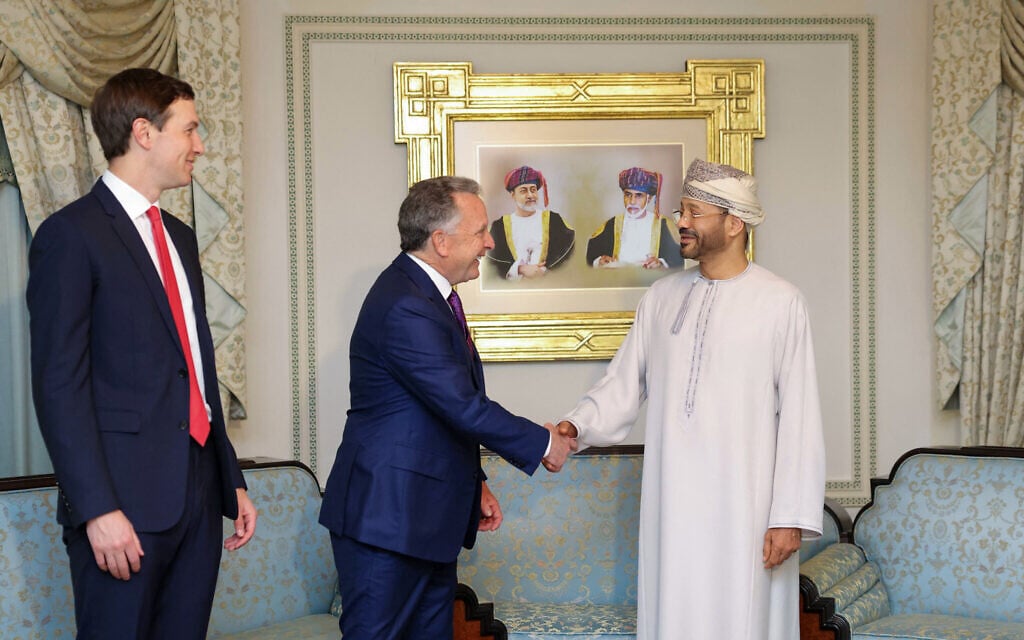
US-Iran nuclear talks conclude in Oman, with another round said planned for coming days
In apparent warning, CENTCOM chief in attendance; Iran FM says discussions focused primarily on finding framework; Omani mediator says talks useful to clarify thinking of both sides
The post US-Iran nuclear talks conclude in Oman, with another round said planned for coming days appeared first on The Times of Israel.
IDF says it hit Hamas arms depot after issuing evacuation warning for Gaza City building
Military says it carried out strike on residential building and targeted weapon production site in Khan Younis overnight in response to attack on troops in northern Strip
The post IDF says it hit Hamas arms depot after issuing evacuation warning for Gaza City building appeared first on The Times of Israel.

Netanyahu: Ties to former PM Barak prove Epstein didn’t work for Israel
PM pushes back against conspiracy theory - one he himself has publicized in past - by highlighting Barak's activities in protest movement 'to undermine the government of Israel'
The post Netanyahu: Ties to former PM Barak prove Epstein didn’t work for Israel appeared first on The Times of Israel.

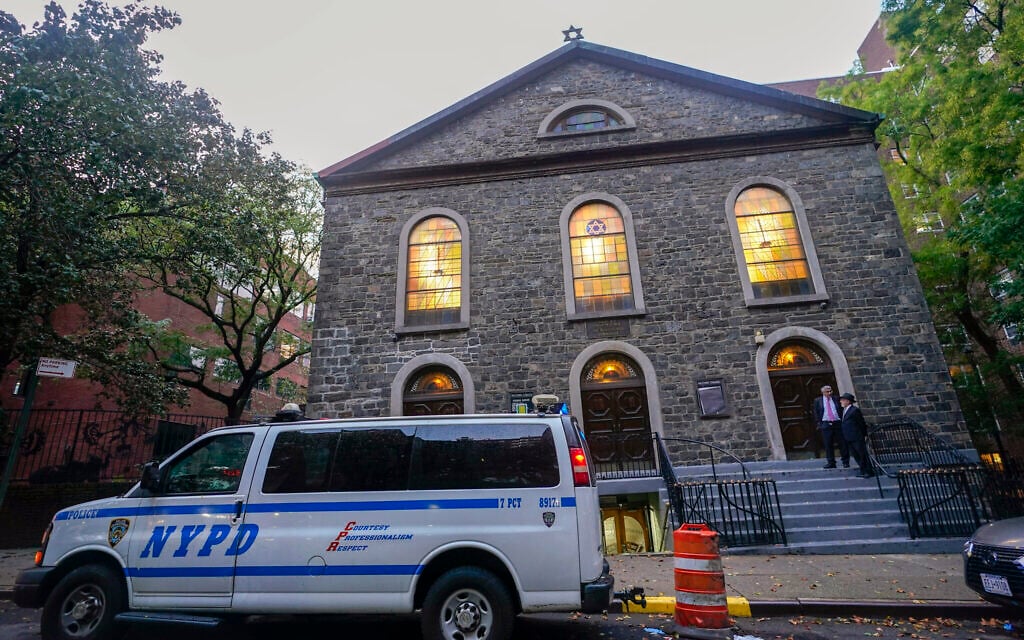
US Jewish leaders express alarm over new political conditions for synagogue security grants
Houses of worship that don't cooperate with ICE or that offer DEI programming are worried new terms will make them ineligible for funding that helps cover essential safety measures
The post US Jewish leaders express alarm over new political conditions for synagogue security grants appeared first on The Times of Israel.
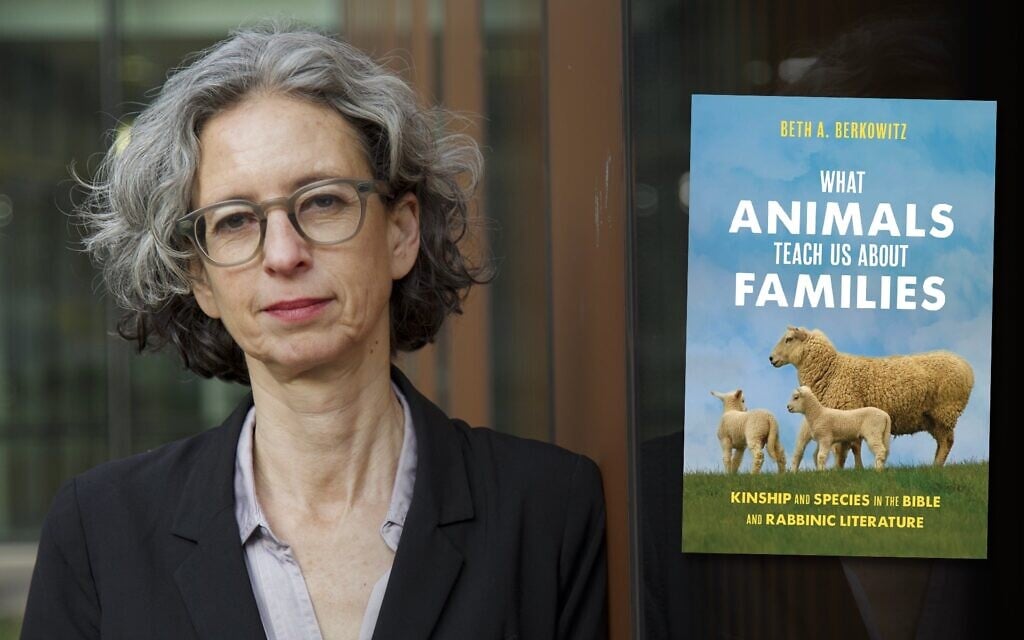
A new book looks at Jewish law’s relationship with animal family bonds
In 'What Animals Teach Us About Families,' Prof. Beth Berkowitz of Barnard College delves into commandments involving mother birds, baby goats - and ethics, if not empathy
The post A new book looks at Jewish law’s relationship with animal family bonds appeared first on The Times of Israel.
Satellite images show Iran is rebuilding missile arsenal, nuclear sites - New York Times

Despite Iran’s three main nuclear facilities remaining inoperative, images show visible work underway.
Iran rejects call to halt uranium enrichment after second round of indirect US negotiations in Oman
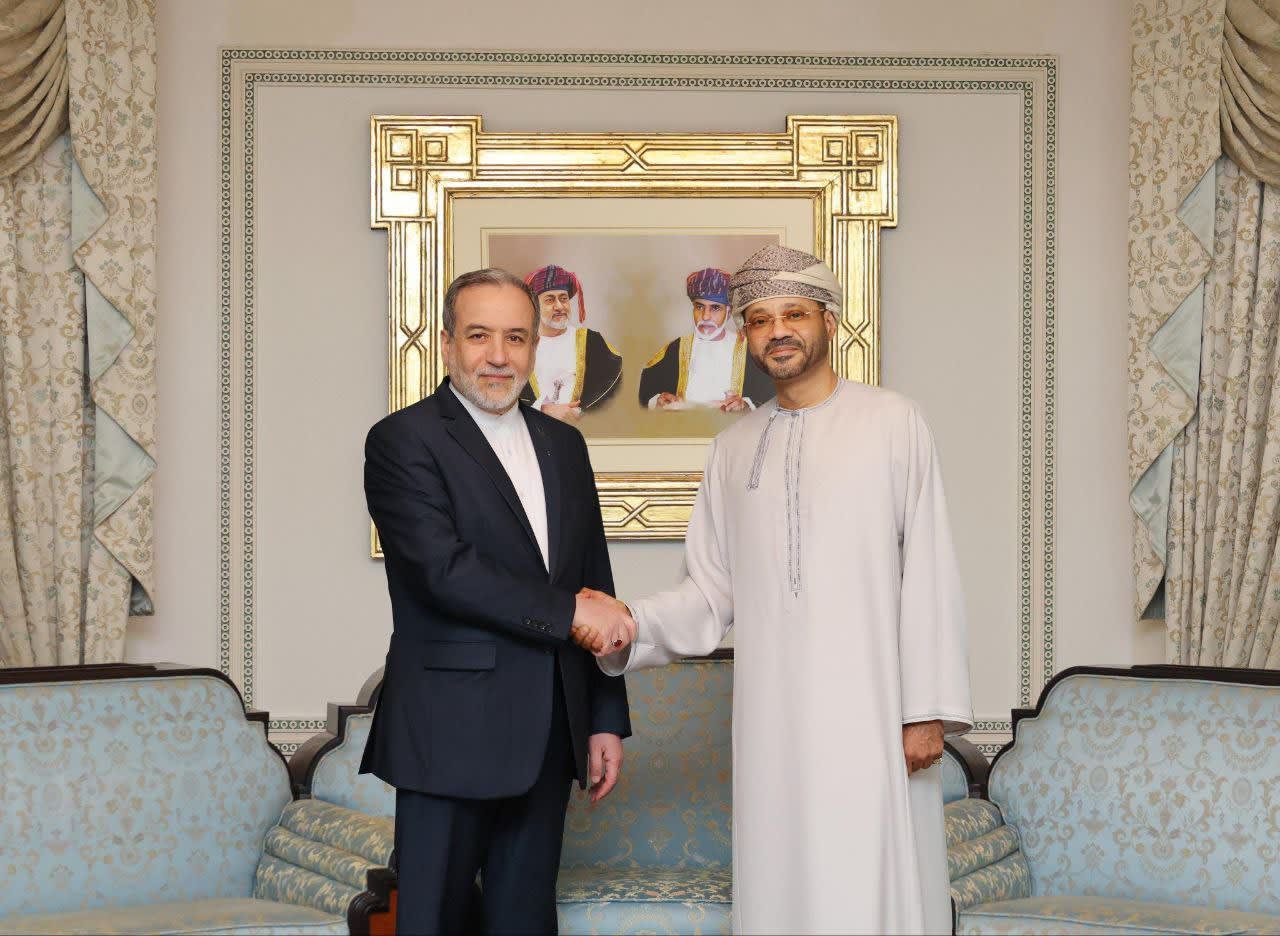
An Iranian official told Reuters the direct talks had not officially started, and that Iran’s demands had been conveyed to the US via Oman.
Hatred of Israel has become a proxy war on the West - opinion

In a bitter historical irony, Europe, the continent responsible for the Holocaust, the greatest catastrophe in Jewish history has once more become one of the main centers of modern antisemitism.
Infiltration alert detected in Karmei Tzur, IDF conducting scans in area

The IDF stated that forces have been deployed to the area for safety scans and that they are in ongoing contact with residents and security officials.
Fire breaks out in Iranian military complex, no injuries reported

Iranian firefighters extinguished the blaze and reported no injuries after it erupted at a carpentry workshop in a Tehran military complex.
Despite Israeli demands, Bank of Palestine refuses to shut down pay-for-slay accounts - exclusive

The bank had agreed to close 1,700 accounts in the West Bank and Gaza, but now claimed it was “unable to act.” The prevailing assessment is that senior PA officials instructed the bank not to comply.
Trump raises controversy after sharing racist video depicting Barack, Michelle Obama as apes
Several hours after the video was published, the White House claimed it had been accidentally posted by a staffer and assured viewers it had been taken down.
Iran ‘playing poker,’ unprepared for regional war, former deputy commander of CENTCOM tells ‘Post’
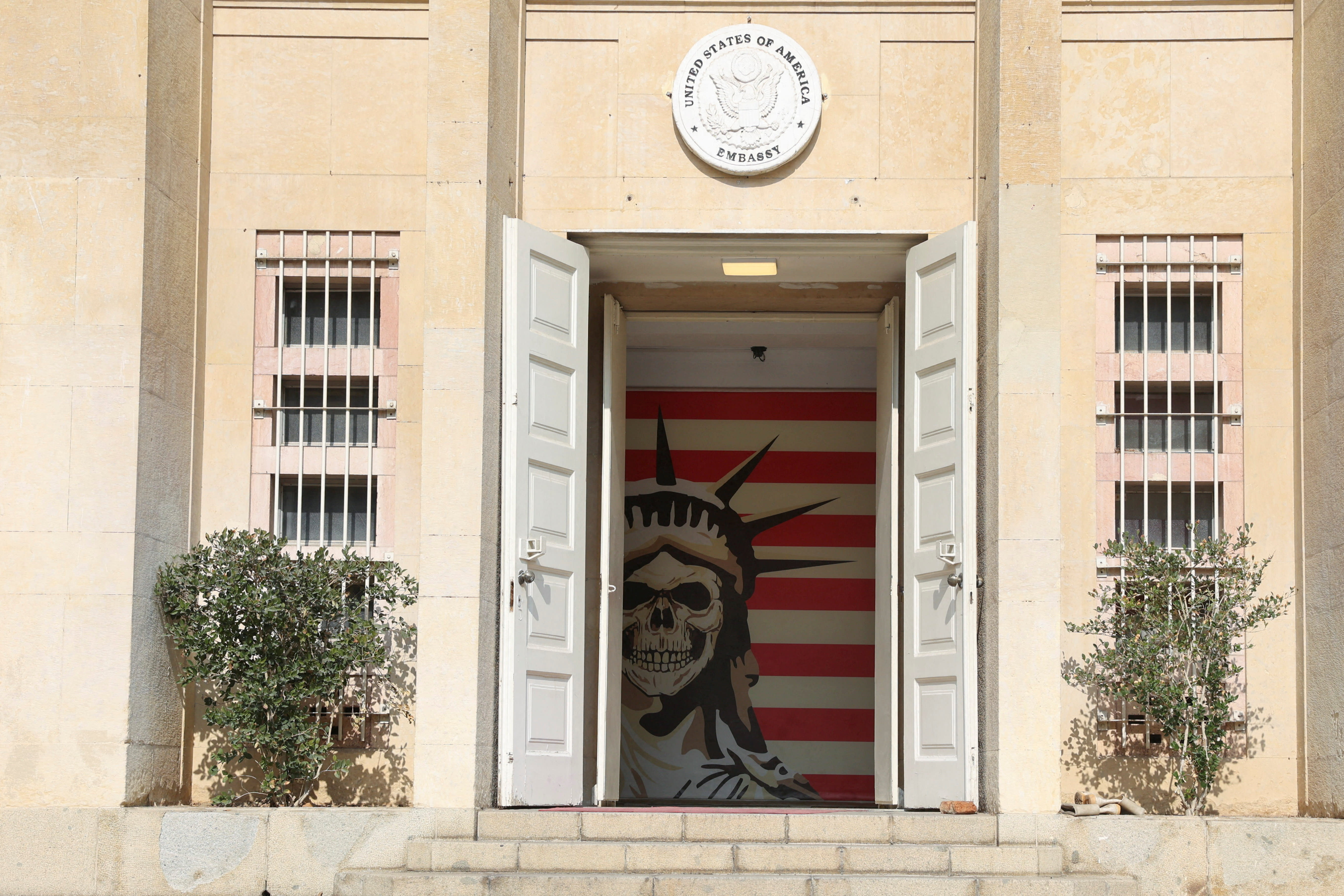
Former Vice-Admiral Robert Harward tells The Jerusalem Post that Iran's regime is near collapse, citing its weakened state, protests, and failed aggression, with US options for supporting protesters.
Israel’s zero-click future: How cyber veterans are reinventing offensive intelligence

MILITARY AFFAIRS: Radiant cyber firm, led by former IDF experts, moves under the radar with advanced tech tools, securing contracts in Western intelligence.
Talking to Tehran: Why US returned to the negotiating table as Iran was at its weakest

MIDDLE EAST AFFAIRS: That is a question many are now asking, alongside other questions that reflect a deeper sense of confusion: Wasn’t the issue Iran’s killing of protesters, not centrifuges?
At least 31 killed in Islamabad Shi'ite mosque bombing, Islamic State claims responsibility

More than 170 others were wounded in the explosion, which occured after security guards attempted to block the attacker from entering the mosque compound.
Sen. Graham ends meeting early with Lebanese official, says Lebanon unreliable peace partner
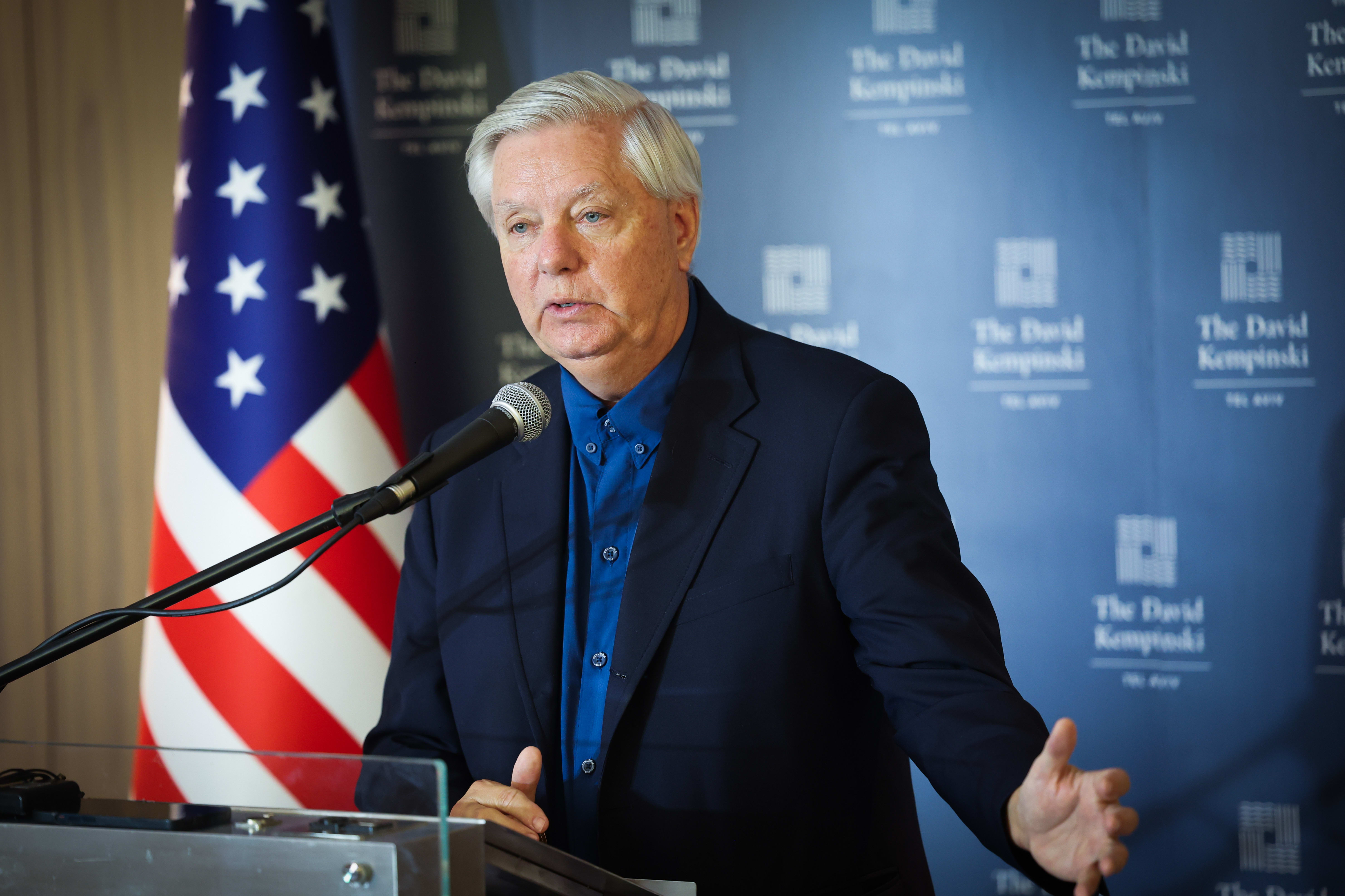
Graham added that “too much is at stake” in the Middle East for the Lebanese attitude, and said that he was “tired of the double speak.”
Good Deeds Day is underway - Twenty years of doing from the heart

Good Deeds Day 2026 will take place on March 10 in Israel and April 12 worldwide, under the key message: United in Good .
'Over 90% of Iranians hate the regime,' INSS’s Beni Sabti reveals from leaked Iran survey

“It was a secret poll which said that 92% of the Iranian people hate their regime,” Sabti said, according to a transcript provided to The Jerusalem Post.
Alshareef: Israel, Jews, should help Iranians seek liberty to ‘repay debt to Cyrus’

Speaking at the Jerusalem Post Miami Summit on Wednesday, Alshareef called on Israel and the Jewish people to back Iranians seeking freedom, as Netanyahu voiced solidarity with the protesters.
How TALMA turns English education into social mobility and a Zionist mission

At the Jerusalem Post Miami Conference, TALMA CEO Ido Mahatzri showed how teachers, language and values reshape Israel’s periphery.
From the front lines to the future: Israeli society and the Jewish people in 2036

Speaking at the Jerusalem Post Miami Conference, IDF veterans and civil-society leaders highlighted service, dignity, and Diaspora responsibility as pillars of Israel’s next chapter.
Watch: The Jerusalem Post Miami Summit

Amid changing geopolitics and evolving Diaspora-Israel relations, the conference served as a platform for powerful ideas, bold discussions, and building bridges across continents.
Netanyahu says Epstein’s ties to Ehud Barak prove he worked against Israel, not in favor
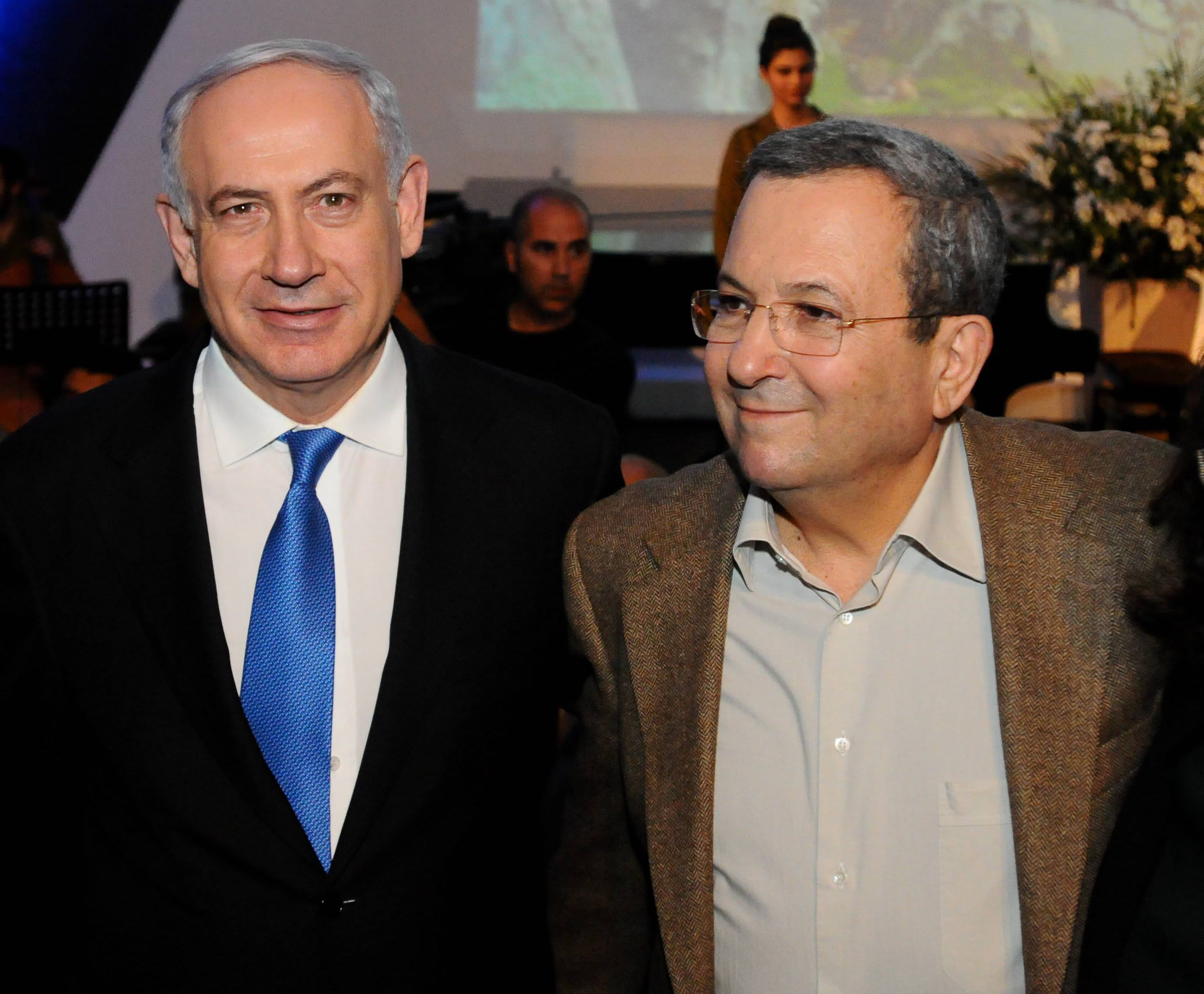
Prime Minister Netanyahu claimed that Barak was engaging in activities that undermined Israel’s government, doubling down on jabs made last year on the former prime minister.
Former Eurovision contestant Yuval Raphael co-writes song selected for this year's submission

Israel’s public broadcaster KAN announced Friday that the song, which was written by Raphael with Nadav Aharoni and Tzlil Klipi, was selected on Friday by its professional committee.
Jerusalem through Ethiopian eyes: Understanding Israel's capital through its Ethiopian communities

As Jerusalem continues to evolve, the rhythms of Ethiopian heritage shape its character in unmistakable ways.
Why Jerusalem’s last-place quality of life ranking doesn’t tell the full story - opinion

A new quality of life report puts Jerusalem last, yet cranes, jobs, housing, and transit projects point to a great future.
Netanyahu releases pre-Oct. 7 intel documents, claims defense echelon urged keeping Hamas in power

The documents, spanning from February 2023 to an hour before attack, show how Israel's defense echelon misread Hamas’s intentions, and characterized the terror group as deterred.
Burn the kitchen down: A transformational Trump must strike at Iran now - opinion

A crushing military blow on Iran is necessary to create a Middle East and a broader world where Washington and its friends are far stronger, and their enemies far weaker, than ever before.
A ‘Venezuelan model’ in Iran would be a disaster for Israel, Iranians - opinion

Removing Ayatollah Ali Khamenei without dismantling the regime risks betraying the Iranian people and leaving Israel facing the same threats under new leadership.
Trump cares more about Iran's nuclear weapons than its protesters, Vance says
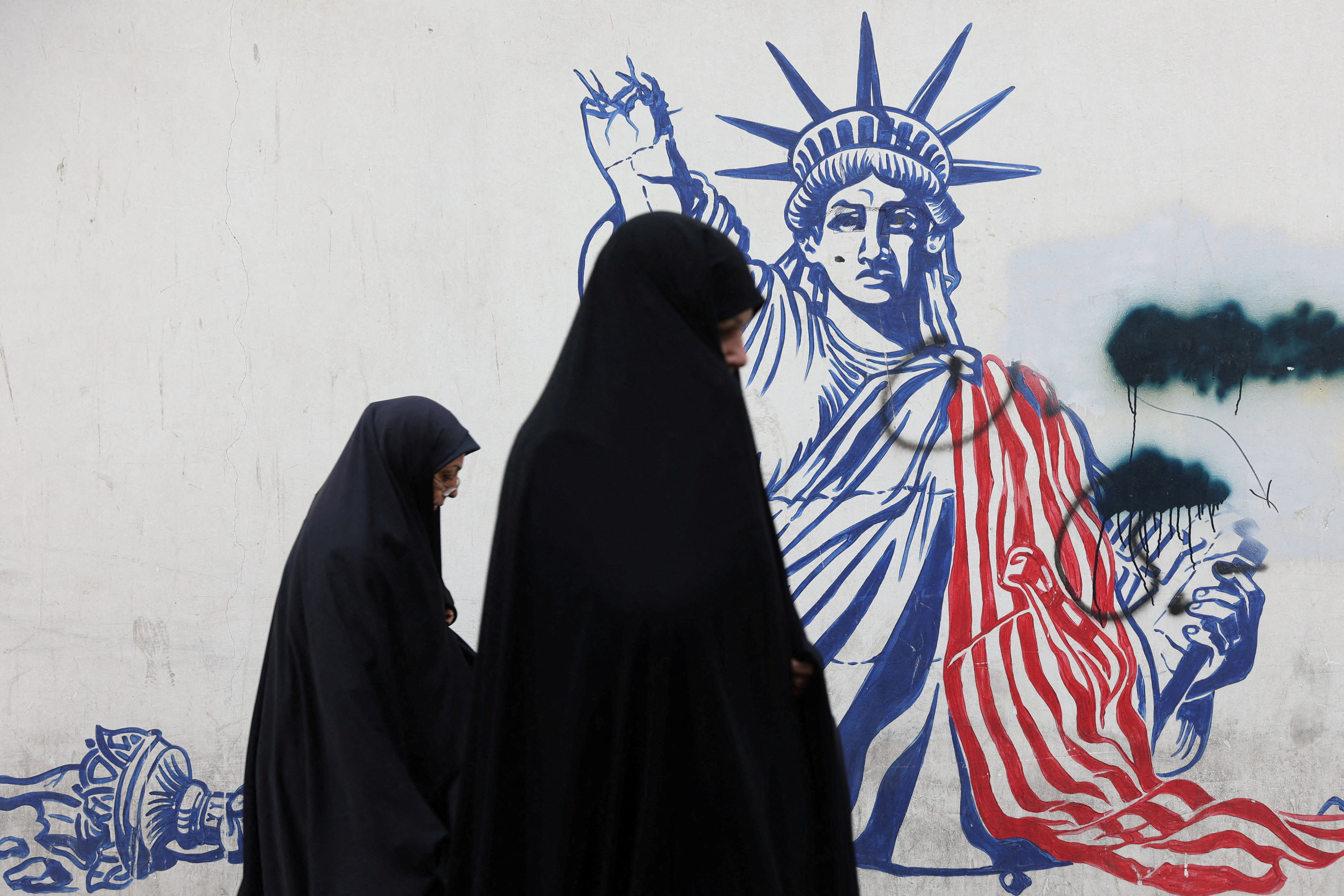
Vance added that the president had also worked with other nations, some allies of the US and others with more fraught relations, to avoid nuclear proliferation worldwide.
MEGA speakers criticize EU leaders for stalling Ukraine diplomacy, urge tougher pro-Israel stance

Inaugural Brussels conference draws US lawmakers and European sovereignty-focused figures, with organizers pitching a bridge to Trump-aligned circles.
"מסתירה מהעולם": ארה"ב טענה - סין ביצעה ניסוי בנשק גרעיני ב-2020
 בזמן מאבק גלובלי במגפת הקורונה, שפרצה בסין והתפשטה לכל עבר: "בייג'ינג ערכה ניסויים גרעיניים נפיצים, כולל הכנות של מאות טונות". כך טען תת-מזכיר המדינה האמריקני. לדבריו, שיטה ייחודית סייעה לה להסתיר את הפעילות. ארגון בינ"ל שמנטר אחר ניסויים גרעיניים: "לא זוהה אירוע כזה"
 מסמך הכזבים של נתניהו: השקרים, ההסתרות - והסערה בקהילת המודיעין
 תשובתו של נתניהו למבקר המדינה היא תערובת של שקרים, סילופים חמורים וטיוח - וחשיפתה בידי ראש הממשלה עצמו מהווה הפרה בוטה של חוקים הנוגעים לביטחון המדינה. סמכותו לחשוף את המסמך הרגיש לא רק שלא קיימת, אלא גם לא מוסרית, בוודאי שלא בשנת בחירות, כשהשאלה המרכזית העומדת למשפט הציבור היא האחריות לטבח. לו היה דובר אמת, הרי שהוא כשל בתכונה החשובה ביותר למנהיג: לבחור את העוזרים והמפקדים הנכונים | פרשנות
 בגלל הבן, ולא בגלל האח: הסיבה שזיני קיבל אזהרה בוועדה הבכירה - ומדוע לא יתפטר
 סערת ההברחות לעזה שבה מעורב בצלאל זיני: גורמים שקשורים לוועדת גרוניס הבהירו כי ראש השב"כ לא מחויב להתפטר מתפקידו גם אחרי שהוגש כתב אישום נגד אחיו - שכן אין קשר בינו לבין המעשים החמורים. הסדר ניגוד העניינים שלא פורסם מאפשר לבהרב-מיארה לדרוש את פיטוריו, אך לא סביר שהיא תעשה זאת
 בשקל, באירו, בדולר: כמויות המזומן שנתפסו אצל משפחות הפשע | תיעוד
 בפשיטה על מתחמי משפחות פשע בלוד, בשיתוף המשטרה, יס"מ ומג"ב, נתפסו 2.5 מיליון שקל במזומן. חמישה מבני המשפחות נעצרו, החשד: כסף מפעילות פלילית, או תשלום "בשחור" כדי לחמוק ממסים. באחד המתחמים טענו: "יש לנו חברת בנייה, עבדנו בווילות יוקרה"
 רצח לאור יום: ניסה להימלט אחרי שירו בו - הרוצחים וידאו הריגה
 רק לפני כחודש השתחרר אסלאם אבו אחמד ממאסר, היום הוא כבר נרצח ביפיע שליד נצרת - בתום מרדף. עד כה לא נעצרו חשודים, מאות בני נוער ערבים הפגינו במקביל נגד האלימות והפשיעה: "הדם שלנו יקר, אנחנו דור השינוי"
 השיקום נגמר באישום: ההורים פנו לסיוע מהמדינה - וזה סיבך את ילדיהם עם המשטרה
 "כבר הפסקתי לספור ניידות", מספרת כרמית, אם לנער שנכנס למסגרת רווחה ייעודית יחד עם פוגעים, נפגעים, בעלי הפרעות חרדה ועוד מגוון נערים עם אבחנות שונות - באופן שיצר מצב בלתי אפשרי לטיפול. שניים מהמוסדות כבר נסגרו ובמשרד הרווחה פועלים לתקן את המצב, אך גורמים בתחום מזהירים: בלי שינוי משמעותי, "המקרים רק יחמירו"
 טראמפ פרסם סרטון של ברק ומישל אובמה כקופים | הסערה - וההתקפלות
 בפוסט שפרסם הנשיא ברשת החברתית שבבעלותו הופיע סרטון קצרצר שבו נראים פניהם של בני הזוג אובמה - מולבשים על קופים בג'ונגל. בבית הלבן טענו כי הדבר אינו פוגעני, אך אחרי רצף גינויים משני צידי המפה הפוליטית מחקו את הסרטון - והאשימו את אחד העובדים
 ה"קו האדום" של איראן בשיחות עם ארה"ב, ו"הדלת המסתובבת" אצל המתווך העומאני
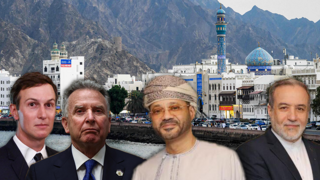 המשלחות ערכו שני סבבי שיחות עקיפות במסקט, ושעות בודדות לאחר מכן הטילו האמריקנים סנקציות חדשות על ישויות וספינות איראניות. שר החוץ האיראני הגדיר את הפגישות כ"התחלה טובה", דיפלומט המעורה בפרטים: "ארה"ב גילתה גמישות בנוגע לדרישות טהרן". דיווח: פגישה ישירה בין וויטקוף וקושנר לעראקצ'י
 מכר סוּכָּר לשוטר סמוי - ונעצר: "סיכמו על קוקאין"
 צעיר מתל אביב נעצר אחרי שבעסקת סמים עם שוטר סמוי מאילת - העביר לו סוכר לבן. החשוד שהה במעצר 13 ימים ושוחרר, במשטרה טוענים כי עבר על החוק: "אם זה היה אזרח, היה לנו נרקומן שלא מקבל אפקט של 'היי' בתמורה לכסף ששילם"
 התפטרות חסרת תקדים בחיזבאללה: הבכיר שהיה מקורב לנסראללה עוזב את הארגון
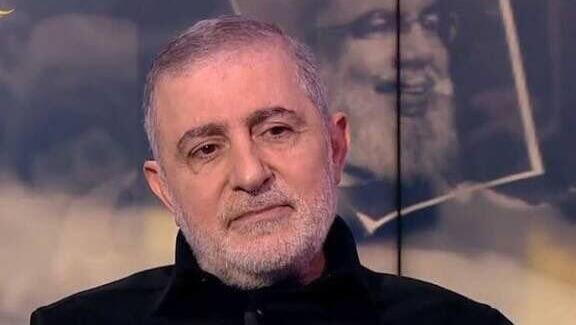 וופיק ספא, האחראי על יחידת התיאום והקישור של חיזבאללה, ומי ששיחק ברגשות משפחות החללים גולדווסר ורגב ביום שבו הושבו גופותיהם ארצה - מתפטר משורות הארגון. הסיבה - מהלך שמוביל נעים קאסם לצמצום תפקידו. דיווח: זה האדם שצפוי לקחת חלק מסמכויותיו של הבכיר
 נתניהו "הזהיר", מערכת הביטחון "טעתה": הציטוטים הסלקטיביים - והמידע שהשמיט
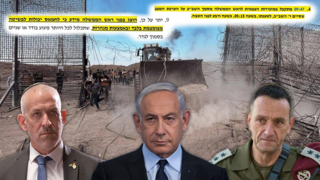 בפרסום תשובותיו למבקר המדינה ניסה רה"מ לייצר נרטיב של "שקיפות", אך למעשה הציג את החלקים שמשרתים את גרסתו. השעות שלא תואמות את היומנים, ההתעלמות מהאזהרות שקיבל והפרוטוקולים שמציגים רק את עמדת צה"ל ושב"כ - כך מנסה נתניהו להסיר מעצמו את האחריות למחדל 7 באוקטובר
 עמנואל רוזן הוא העיתונאי הבכיר שנחקר בחשד שתקף את בתו: "היא כל עולמי" | זו גרסתו
 עמנואל רוזן נעצר לחקירה בחשד לתקיפת אישה, לאחר שבתו בת ה-11.5 כתבה על כך בקבוצת וואטסאפ. בחקירה עלה כי הילדה הודתה שהמציאה את הסיבה לתלונה, אך במשטרה לוקחים את הטענה בערבון מוגבל. "אני מעניק לה את כל האהבה והביטחון האפשריים", כתב רוזן ברשת X
 המאבק הקשה בג'יהאד הרך: תודעה כזירת לחימה
 בורות מערבית כלפי האיסלאם הפוליטי הפכה לאחת הסכנות המרכזיות לחברות ליברליות. כיום, מלחמות מוכרעות בנרטיבים לא פחות מאשר בנשק - האחים המוסלמים הבינו זאת כבר לפני קרוב לארבעה עשורים, וישראל ומדינות המערב לא יכולות להרשות לעצמן להזניח את החזית הזו
 ארה"ב ואיראן השלימו שני סבבי מו"מ: "אווירה רצינית, דנו רק על הגרעין"
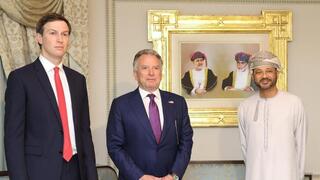 הטלוויזיה האיראנית דיווחה כי השיחות בעומאן מתמקדות באחוז העשרת האורניום. המו"מ, "שיימשך בימים הקרובים", התנהל באופן עקיף - כשנציגי טראמפ והמשטר בטהרן לא בבניין בו-זמנית. לשיחות הגיע גם מפקד פיקוד המרכז של ארה"ב, מקור איראני: "מסכן את השיחות". ניו יורק טיימס: איראן תיקנה "במהירות" מתקני טילים בליסטיים
 אישורי תכניות לאיראן: הדיון המרכזי של מפקד חיל האוויר וראש אמ"ן
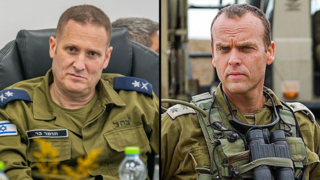 פרסום ראשון: כשברקע צבירת הכוח האמריקנית, ל-ynet נודע כי אלוף תומר בר ואלוף שלומי בינדר דנו על השלמת ההכנות, בהינתן שארה"ב תפעל. ישראל עשויה להשתתף אם תותקף. דובר צה"ל: "ערוכים בהגנה ובהתקפה, אין שינוי בהנחיות"
 "הלכתי לחלון בלי אישור. כשחזרתי, המחבל חיכה לי עם קרש. אחר כך חשבתי איך להתאבד"
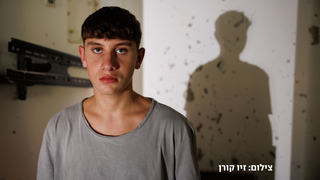 הבדידות הייתה הכי קשה ליגיל יעקב בעזה, והיו גם רעב, מכות ואיומים. ילד מוקף מחבלים, שעבר בין בתים ברצועה ונסגר ללילה ברכב עם 5 מהם במחנה פליטים. ישראלים ראה רק בסוף, כשנדהם שפגש באחיו ולפני כן בבת זוגו של אביו, שלימים התברר שנרצח. ״הראו למשפחה שלי סרטון מהלינץ׳. אבא לבן 3 אומר לו לבעוט, והוא בועט. לפעמים מרגיש לי ששוכחים מה היה. ששוכחים אותנו״
 רצח ליד נצרת: גבר נורה למוות ביפיע
 37 נרצחים מתחילת השנה בחברה הערבית, וגל האלימות לא עוצר: הגבר, כבן 30, נורה למוות ביישוב. המשטרה, שהודתה כי היא לא מצליחה לבלום את האלימות, מסרה שהרקע פלילי
 "פתאום היה בום. הכול עף ונשבר": אוטובוס התנגש בחנות ברמת גן, 10 נפצעו - בהם אחת אנוש
 התאונה אירעה בכיכר כופר היישוב בעיר, והצומת נחסם לתנועה. האישה שנפצעה אנושות, כבת 25, פונתה לאיכילוב. יעל, שהייתה במקום: "הכול קרה בשניות, אנשים ברחו. לא הבנתי אם זו תאונה או פיגוע". נהג האוטובוס טען שהאיץ במקום לעצור - ואיבד שליטה. הוא נעצר לחקירה, שב"כ מעורב. צפו בתיעוד מרגעי הפגיעה
 חשד מזעזע: אנס את גיסתו במשך שנים - והכניסה להיריון
 אישה בת 28 התלוננה כי תושב ראש העין, בן 41, אנס אותה מאז שהייתה בת 14 - ועד חתונתה. לפי עדותה, כשהייתה בת 18 נאלצה לעבור הפלה. החשוד טוען שהמעשים נעשו בהסכמה, מעצרו הוארך
 "ירה פעמיים ממרחק קצר, והמשיך": החייל הואשם ברצח בכוונה בכביש 6
 כחודש לאחר האירוע החריג שבו נהרג שריף מופק חדיד לאחר עימות בכביש, הגישה הפרקליטות כתב אישום חמור נגד החייל שירה בו. מעצרו הוארך עד לקבלת החלטה אחרת. באחד הדיונים אמר השופט: "חשבתי שמדובר בהגנה עצמית, אבל העובדות שונות ב-180 מעלות"
 חפשו את התיכון שלכם: ציוני הבגרויות של כל בתי הספר בישראל | ומי המצטיינים?
 פרויקט מיוחד של ynet, התנועה לחופש המידע ומדלן חושף לראשונה את תוצאות הבחינות של 2024. בדקו בעצמכם: מה הממוצע של בית הספר שלכם, אילו ערים ותיכונים נמצאים בצמרת, מי בתחתית - וכמה גדולים הפערים בין הפריפריה למרכז
 רוסיה: מספר 2 במודיעין הצבאי נורה בבניין מגורים במוסקבה
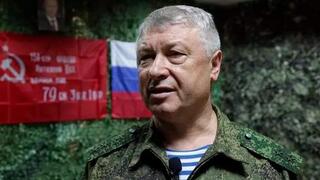 לוטננט-גנרל ולדימיר אלכסייב, הסגן הבכיר במודיעין הצבאי של רוסיה, נורה כמה פעמים בבניין והובל לבית חולים. היורה נמלט. בעבר ביצעה אוקראינה פעולות חיסול נועזות בעומק רוסיה, שר החוץ לברוב: זו הייתה קייב
 עונש מקל למדריך בחוג צילום שניצל ואנס נערות שעלו לארץ: "הפך לבובת מין"
 גנדי לויטס, בן 66 מאשדוד, נשלח ל-8 שנות מאסר ויפצה את הקורבנות. על המתלוננת המרכזית, עולה חדשה בת 15, כתבו השופטים: "היא ראתה בו איש סוד, בזמן יחסים מורכבים עם הוריה וציפתה שיהפוך אותה לכוכב זוהר. הוא ניצל זאת עד תום". הפרקליטות ביקשה 14-10 שנות מאסר: "לא לקח אחריות"
 נפתח המו"מ בין ארה"ב לאיראן; טהרן: "זוכרים את השנה האחרונה"
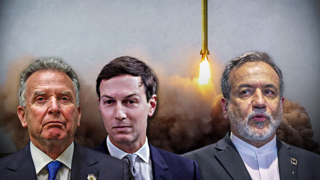 המו"מ חודש לראשונה זה 8 חודשים, עם וויטקוף וקושנר מהצד האמריקני - ומשתתף מפתיע: מפקד פיקוד המרכז של ארה"ב. שר החוץ של איראן: "באים בעיניים פקוחות ועומדים על זכויותינו". דיווח בארה"ב: נושאת המטוסים לינקולן מתקרבת לטווח תקיפה באיראן, אבל אין הוראה ספציפית מטראמפ
 החשד לשחיתות בעיריית אשקלון: השחקנית ענבל גלאם נחקרה באזהרה
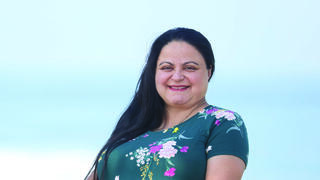 אחותו של ראש העיר, שמוכרת מ"שנות ה-80", מופיעה בשמה ברשימת הספקים שנתנו שירותים ל"קרן אשקלון". לפי החשד, קיבלה כספים פיקטיביים עבור עבודה שלא ביצעה. חשד נוסף הוא שהצעות מחיר שהגישה התקבלו באופן לא תקין. היא שוחררה בתנאים ומכחישה את החשדות: "לא קיבלה שקל שלא כחוק"
 תאונה קטלנית ליד צומת מודיעין: גבר כבן 40 נדרס למוות
 צוותי מד"א הוזעקו לכביש 443 בעקבות דיווח על הולך רגל שנפגע מרכב. מותו נקבע במקום. אדם נוסף נפצע באורח קל, ופונה לבית החולים
 עם סכנת היפוך קנים: ישראל תומכת בעשרות מיליונים במיליציות בעזה | גילויים חדשים
 נותנים להם רובים: בשקט בשקט, לפי דיווחים זרים, ישראל מתחזקת את המיליציות המתנגדות לחמאס שנותר עדיין הארגון החזק ברצועה. פרט לתחמושת, התמיכה כוללת מתחמים מוגנים למשפחות, טיפולים רפואיים, רחפנים, כלי רכב, דלק, מזון ואפילו סיגריות. עכשיו יש גם מי שמעלים חשש מהיפוך קנים נגד צה"ל
 "האיום החדש" מערי הטילים, וההבטחה: "טראמפ לא ימצמץ" | המו"מ למניעת מלחמה יוצא לדרך
 שר החוץ האיראני דיבר על "דיפלומטיה בעיניים פקוחות - וזיכרון מהשנה האחרונה". וויטקוף וקושנר מגיעים עם "קווים אדומים" אחרי השיחות מול נתניהו. המו"מ יחל בעומאן, בכיר ישראלי מבטיח שארה"ב לא תתקפל, אך רה"מ הודה בקבינט: "לא יודע מה טראמפ יחליט". משטר האייתוללות מתרברב עם "טיל בטווח של 2,000 ק"מ ומהירות של 16 מאך", אך בפועל חושש מקריסה. עדיין: הסיכוי שיוותר על "כיפת ברזל" שלו - הטילים - קלוש | אלו סוגיות המחלוקת
 למה אני רוצה להיות הרב הראשי של תל-אביב
 ככה עובד עיקרון "העיוורון הנורמטיבי" בכלכלה ההתנהגותית: אם מותר לשר אוצר לא להבין בכלכלה, למה אסור לרב לא להבין בהלכה?
 סעודיה וטורקיה: גידור סיכונים, לא אידיאולוגיה
Abraham Accords on brink of collapse as UAE loses patience with Netanyahu
If the Abraham Accords ever stood on the edge of collapse, it happened on September 9, 2025. That day, Israeli Air Force jets bombed a building in Doha, Qatar's capital, where Hamas leaders had gathered. The shockwaves from the historic strike reverberated clearly 310 miles (500 kilometers) away in Abu Dhabi, the UAE capital. They violently shook the walls of President Sheikh Mohammed bin Zayed's palace.
"He very much disliked the fact that Israel rampages with its aircraft wherever it wants," said an Israeli official, a senior defense figure until recently, who maintains close ties with Abu Dhabi's political leadership and has met personally with bin Zayed. "It touched him."
Following the Israeli strike, the furious bin Zayed convened an emergency meeting to discuss the UAE's response options – the dominant country on the Arab side of the Abraham Accords. As Israel Hayom first reported, one option raised at the table was a dramatic decision to freeze the accords. "This was the biggest scratch the Abraham Accords have encountered until now," said another Israeli official who has maintained contact with the UAE security leadership for years.
The option to freeze the Abraham Accords did come up at that Abu Dhabi meeting, but ultimately came off the table. Still, on the Emirates' scale – skilled statesmen who usually conduct themselves in a measured and moderate manner – their response to the Doha attack was wild. "A crude and cowardly move, a reckless and aggressive act," bin Zayed described the strike in an official statement issued by the Emirati foreign ministry that same day.
The next day, Israeli defense industries' participation in the air show scheduled in Dubai was canceled, and later the Israeli ambassador, Yossi Shelley, was summoned for a reprimand. "Israel's aggressive and provocative behavior establishes an unacceptable reality," he was told.
 UAE's President Sheikh Mohammed bin Zayed Al Nahyan arrives for his meeting with Russian President Vladimir Putin at the Kremlin in Moscow, Russia, January 29, 2026 (Photo: Maxim Shipenkov/Reuters) via REUTERS
However, the most significant diplomatic step bin Zayed took was his decision to fly the day after the Doha strike for a solidarity visit to Qatar. For bin Zayed – who marked the Muslim Brotherhood as his country's greatest enemy, participated in the Arab boycott of Qatar from 2017 to 2020, and views the Gulf state as one of the main threats to Emirati national security – the Qatar visit was a glaring message to Israel that enough is enough.
The crisis surrounding the Doha strike was indeed the peak moment – or more precisely, the low point – in relations between Israel and the UAE since signing the Abraham Accords, but it did not occur in a vacuum. An Israel Hayom investigation, based on conversations with figures in Israel and the Emirates, reveals that for a long time, the palace in Abu Dhabi has felt deep frustration and disappointment with Jerusalem, questioning the benefit they gain from the Abraham Accords. Behind this stand a series of failed economic deals, an ambassador who evokes negative emotions, extremist statements by government ministers, unclear Israeli policy regarding Gaza's future and Judea and Samaria – and no small amount of suspicion toward Prime Minister Benjamin Netanyahu.
The Emiratis themselves, in keeping with their diplomatic character, will not openly admit their displeasure with Israel, but their patience appears to be running out. A foreign figure recently asked whether the UAE's relationship with Israel is realizing its full potential responded with three words: Not even close.
Below the radarTrue, Israel has gained tremendously from the Abraham Accords and normalization with the UAE, and vice versa. The diplomatic breakthrough positioned both countries as regional powers with stability and served as a significant counterweight to Iran's expanding influence. "The Emiratis even talk in closed rooms about establishing a Middle East NATO, with Jewish and Muslim soldiers," said a former senior security official who maintains contacts with Abu Dhabi.
Economically, the Emirates ranks ninth among countries exporting to Israel in 2024, and trade between the countries totals more than 10 billion shekels ($2.8 billion) annually. The tourism industry to Dubai thrives, and it seems every other Israeli has already visited the city on the Persian Gulf's shores. Emirati airlines operate about 120 flights per month to Israel and were the only foreign carriers that did not stop flying to Ben Gurion Airport since October 7, except during security escalations such as the war with Iran.
One Israeli who recently flew to the Emirates is Foreign Minister Gideon Sa'ar, who has visited the country three times since entering office, more than any other country. As we reveal for the first time, Sa'ar's latest Emirates visit occurred a few weeks ago and has remained below the radar due to its sensitivity. Security cooperation between the countries also conducts most of its business below the radar, which has helped relations weather "tension points," according to an Emirati official.
However, from the Emirates' perspective, cooperation with Israel has exacted a heavy price. From the moment the Abraham Accords were exposed, many of their Muslim brethren have perceived them as assisting Israel in its struggle against Palestinians and Arabs. "They call us traitors," an Emirati official frankly admits. Recently, the Emirates began wondering whether this heavy price is worth clinging to the Abraham Accords.
"The Abraham Accords put the Emirates on the radar of the Iranians and other Muslim countries. For them, it was a move with many risks," said a senior figure in the cyber industry who has worked with the Emirates for many years. "But when I ask the Emiratis what they gained from the Abraham Accords, their answer is 'a 450% growth in terror attack warnings.' In the 12-day war (the June 2025 Iran-Israel conflict), for example, there were hundreds of Iranian attempts to harm Israelis on Emirati soil, and the Emiratis are overwhelmed with this.
"On the other hand, economically and politically, they are not receiving everything they can from Israel. They are in a mode where they are also being driven out of town and eating the rotten fish."
The situation has worsened since October 7, mainly due to allegations of "genocide" Israel is committing in Gaza, which echoed in the Arab world and penetrated Emirati society itself. "Senior Emiratis control their country very well, but they also hear voices from their people, who identify with the Palestinians in Gaza, and this puts a lot of pressure on them," an Israeli official said. "This pressure slows down the tightening of ties between governments and also between people."
According to a long line of experts and Israeli figures operating in the Emirates, the Abraham Accords are far from yielding the promise embedded in them. "The relationship between Israel and the Emirates has strategic national potential unlike any other, but it is being missed," one of them said.
"The potential for security-technological cooperation between Israel and the Emirates is also far from realization, and that's a shame," agreed Shalev Hulio, CEO of DREAM and one who maintains close contacts with security figures in the Emirates since his previous company, NSO's days. "The Emirates currently operates in a way very few countries know how to conduct, with long-term thinking, investment in advanced technologies, and the ability to move entire systems very quickly. If there is a country aiming to become the next 'Startup Nation,' the Emirates is definitely there."
 Shalev Hulio, CEO of DREAM and one who maintains close contacts with security figures in the Emirates
"The UAE is not an empty ocean. The whole world is eyeing cooperation with them, and if Israel does not do so, they will cooperate with other countries. We have a lot to lose," joined an Israeli official who previously served in an official capacity in one of the Gulf states. "We have achieved much from contact with them, but if we had behaved correctly, we could have achieved twice as much. All the current government lacks is to build trust with them, really."
The basis of suspicionThe word "trust" keeps recurring in the many conversations we have had in recent weeks about Israeli-UAE relations. Usually, it is associated with the name "Netanyahu." Paradoxically, it seems the one struggling to gain the Emirates' trust is precisely the man who signed the Abraham Accords with them. One of the clearest signs of this is that, more than five years after signing the accords, Netanyahu has not been invited for an official visit to the Emirates. Even President bin Zayed's historic visit to Jerusalem, whose details had already been finalized during the previous government's tenure, was canceled by the current government.
While Netanyahu's visit to the Emirates lingers, Naftali Bennett did visit there once, as prime minister, and once about a year ago as a private citizen. On both occasions, he met with Sheikh bin Zayed. Recently, Bennett met with bin Zayed again, secretly, for the third time. Yair Lapid also visited Abu Dhabi, once as foreign minister and once as opposition leader.
According to an Emirati official, the timing of Netanyahu's official visit to Abu Dhabi has not yet been finalized. He compared it to going to the beach – "You go to the beach to enjoy, right? You would not go to the sea on a stormy day, with strong wind and rain. In the current climate it would not be right for the Emirates to invite Netanyahu for a visit. This would only fuel conspiracy theories in the Arab street that the Emirates is working hand in hand with Israel to bomb Gaza and so on."
Israeli officials we spoke with claim Netanyahu holds many shares in creating that stormy "climate." "After the Abraham Accords, in the half-year Netanyahu was still in power, relations experienced a honeymoon," said a figure who speaks with many Emiratis daily. "This continued under the Bennett-Lapid government, which enjoyed the accords' fruits. But since Netanyahu's return to power in 2022, there has been widespread suspicion toward him in the Emirates.
"When the judicial reform began, obviously, that itself did not move them. But they wanted relations with a country whose stability they understand, and suddenly they find Israel drowning in protests. Also on October 7, the Emirates' support for Israel was uncompromising. But as the fighting in Gaza continued, the IDF's aggressive conduct and lack of understanding where Israel is heading did not make them happy."
Several Israeli sources we spoke with agree that what infuriated the Emirates more than anything were extremist statements by government ministers, such as Amichai Eliyahu, who raised the possibility "to drop an atomic bomb on Gaza," and Finance Minister Bezalel Smotrich, who suggested to their Saudi neighbors "to continue riding camels in the desert."
Knesset members from Likud who called "to burn Gaza" or "starve" Gazans also did not help diplomatic relations with Abu Dhabi. The Foreign Ministry tore its hair after these statements and tried to explain to the Emiratis that Israel is a democratic country with freedom of expression, where one cannot control every minister's statement. It is not certain that this argument was understood.
"Recently, I sat with one of the emirs' sons, who told me, 'I do not understand – your ministers talk about erasing Gaza and taking over the Temple Mount. Is this really the Israeli position?'" an Israeli official said. "The Emiratis are by their definition a peace-pursuing people, truly neutral. They went with Israel into an alliance of moderates, and suddenly they find Israel as a psychotic player in the Middle East. This stresses them very much."
"In closed conversations, the Emiratis express shock and astonishment at ministers' statements, especially from right-wing parties," said Dr. Yaoz Sever, chairman of AGC consulting firm and chairman of the Israel-Gulf States Chamber of Commerce, who conducts business with the Emiratis daily. "They cannot understand whether these positions represent the people. But since the Emiratis are people who express themselves delicately, their displeasure is mainly expressed in the fact that Netanyahu has not yet been invited to the Emirates. This is the Emirates' quiet and so dignified way of telling Israel 'we are not satisfied.'"
 Dr. Yaoz Sever, chairman of AGC consulting firm and chairman of the Israel-Gulf States Chamber of Commerce
"The rise of the current right-wing government caused significant erosion in relations," agreed Dr. Moran Zaga, lecturer and researcher at the University of Haifa and expert on Gulf states. "Businesses, official visits, and additional contacts slowed or stopped. What is being missed at the first level is the personal connection between leaders. Gulf politics is fundamentally based on personal and tribal connections, and on top of these foundations, additional layers of ideology, pragmatism, and nationalism were built. But the original structure still sets the rules.
"Look, for example, at the warm connection Trump managed to create with Saudi ruler bin Salman. Therefor,e we see to this day how certain Israeli figures receive a warm embrace, while others are pushed out. Sometimes this is expressed in preference for an Israeli opposition figure, simply because the personal connection with him is stronger."
In the complex reality of the Middle East, the October 7 war also gave Israel an opportunity to upgrade its relations with the Emirates, a country whose senior officials hate Hamas no less than we do. "October 7 shook them on insane levels," said an Israeli official who knows the Emirates well. "Hostage release is in their discourse at such a level that on the day the last hostages are released, they will stop everything and go to television. On the other hand, the humanitarian situation in Gaza is difficult for them."
The Emiratis were indeed the main force that mobilized to finance and ship humanitarian aid to Gaza during the war. This move allowed them to prove their concern for the Palestinian population while allowing Israel to continue conducting fighting in the Strip under international pressure. "The thing that succeeds most today in the Israel-UAE relationship is the humanitarian effort in Gaza. There, surprisingly, there is the most fruitful cooperation," said Dr. Zaga. "The Emirates exploit the contact with us to break through and lead the humanitarian arena in Gaza, and they are very proud of it."
At least one figure in the IDF leadership tried at the war's beginning to leverage the interest and harness the Emirates to the day-after issue. "The Emiratis were ready to train Palestinian security mechanisms' personnel so they would enter the Strip," he said. "But in Israel, the Palestinian Authority is taboo to mention. Instead, the Israeli government was finally forced to surrender to American dictates and bring Qatar and Turkey into the Strip, which support the Muslim Brotherhood and constitute one of the greatest threats to the Emirates."
In contrast, official Israeli figures claim the Emiratis are now reaping the seeds they planted in Gaza – while the Israeli government tries as much as possible to reduce Qatari and Turkish involvement in the Strip's rehabilitation, the political echelon encourages Emirati elements to enter the Strip, especially regarding education. As we now reveal, one aspiration is for the Emirates to establish in IDF-controlled areas a network of educational institutions, where they will exploit the experience they accumulated in de-radicalization to influence Gaza's next generation.
"The Emirates have a central role in the day after," one official we spoke with said. "They understood long ago that Islamic education can take the country to bad places, so they hired British and American kindergarten teachers and teachers, replaced the educational staff in the kingdom, and thus grew an educated and tolerant generation in a Muslim country. This thing can also happen in Gaza."
The Emirates are so zealous about their education that early this month it was published that they stopped government subsidies granted to students going to study at British universities due to concerns about Islamic radicalization and Muslim Brotherhood influence on students in the European country.
"To build trust bridges"Israeli-UAE relations have already known ups and downs. In 2011, the Mossad assassinated senior Hamas figure Mahmoud al-Mabhouh in a Dubai hotel, causing a break in the secret relations conducted until then between the countries. The connection was restored mainly through a series of security deals conducted underground, including, among other things, the Emirates' purchase of NSO's "Pegasus" offensive cyber software.
Later, Israeli defense industries entered the picture, such as Rafael and Elbit. "Pegasus and the defense industries caused intimate relations to tighten between the Israeli security system and the Emirati one," an Israeli official said. "This also created a direct line between leaders. The security successes led to contacts in fields like medicine, agriculture, and energy, which required normalization agreements to realize. The sense of intimacy and need for cooperation above the radar formed the basis for the Abraham Accords."
The Abraham Accords served the Emirates not only on the practical level but also strategically. "Its main motive for entering the accords was to further expand its influence in the Levant and exploit Saudi distance from this arena," said Dr. Zaga. "In addition, Abu Dhabi leadership explained it saw the Abraham Accords as leverage for creating a diplomatic breakthrough between Israel and the Palestinians. But in practice the opposite happened."
The influence race and aspiration for an arrangement with the Palestinians were also the reasons the Emirates joined the "Negev Forum," which united Abraham Accords countries alongside the US and Egypt and aimed to advance political, security, and economic initiatives in the region. But after one publicized summit during the Bennett-Lapid government, the forum's activity ceased and was not renewed under Netanyahu's government. "This is because these countries quickly despaired after a period of tension in the Palestinian arena and difficulty creating legitimacy in the Arab street," Zaga explained.
Another regional initiative that got stuck is the "water for electricity" project, aimed at fighting the climate crisis by purchasing green electricity from Jordan in exchange for exporting desalinated water from Israel with Emirati financing. Emirati officials recently said they are very disappointed that the project is not advancing, partly due to Israeli delays. The Emirates' frustration with regional cooperation with Israel was expressed about three months ago by Dr. Ali Rashid Al Nuaimi, member of the Federal National Council. At the Knesset caucus conference for promoting regional security, he scolded participants via video call – "All Israeli politicians must understand that normalization is not peace, but only an agreement on a piece of paper. What is needed is to build bridges of trust, understanding, and respect."
Although peace efforts between leaders experience turbulence, direct meetings between Israeli entrepreneurs and Emirati investors have helped strengthen ties at the private level. "The Emiratis are amazing hosts, unusually educated, men of the world, and know exactly what they want," said Dr. Sever, whose business activity is concentrated in the Gulf region. "But unlike the Israeli businessman, their main goal is not 'to bring the hit.' Despite being wealthy, the Emiratis do not like wasting money. Business with them is conducted very carefully because many people from all over the world come to the Gulf region, and Dubai in particular, thinking they will make easy money. The reality on the ground is completely different."
 General view of the Burj Khalifa skyline in Dubai, United Arab Emirates, December 8, 2021 (Photo: Reuters/Abdel Hadi Ramahi) REUTERS
"The UAE is one of the best countries in the world to do business in. However, the Emirati investor is educated, sophisticated, and careful, and is likely already in business with superpowers such as the US, Russia, China, and India. Therefore, he will not invest in a deal that is not sustainable," joined Saud Sakher, an engineer and businessman resident of Abu Dhabi who invests in Israeli companies.
Saud, who came to Israel in the first delegation to leave Abu Dhabi after signing the accords, is a good example of the warm connection that can form between Israelis and Emiratis. On his first visit here he visited the Western Wall, Yeruham, and Nazareth, and on his second visit already managed to participate in two weddings, a bar mitzvah, and a Hanukkah candle-lighting ceremony. "I saw the Israeli community as it is, in its most distilled form – Jews, Druze, Muslims, and Christians living together. True, not everything is perfect, but overall everyone gets along," he said in a conversation conducted in English spiced with Hebrew words. "The Abraham Accords survived the test of October 7, an event that connected the Emirati people to the Israeli people. The connection between the peoples also survived the Gaza war. We want the Abraham Accords to push our countries forward."
"The UAE is not an empty ocean. The whole world is eyeing cooperation with them, and if Israel does not do so, they will cooperate with other countries. We have a lot to lose. All the current government lacks is to build trust with them, really."
"The Emiratis pride themselves on having residents from all countries in the world, and therefore they know how to give respect to every nation and religion," Sever said. "If you arrive in Dubai during Ramadan, it will be decorated accordingly; at Christmas, you will find Christmas trees there; at Hanukkah, menorahs; at Diwali, you will feel like you are in Delhi; and at Halloween, everyone on the street will be in costume. The Emiratis participate in these celebrations happily and enjoy congratulating everyone. I would not call them 'liberal' in the Western sense, but they have a lot of tolerance."
"I am experiencing stormy divorce from the perception that there is an inseparable connection between democracy and liberalism. Precisely the non-democratic countries turn out to be liberal," said another Israeli who spends much of his time in the Emirates and is in contact with Abu Dhabi leadership. One of the moves that amazed this Israeli is the Emirates' decision to reduce its dependence on oil money. "The Emirates reduced state revenues from oil to only about 25% of total state revenues, thereby cutting their dependence on natural resources," he enthused. "In other words, the UAE's success does not stem only from money but also from leadership. The Emirates is not just Burj Khalifa, a Ferrari in the yard, and fancy malls. It is also a school for strategy, geopolitics, education, and leadership.
"Everything so lacking in Israel is found there. There is education cultivating the future generation and a country managed like a good high-tech company. It is a shame that in Israel they cannot understand this and cultivate the strategic connections with them. This is a miss."
Another matter missed in strategic and personal relations with the Emirates concerns the Israeli ambassador to the country. In early 2025, Netanyahu appointed Yossi Shelley, until then Prime Minister's Office director general and formerly Israel's ambassador to Brazil, as ambassador to the Emirates. Shortly afterward, Emirati security personnel complained that Shelley treated them disrespectfully. Israeli media even reported that following this, bin Zayed demanded Shelley be replaced with another ambassador and threatened to expel him from the country.
"They put a terrible ambassador there who almost ruined relations," an Israeli official in contact with the Abu Dhabi palace said. "They looked at him and said, 'What, are the Israelis idiots? Is this who they sent here?' This is another example of how the state is missing the strategic connection with the Emirates." Several officials we spoke with claim that since the affair, Shelley struggles to fulfill his mission. "He does manage to mediate business and economic contacts, but he has no access to the political leadership," one of them said. "He is 'dead man walking.'"
How to proceed?Failure to recognize the potential embedded in Israeli-UAE relations is also evident in the economic dimension. Though trade volumes between the countries have grown, the wealth is not distributed symmetrically. "In practice, the relationship is almost one-sided," said Oren Helman, CEO of the Israel-Gulf States Chamber of Commerce. "There are many Israeli companies active in the Emirates, exploiting the tax breaks there and financial investments in Israeli technology. The problem is that it is hard to bring the Emiratis to Israel."
In this situation, the State of Israel is losing considerable tax revenue. Several huge investments the Emirates tried to make in Israel also ended in disappointment from the Emirati perspective. This happened for example when the DP World group, controlled by Dubai government, withdrew from the tender to privatize Haifa port after its participation was disqualified for security reasons, and when the decision by Emirati funds to invest $2.3 billion in purchasing parts of the Phoenix Group was blocked due to regulatory restrictions Israel imposed. In both cases it was explained after the fact that canceling the deals stemmed from concern that Israeli pension funds and strategic assets would be managed by a foreign country, especially an Arab one. The Emirates did not like this explanation.
The enormous investment the Emirates planned in the EAPC (Europe Asia Pipeline Company), a project that would significantly increase fuel transport capacity between Eilat and Ashkelon, also came to nothing, this time due to civil-environmental protest, something the Emiratis are a bit less accustomed to. "I am not entering Israel's strategic interests; it is possible the considerations for canceling these investments were justified," said Dr. Zaga, "but because of this and additional reasons, the Abraham Accords are now perceived in the Arab world as a process in decline, despite their survival and despite continuing cooperation."
As Israel aspires to expand the Abraham Accords and recruit Saudi Arabia and additional giant Muslim countries to them, Zaga proposes first concentrating on rehabilitating the existing. "To attract other countries, strong and important to Israel," she said, "there is first of all importance in improving relations and presenting a success story with the Emirates."
The post Abraham Accords on brink of collapse as UAE loses patience with Netanyahu appeared first on www.israelhayom.com.
Beneath Gaza, Israel's war with Hamas has only begun
After meeting with us, Lt. Col. Y., head of the Subterranean Branch in the IDF Southern Command, waited for representatives of the US military near a Hamas attack tunnel discovered close to Kibbutz Nir Am about a decade ago.
The Americans wanted to hear an explanation of the phenomenon and exchange information on tunnel warfare. Some believe the danger will fade with slogans like "total victory," while others think this is only the beginning.
"Look at Pakistan and India," Lt. Col. Y. says. "The Pakistanis plant explosives under Indian patrol routes. Between Mexico and the US there are smuggling tunnels that make what we see here look like child's play. In the war between Russia and Ukraine, the subterranean front has taken on major significance. Go back to history. What did the Maccabees do? They dug. You see it in Iran, in Yemen, in Lebanon, and it is only going to intensify. We as a military understand this. Today, at the Kirya in Tel Aviv you sit in a bunker, and at Northern Command you sit in a bunker, which is essentially a fortified underground facility. The world is moving in that direction. Whoever controls the subterranean realm will control many things, because it is a front that has not yet been fully cracked technologically, and in my view not even physically. On land you know if you hit the target, and if you blow up a satellite you see the result with your own eyes. Underground, you have no real sense of whether you accomplished the mission. It is a lot of trial and error, and waiting to see how the enemy responds."
 A massive tunnel beneath the Philadelphi Route. Photo: IDF Spokesperson's Unit
Right under our noses
A massive tunnel beneath the Philadelphi Route. Photo: IDF Spokesperson's Unit
Right under our noses
Until October 7, Israel knew that digging was taking place in Gaza, and on a massive scale. But for a long time, warning signs were ignored, and there was a refusal to believe that one day we would discover a dark, brutal world beneath the ground. Today, after more than two years of fighting, tunnel experts who grew out of experience on the ground are warning against falling asleep on watch again.
"Before the war we said, 'It's there, we're here, we'll make sure there are no tunnels crossing the fence.' Basically, we created a separation," says Lt. Col. R., commander of the IDF's 603rd Combat Engineering Battalion, who knows Gaza's shafts and passageways intimately. "At the end of the day we're the tactical level, but I hope the level above us understands there is no other way. If they are digging beyond the border, it's not to get home faster. It's to get here and slaughter Jews. We understand their learning curve is constantly improving, and we are doing the same. I am a million percent certain that at this very moment they are digging."
Are new tunnels still being found at this stage?
"There are surprises all the time. Even right now. We won't go into details because we're dealing with it, but there are surprises in depth and length. Intelligence is not precise down to where a tunnel starts and where it ends. It gives an assessment, and you have to find it. Before the war, locating a subterranean site was considered an achievement. We'd say, 'Wow.' But last Saturday alone, just in my sector, a company commander destroyed a kilometer and a half of tunnel. It's no longer exciting. We're in a different place in understanding the enemy."
In 2024, the New York Times estimated that Gaza's underground network was between 560 and 720 kilometers long. When I try to understand how many tunnels have been found in recent years, Lt. Col. Y. is careful not to cite a number.
"When we began the ground maneuver, the target of the first brigade to cross the fence was Hamas' 'Ashkelon' outpost," he recalls. "Everyone was waiting to see a tunnel explode. We encountered two shafts and said, 'Let's go.' In hindsight, those were agricultural pumping shafts, but we still said we had blown up a tunnel. From that moment, everything flipped. It's not normal, but every meter, every maneuvering force encountered subterranean infrastructure. The terrain produced more information than we ever knew. We set up collection and management systems for every shaft the forces encountered. Today the system is at the level of thousands. I won't say how many, but it's closer to tens of thousands than to a few thousand shafts that were probed and marked by the forces."
The two officers, who have spent years studying hundreds of tunnels, never imagined when they enlisted that a significant portion of their service would take place underground. Today, it is part of their daily routine.
"In tunnels without reinforcement you feel the humidity and you sweat," says Lt. Col. R. "Once we prepared infrastructure inside a tunnel to pump in a certain substance. Two days of work, but days of Sisyphean labor where you spend most of the time inside with no ventilation. Physically, it's hard on the body. When you come out, you get fresh air into your lungs and it feels great."
Lt. Col. Y., who has become an expert on all things subterranean, agrees. "There wasn't a single time I exited a tunnel and wasn't happy," he admits.
 Lt. Col. R., commander of the IDF's 603rd Combat Engineering Battalion, inside a Hamas tunnel. Photo: Micha Brickman
Fighting insects
Lt. Col. R., commander of the IDF's 603rd Combat Engineering Battalion, inside a Hamas tunnel. Photo: Micha Brickman
Fighting insects
Neither officer shows any trace of contempt for the work done by the enemy. Lt. Col. R. is keen to stress this point. Over the two years since the fighting began, the IDF realized it is not dealing with amateurs hauling wheelbarrows underground. This is an organization that works methodically and knows exactly where it wants to go.
"I know the image sometimes is of four laborers with shovels, but that's light years from reality," says Lt. Col. R., 37. "Here, in the tunnel we're standing over now, they dug with pneumatic drills. That's a completely different pace. Since then they've advanced significantly. They have good mapping of where they dug, at what depths and angles. In northern Gaza there is the 'Orchid-like' tunnel, six meters wide, with vehicles driving inside. So it's not just the size that's impressive. You need ventilation systems, engineers who know what they're doing, water drainage, electricity, communications, sleeping quarters. In Gaza City we found a tunnel with an elevator."
Lt. Col. Y., 36, knows the findings well. "They live there in routine times, not just during war," he says. "We saw prayer rooms, offices, production sites. Think about what it means to lower an entire factory deep underground. And I'm not talking about five meters down, but 30 meters. You encounter a place where they mix high explosives, an insanely toxic chemical process. Underground, this is planning at the most advanced level. Hamas invested close to a third of its annual budget in the subterranean program. It understood the relative advantage, and once it understood how we operate, it improved."
To this day, it sounds like a cat-and-mouse chase beneath the surface. Both sides are in an arms race, one refining digging methods, the other improving detection and destruction.
"The most challenging thing is the endless learning competition, even during the war," says Lt. Col. R. "Over these two years we've seen monthly changes in their infrastructure, thinking, and operational methods. Hamas understands how we work and adapts defensively, and we have to reinvent ourselves."
Lt. Col. Y. jumps in. "Unlike the IDF, Hamas can change much faster. It places no real value on human life. From its perspective, if you try something innovative underground and die, it's not a disaster. Another factor is the absence of regulation. A field operative understands something and implements it the next day. He doesn't need to go to a company commander, who needs to go to a brigade commander, who needs approval from Sinwar. I cannot absorb the cost of soldiers' lives just to learn faster. Think of evolution among creatures with an 80-year lifespan versus insects that live four days. The evolution of warfare is faster. And if you ask what parameters allow Hamas to survive, it's the population it relies on and the subterranean realm."
Because of the understanding that underground warfare requires a decisive response to the advantage Hamas has built over the years, the IDF has been developing solutions on the move, drawing on accumulated field experience.
"We discovered connectivity between tunnels," says Lt. Col. D., a company commander in the elite Yahalom engineering unit. "Imagine a corridor you're walking down, sometimes you knock on the wall, feel a hollow space, open it and discover something new. We said the first thing is to cut the Strip north to south, then cut it east to west. That way we prevented reinforcements and movement. We came up with operational ideas that weren't just 'let's blow up a shaft,' but a systemic way of looking at the network and forcing the enemy into closed spaces it can't escape. In a tunnel the space is narrow and low. Operatives sit there eating dates and canned food until supplies run out and they have nowhere to relieve themselves. That's real. They suffocate until they come out and are killed, basically."
 Lt. Col. Y., head of the Subterranean Branch in the IDF's Southern Command. Photo: Micha Brickman
Everyone, now
Lt. Col. Y., head of the Subterranean Branch in the IDF's Southern Command. Photo: Micha Brickman
Everyone, now
One of the biggest challenges underground was not just the fear of direct clashes with terrorists, but the concern that hostages could be harmed during operations, a possibility that hovered for two years of fighting.
"I gathered the guys, brought them into the office, and said, 'No one leaves until there's an operational idea or a ruse that allows us both to protect the hostages inside the tunnels and to destroy the enemy or push it away so it doesn't hurt us,'" says Lt. Col. D., 34. "You're careful with the means you use. During Operation Gideon's Chariots II in August 2025, we developed an idea that in practice meant no hostages were killed in underground operations, largely thanks to it."
What kind of methods?
"A set of actions. Some inside the tunnels, some aerial, and also the pumping of liquids. When you pump liquids into a tunnel, you can choose the flow strength and level, whether it's lethal or not. I'll leave it at that."
Another key to dealing with the subterranean threat was the intelligence treasure trove discovered in command tunnels that were exposed. Today, almost every soldier can distinguish between tunnels used by low-level Hamas operatives, like those found in large numbers in Rafah, which were filthy and neglected, and tunnels of senior leaders uncovered in Gaza City, which were painted and sometimes had synthetic grass and conference rooms.
On one computer hard drive, security camera footage led in May 2024 to the discovery of the bodies of Shani Louk, Itzhak Gelerenter, and Amit Buskila, all murdered on October 7.
"In the footage we saw bodies being taken out of a building, loaded into a vehicle, and lowered into a shaft," says Lt. Col. Y. "We found the shaft and uncovered an explosive charge hidden in the wall, aimed exactly at the entrance. They were waiting for the moment we arrived. Through tactical actions by the force, the charge was neutralized, and we realized something of value was hidden inside. The force located the three bodies in two separate graves. There was a small doubt there might be another body, because we identified a blockage of sacks from floor to ceiling. For 12 hours we cleared an enormous number of sacks, each weighing 20 kilograms. Every piece of fabric was collected with reverence and placed in a Ziploc bag. We essentially set up a forensic lab. We didn't bring back new information, but it showed that everything would be done to bring a hostage home."
The search for the body of Lt. Hadar Goldin, killed and abducted by Hamas during the 2014 Gaza war, was also conducted based on intelligence, painstaking work that stretched over a year and a half.
"We didn't sleep for long nights," says Lt. Col. R. "If someone took a satellite image of the area, they'd see the number of shafts drilled, because every time a new intelligence fragment came in. We carried out several searches a week and turned over every centimeter. Imagine a length of 10 kilometers, and you go concrete slab by concrete slab, opening, searching, and closing. It's thorough work."
Did it frustrate you that you didn't find living hostages?
Lt. Col. R.: "There were areas we avoided searching because you understand that if you corner a kidnapper, the easiest thing for him is to kill the hostage. In the Strip you can see where there are still standing houses, ones that weren't hit because hostages were nearby. We didn't strike there, above ground or below."
In the end, it was Hamas that closed the open wound of the Goldin family, returning the officer's body last November. Lt. Col. Y. is convinced it happened only because the terrorist organization understood the IDF was close to finding the body itself.
"They realized we were right there, and that if they didn't return it, they wouldn't even gain the half gram of legitimacy from returning a fallen soldier who became a symbol," he says. "Hamas did it because it had no choice."
 Hamas tunnels in Gaza. IDF Spokesperson
Destroying the "how"
Hamas tunnels in Gaza. IDF Spokesperson
Destroying the "how"
When senior officers talk about the tunnel industry, they point to the areas around Rafah in southern Gaza as the capital of digging.
"There's a joke that wherever you drop a drill there, you'll hit a tunnel," says Lt. Col. Y., no longer smiling. "At first we laughed, and in the end we discovered it was true. Historically, Rafah is the mother of tunnels. It started with a unit that led smuggling between Gazan Rafah and Egyptian Rafah, but I have a subterranean archive in command with testimonies from 1967 of tunnels that were basically underground pantries. From the 2000s it became an empire. Every crime family that wanted to set up a business without a headache dug a tunnel."
Lt. Col. R.: "Just along the Philadelphi Corridor, over nine kilometers, we found about 200 tunnels, and I've been in all of them. Sometimes you find one tunnel beneath another. That's what happens when you don't need city permits. In my view, the future hinges on the question of our presence. If there's a presence, we'll have the ability to sample and inspect digging on a daily basis. The moment we leave, their ability to dig freely becomes much easier. We saw digging in Philadelphi just 30 meters from an Egyptian position. There's no confusion. The Egyptian saw them digging."
 Entrance to a Hamas tunnel in Gaza. Photo: Micha Brickman
The detection of tunnels in Rafah increased Gazans' use of drones and maritime smuggling. "Carefully and humbly, we understand that the situation in Philadelphi does not allow Hamas to operate freely today," says Lt. Col. Y. "We see other efforts intensifying, which reinforces the understanding that underground operations are complex for them. But we don't trust anyone."
Today, extensive work is underway to destroy a large portion of the tunnels, whether through controlled explosions, sealing with concrete, and other projects requiring massive effort.
"These are major engineering operations," explains Lt. Col. Y. "The largest concrete pour ever done in Israel was around 20,000 cubic meters. We have a tunnel into which 12,000 cubic meters were poured over three days. That's about 1,000 truckloads and shutting down concrete plants across the southern region. But this was a tunnel that demanded treatment because it threatened Israeli communities. We are focused on destroying subterranean infrastructure in the Green Area, territory under Israeli control. That's the mission given to us by the political leadership and the IDF chief of staff. There is no hermetic seal underground, but we want to get as close as possible, to locate tunnels reaching the area and destroy them."
How do you decide which tunnel to destroy?
Lt. Col. Y.: "A substantial amount of underground infrastructure has been handled. If you quantify it in percentages, once you hit 50 percent or more, the damage becomes significant. We have inflicted significant damage. Hamas doesn't function as a single integrated system. It can't enter a shaft in Gaza City and exit in Rafah. It has to move above ground. The issue isn't how many kilometers you destroyed, but what you destroyed. You need to eliminate centers of gravity that destabilize the organization. When we destroyed the attack tunnels, we destabilized it. When we destroyed junctions connecting battalions and brigades, we prevented it from conducting organized fighting. When we hit underground command centers, senior leaders had nowhere to convene and make decisions. When we eliminated production sites, where would they manufacture explosives? We focused on systemic and strategic centers of gravity. Still, in the Green Area I don't want a single meter of a functional tunnel. That's a statement. IDF forces will defend areas only when they are confident in the subterranean space beneath them."
Lt. Col. R.: "It's easy to stand on a rooftop, see standing buildings, and say, 'There's a cluster there that threatens us, let's remove it.' Underground there is no 100 percent certainty. The threat of a raid on an IDF post is very real. These terrorists aren't going to become better people. The distance between the buffer line and the kibbutzim is six to seven kilometers, which is a major digging investment. Digging toward an IDF post is shorter and could yield a bigger operational 'achievement.' They will try to hit us. If there's a raid soon, I won't be surprised."
Just last month, in an area of Rafah under IDF control, six terrorists emerged from an underground shaft and exchanged fire with Israeli forces.
"It was pouring rain," Lt. Col. R. recalls. "They disappeared into the rubble. To avoid endangering soldiers, we used two robotic D9 bulldozers to push the debris until the terrorists popped out. Armed terrorists were moving in our territory and firing during the incident."
Lt. Col. Y.: "Before the war, the average digging rate was six to 11 meters per day. The pace has slowed significantly. Digging has become manual, less massive, but that doesn't matter. In my view, their intention now is not to reach communities. Think about it: if Hamas manages to abduct a soldier, we're back to square one. That's the goal from their perspective. If you think they're digging for defensive purposes, I say they're doing it for offensive ones. They just don't know the timing."
Are there still cross-border attack tunnels?
Lt. Col. Y.: "You have to look at this more deeply. There hasn't been a single raid since October 7 until now from attack tunnels. Hamas understands the superiority that has been developed here in the underground barrier space. There's something strong here, especially in deterrence. They dug dozens of attack tunnels and didn't use them. They didn't attack our maneuvering forces through them because they understood the IDF has superiority there and it's better for them to avoid it."
 About 200 tunnels over a 9-kilometer (5.6-mile) stretch of the Philadelphi Corridor. Photo: Reuters
A bottomless pit
About 200 tunnels over a 9-kilometer (5.6-mile) stretch of the Philadelphi Corridor. Photo: Reuters
A bottomless pit
The Gaza Strip is in ruins, and in the IDF there is an assessment that even now Hamas operatives are using remaining tunnels to hide, especially as targeted killings continue. There, underground, the enemy is preparing for the day after.
"You can dig a hole in the ground too," says Lt. Col. Y. "To stop it, you need something more complex, and it's not at the system-wide, IDF level. The destruction caused by the fighting is now fertile ground for digging. How do you distinguish, amid entire neighborhoods lying in rubble, between someone clearing sand to salvage belongings from a destroyed home and someone digging a tunnel? At this stage Hamas isn't fantasizing about strategic tunnels. It's planning moves that can yield a tactical advantage in the next round of fighting. And that's something it knows how to do."
Lt. Col. R., commander of the 603rd Battalion, knows where the challenges will arise soon.
"The tunnel in Gaza City that housed Hamas' intelligence data was 13 meters deep, in a UNRWA compound," he says. "It took time to find it, and while we were searching for the shaft, a deputy battalion commander and a company commander from the IDF's Shaldag unit were killed by a sniper ambush. The electricity we identified underground was connected to UNRWA headquarters. That's the challenge. Identifying a digging workshop in the middle of nowhere and saying, 'These are Hamas operatives,' is easy. Identifying a UNRWA employee building what appears to be a regular structure in his compound is different. No one notices if instead of 10 trucks, 200 trucks of sand leave the site. He builds a tunnel in a place that is hard to strike because of legitimacy and international law."
As we spoke, gunfire could occasionally be heard across the border. With it came the understanding that despite the return of the body of Ran Gvili, the final hostage, and talk of the next phase in Gaza, it will take a long time before the threat to the south of Israel is removed.
"The underground threat we will face in the future won't resemble what we're dealing with today, so we'll have to improve," Lt. Col. Y. is convinced. "Factually, Hamas is deterred. But the question is whether it has a choice. From its perspective, what it went through was successful. To sustain two and a half years of fighting against the strongest army in the Middle East, regardless of how, all within a relatively small territory, that's a significant achievement in its eyes."
The post Beneath Gaza, Israel's war with Hamas has only begun appeared first on www.israelhayom.com.
'Leave Iran now': US sounds alarm as countries hold talks in Oman
Friday morning, the US issued a travel warning for Iran amid the gathering of nations for negotiations in Oman. The embassy website stated that there has been an escalation in security mechanisms, road blockades, and the ongoing blocking of internet access. As a result, airlines are reducing flights or canceling them entirely. "Leave Iran now," the embassy statement said. "Plan alternative means of communication, and, if safe to do so, consider departing Iran by land to Armenia or Türkiye."
 Iranians attend an anti-government protest in Tehran, Iran, Jan. 9, 2026 (Photo: AP)
High-ranking Iranian and American officials convened in Oman on Friday for negotiations concerning Tehran's contested atomic program, as well as its ballistic missiles and proxy networks, according to The New York Times. The diplomatic engagement seeks to forestall further hostilities in the Middle East as US military assets accumulate in the region.
 Missiles are launched during a joint exercise in the southwest of Iran (Photo: via Reuters)
The Wall Street Journal reported that the discussions represent the initial encounter between the nations following June's 12-day conflict with Israel, which concluded when American forces bombed Iranian nuclear installations. The session unfolds as Washington has repositioned air and maritime units in proximity to Iran while issuing strike warnings regarding the Islamic Republic's nuclear activities.
The post 'Leave Iran now': US sounds alarm as countries hold talks in Oman appeared first on www.israelhayom.com.
A civilization of freedom
1.
A nation is born amid a storm of plagues and blood after years of enslavement. It begins to peel away the layers of a servile consciousness from its spirit. The Passover sacrifice was a symbolic "patricide," in which the slaves slaughtered the source of Egyptian authority. As is well known, the chief Egyptian deity, Amun-Ra, was depicted as a man with a ram's head. Egypt's firstborn also died. "The blows of Amun are done. The pillar of dawn has risen," wrote Nathan Alterman.
The newborn people set out, almost expelled, from the house of bondage into the wilderness, where they face existential terror as the Egyptians pursue them. The Hebrews are called upon to enter the sea, with the waters rising to their very souls. Then the sea splits, and they cross through it. From the far shore, they watch their oppressors drown, and a mighty song of national deliverance bursts from their mouths. Another layer of slavery is shed.
2.
After the sea, when they encounter their first security challenge, they already muster courage and fight. Amalek arrives and strikes at the stragglers, the elderly, mothers and their children, abusing a people of the sword's survivors who had only just gained their freedom. This cruel tradition has been preserved by our enemies to this very day. Joshua, son of Nun, selects brave fighters, and they strike down Amalek by the sword.
Now they turn toward the mountain where God first revealed Himself to their leader and sent him to save them, promising: "And this shall be the sign for you that I have sent you: when you bring the people out of Egypt, you shall worship God on this mountain" (Exodus 3:12). Moses' encounter with the bush that burned yet was not consumed was a symbolic illustration of the entire people's encounter with Mount Sinai, burning with fire yet not consumed. Just as Moses accepted his mission at the bush, the people at Mount Sinai accepted their historical mission to the world.
3.
The revelation at Mount Sinai is the first and most important covenant in a series forged between God and His people. This is not a mutual contract but the coercive "holding of the mountain over them like a barrel" by the One who redeemed His people and brought them into a covenant through the acceptance of the Torah. A covenant with God is akin to the laws of the universe: "If not for My covenant day and night, I would not have established the laws of heaven and earth," prophesied Jeremiah shortly before the destruction, apparently in 587 BCE, while imprisoned in the Court of the Guard (Jeremiah 33:25).
Even if the land is destroyed, the covenant will never be annulled, whatever the circumstances. This is not a revelation before a select few who then told the world the message they heard. No sect stands here, and no religion, but a national event of a people receiving its eternal constitution. Thus, God says as a preface to the revelation: "You shall be My treasured possession among all the peoples … and you shall be to Me a kingdom of priests and a holy nation" (Exodus 19:5–6). The terms are explicit: a people, a kingdom, a holy nation.
4.
Things that could not be said had they not been written: "The Lord descended upon Mount Sinai, to the top of the mountain" (Exodus 19:20). This is the rupture of the metaphysical into the physical, the eruption of eternity into history. "The Lord called Moses to the top of the mountain, and Moses went up" (Exodus 19:20).
Even Moses did not ascend without an explicit command, after the mountain had first been bound and sanctified. And once he approaches the sacred, it is said that he ascended, but not to the summit itself, rather to the boundary between the human and the divine. Even in this singular event in history, there is no blurring of realms. God does not assume a form, and the human being does not become divine. "You heard the sound of words, but saw no form, only a voice," Moses recalled forty years later (Deuteronomy 4:12). Not by chance does the most famous sentence of our people begin with the words: "Hear, O Israel" (Deuteronomy 6:4).
The revelation at Mount Sinai transformed prophecy from an individual matter into a national story. Prophetic revelation is the innovation brought by the people of Israel: God speaks with human beings. Abraham Joshua Heschel described it as "the piercing of the thick, dense silence that fills the infinite distance between God and man." God takes interest in us, and His revelation is not the product of human mystical effort, but of God seeking out the human being. Heschel continues: "Not only does man need God, God 'needs' man as well. This is the knowledge that fortifies the soul of the people of Israel against despair."
5.
"I am the Lord your God, who brought you out of the land of Egypt, out of the house of bondage" (Exodus 20:2). First, "I." God is not an abstract philosophical idea, but addresses the human being directly: "I am the Lord your God," presenting Himself by His unique name, written but not pronounced. This is the One who stood behind the events in Egypt and at the sea.
In his philosophical work, Judah Halevi describes the king of the Khazars asking the Jewish sage about his faith. The sage drops a bombshell: "I believe in the God of Abraham, Isaac, and Jacob, who brought the children of Israel out of Egypt with signs and wonders …" The answer astonishes the king, because the sages of other religions begin their faith with the God who created the world. Halevi follows the line of the first commandment. The God of Israel is thus the God who reveals Himself in history, leading His people to the promised land through the valley of the shadow of death among nations and beliefs, facing countless attempts to annihilate it.
One of the foundational assumptions of the Jewish tradition, Heschel wrote, is that the "source of truth" is not found only in an inner psychological process, but in "unique events that occurred at specific moments in history. There is no substitute for events of a prophetic nature." Therefore, Moses does not tell Pharaoh that the Creator sent him, but rather "the Lord, the God of Israel," the One revealed in the history of His people.
"Who brought you out … out of the house of bondage." Freedom is not merely negative, freedom from human enslavement alone, since one can leave only to live a life of lawlessness. The first commandment given in Egypt, "This month shall be for you the first of the months" (Exodus 12:2), dealt with the sanctification of the month, freedom from the shackles of time, and from the ordinary laws of history that govern other nations. One who sanctifies time is not subject to it but rules over it. "Slaves of time are slaves of slaves; the servant of the Lord alone is free," wrote Rabbi Judah Halevi in the 12th century, in the depths of exile, when we were subject to the mercy of others. He expressed our profound concept of freedom, mocking attempts to remove us from the stage of history. Freedom from the shackles of time led to the exodus from the house of bondage, freedom from human chains, and from there to universal freedom at Mount Sinai.
6.
The conclusion of the fifth commandment closes the circle with the first. Why did I bring you out of Egypt? "So that your days may be long upon the land that the Lord your God is giving you" (Exodus 20:12). Here, in the middle of the Ten Commandments, the promised land is mentioned as a kind of ultimate overarching goal. This is not a religion alone, but a national civilization bound to a specific land and aspiring to establish a kingdom within it.
Four expressions of redemption were seared into our flesh at Sinai: "I will bring out … I will deliver … I will redeem … I will take you to Me as a people, and I will be your God" (Exodus 6:6–7). The fifth expression, "I will bring you into the land" (Exodus 6:8), remained suspended throughout our wanderings in the wilderness of nations.
Today, as we once again tread that promised land in an independent state, we understand that the Sinai covenant was never merely a dim memory, but a living engine that propelled us through the generations of hardship. The sovereign kingdom we established demonstrated how the laws of history bent before the laws of the covenant. The age of wonders still lies ahead. Patience.
The post A civilization of freedom appeared first on www.israelhayom.com.
China highlights new chapter with Israel at embassy celebration
The Chinese Embassy's first large-scale event since the Gaza war ended carried unmistakable diplomatic weight. Ambassador Xiao Junzheng used the Lunar New Year reception – celebrating the upcoming Year of the Fire Horse – to signal Beijing's renewed commitment to Israel, addressing the Gvili family by name and emphasizing resilience in both nations' cultural traditions. Hagai Shagrir, head of Asia Pacific Bureau at the the Ministry of Foreign Affairs, represented Israel at the event.
"In traditional Chinese culture, the horse symbolizes courage, speed, and hard work, and is often regarded as a sign of good fortune and success. In Jewish culture, the horse represents strength, honor, and resilience. While our cultures differ, the spirit of the horse is deeply shared by both traditions," Xiao said.
 The People's Republic of China's ambassador to Israel, Xiao Junzheng during the reception at the Chinese Embassy on February 4, 2026
The ambassador, who took office in November 2024 during the war's height, continued at this event with the approach he adopted upon arriving in Israel, expressing solidarity with Israeli society and highlighting its achievements despite all the challenges it faces. He even addressed the Gvili family directly.
"After 843 days, the final hostage, Ran Gvili, has come home to be laid to rest," Ambassador Xiao said. "I extend my deepest condolences to his family. My thoughts are with all hostage families and the people of Israel, who have endured unimaginable pain throught these long days. May peace prevail."
Xiao emphasized that bilateral stability persisted throughout the war's upheaval. Joint trade reached a historic high of $33 billion in 2025, maintaining China's position as Israel's second-largest trading partner worldwide. The ambassador specifically praised the approximately 20,000 Chinese workers who remained in Israel and contributed to development projects despite the fighting.
While China initially adopted a relatively hostile diplomatic stance when the war began, Beijing never suspended joint projects or regular airline flights. At the governmental level, Chinese officials gradually shifted toward expressing admiration for Israeli resilience – an evolution that may have culminated in the ambassador's remarks.
The reception's timing and scale carried its own message. "While our cultures differ, the spirit of the horse is deeply shared by both traditions. We look forward to China–Israel relations moving ahead with new energy and opening a bright new chapter," Xiao said, perhaps signaling that Beijing considers the barrier to fully realizing bilateral potential now removed as Israel emerges victorious from the war.
The post China highlights new chapter with Israel at embassy celebration appeared first on www.israelhayom.com.
Iran blinked in Oman talks as US anger forced Tehran to back down
Despite what appeared to be an Iranian achievement at the outset of the Oman talks with the Americans, in practice the regime has retreated, at least in front of the mediators, from several core negotiating positions, chief among them the agenda itself.
According to diplomatic sources familiar with the talks, Iran's Foreign Minister Abbas Araghchi informed the mediators, Saudi Arabia, Oman, Turkey and Qatar, that Tehran would be willing to discuss not only the nuclear issue but also long-range ballistic missiles and the financing of terrorist organizations operating under the patronage of the Islamic Revolutionary Guard Corps' Quds Force.
Another issue on which progress may be possible is Iran's readiness to transfer the enriched uranium in its possession to an agreed third country, most likely Russia. According to the sources, Iran will not make this position public, as it faces strong opposition within the regime, including senior figures in the Revolutionary Guards and the parliament. One example is Ebrahim Rezaei, a member of the parliament's Foreign Affairs and Security Committee, who said that uranium enrichment and missiles are red lines for the regime.
 Araghchi, Witkoff and Kushner. Photo: AP/Arab networks
Khamenei's position depends on the price
Araghchi, Witkoff and Kushner. Photo: AP/Arab networks
Khamenei's position depends on the price
The sources acknowledged that even if a deal is reached, in exchange for sanctions relief and the removal of the threat of a military strike, it will be difficult for Araghchi and President Masoud Pezeshkian to persuade opponents to accept it. The decisive figure is the supreme leader, Ali Khamenei. Intelligence officials assess that his position will depend on what Iran receives in return. Tehran is demanding a long-term arrangement that would allow it to rehabilitate its economy.
As for the fourth issue raised by the Americans, the suppression of unrest and the execution of protesters, Iran is insisting that the matter is entirely internal and is refusing to discuss it or accept any outside involvement.
 Ayatollah Ali Khamenei makes a rare public appearance. Photo: AFP
A senior European official involved in the issue said that among the mediators there is a sense that Iran is wounded but determined to fight, and convinced it can preserve the regime even if it comes under attack. He revealed that at this stage Khamenei has managed to keep the deep internal dispute within the regime, between Pezeshkian and Araghchi on one side and hardline supporters on the other, within reasonable bounds, preventing a rupture that could lead to the removal of the Iranian president.
According to the official, if an agreement is reached that the Revolutionary Guards do not accept, such as restrictions on the missile project and on ties with proxy organizations, they would rebel even against Khamenei.
The very fact that the talks in Oman are taking place is an initial Iranian achievement, and the format, Omani mediation with reduced involvement by other countries, is exactly what Tehran wanted. At the same time, the Iranians are aware that it was the leaders of Qatar, Saudi Arabia and Turkey who on Wednesday prevented a crisis and the postponement of the talks, pressing the Americans to avoid a blowup.
 The aircraft carrier USS Abraham Lincoln. Photo: AFP
Israel Hayom has learned that on Wednesday afternoon an Iranian message arrived stating that Tehran was not prepared to discuss the issues raised by the Americans unless it first received a commitment to lift some of the sanctions and a partial withdrawal of forces deployed to the region. The Americans were furious, announced that there would be no talks, and this prompted Iran to back down and, in principle, accept the discussion agenda.
A US diplomatic source said that envoy Steve Witkoff arrived with preconditions and, in his words, "a mountain of skepticism." If it becomes clear that Iran is continuing its maneuvers, the talks will be halted. "There will be no troop withdrawals or promises of sanctions relief as long as Iran does not pay in hard currency, meaning concessions on the core issues, the nuclear program and the missiles," he said.
The post Iran blinked in Oman talks as US anger forced Tehran to back down appeared first on www.israelhayom.com.
Iran agrees to include missiles, proxies in talks
Iran has agreed to discuss both its ballistic missile program and its support for terrorist organizations in the Middle East, not only its nuclear program, The New York Times reported on Thursday, citing three Iranian officials and one Arab official. These two issues, alongside the nuclear file, are clauses Israel has presented to the Americans as critical to any negotiations.
In return, the US agreed that the talks would be held on Friday in Oman without additional countries that were initially expected to participate, and in the format of direct, face-to-face discussions between the sides. The goal, according to the report, is to formulate a framework for an agreement. Meanwhile, US President Donald Trump said during a breakfast with religious leaders: "General Caine [Chairman of the Joint Chiefs of Staff; D.K.] is very quiet, but he's brutal. Ask Venezuela, ask Iran. They're negotiating, they don't want us to attack them. We have a fleet on the way there." Trump made the remarks while wearing an F-35 jet pin on his jacket.
At the same time, Al Jazeera reported that mediators from Qatar, Turkey and Egypt had submitted a framework of principles to both sides ahead of the talks. According to two sources familiar with the negotiations, including a senior diplomat, the framework includes a demand that Iran completely freeze uranium enrichment for three years, and then limit enrichment to below 1.5 percent. Iran's stockpile of enriched uranium, including about 440 kilograms enriched to 60 percent, would be transferred to a third country.
On the flight deck of an aircraft carrier, what looks like a random rush of jets and people is actually a well-orchestrated routine. Sailors aboard the USS Abraham Lincoln are trained to work as a team to launch and recover safely and on time, every time. pic.twitter.com/64ubKaG1wC
— U.S. Central Command (@CENTCOM) February 5, 2026
Beyond the nuclear file, the framework requires Iran to commit not to transfer weapons and technologies to its regional proxies, and not to "initiate the use of ballistic missiles," a demand that falls short of the American position seeking to reduce both the number of missiles and their range. The mediators also proposed a "non-aggression pact" between Tehran and Washington. It is not yet known how either side responded to the proposal.
Denials soon followed from Tehran. Tasnim, a news agency close to the Islamic Revolutionary Guard Corps, described reports of a crisis in the talks as an "American-Israeli media and psychological war" aimed at "testing Iran's resolve," and claimed that ultimately the US and Israel had accepted the previous format: talks limited to the nuclear issue alone.
Al-Hadath reported, citing an Iranian source, that the talks would be indirect, contradicting The New York Times report of direct negotiations.
 An Iranian uranium enrichment facility. Photo: AFP
According to The New York Times, Tehran feared that a broad, multilateral meeting would create the impression that Trump was staging a "show," and that negotiations were being imposed on Iran by the entire region, not only by Washington. US Secretary of State Marco Rubio clarified that the talks must also address ballistic missiles, Iranian support for terrorist organizations and the regime's treatment of its citizens. Iran rejected this, the talks were stalled, and only mediation by Arab states, led by Saudi Arabia, Oman and Qatar, averted their collapse.
In parallel, the BBC reported that the US Air Force base at Spangdahlem in western Germany, a key NATO facility, had shifted to continuous 24-hour operations, based on intercepted communications from a US C-17 transport aircraft analyzed by the BBC. In addition, a third E-11A relay aircraft, which serves as an airborne communications hub for US forces, was en route from Crete to Prince Sultan Air Base in Saudi Arabia.
These reports add to a broader picture of an expanded US military presence in the region, including an aircraft carrier, destroyers, fighter jets and aerial refueling planes deployed to the Middle East in recent weeks. President Trump warned that "bad things" would happen if no agreement was reached, and told NBC in an interview on Thursday that Iran's Supreme Leader Ali Khamenei "should be very worried."
The post Iran agrees to include missiles, proxies in talks appeared first on www.israelhayom.com.
When the Iranian threat collapses, a New Middle East emerges
This has already become a prewritten script: every time the United States moves to strike a Middle Eastern dictatorship, it is preceded by a nerve-racking wait, followed by feverish diplomatic contacts—and above all, the local dictator refuses to grasp the severity of his situation until it is too late.
Abbas Araghchi will not be the first foreign minister to fly urgently to meet Americans in an attempt to prevent war. Before him came Iraqi foreign minister Tariq Aziz, in a futile meeting with his counterpart James Baker. Saddam Hussein promised both President George H. W. Bush and President George W. Bush that the United States would discover hell in Iraq, that its forces would die there in droves, and that his country would stand firm. Aziz ended his life in a Baghdad prison; Saddam went to the gallows.
The Iranians are no more flexible, no less fanatical, and burdened with the same problems as their hated Iraqi predecessors. Their almost last hope of preventing action lies with the Sunni states of the Middle East. Qatar, Turkey, Egypt, and Saudi Arabia publicly warn that an American strike could escalate into a regional war. In practice, a Middle East expert told me this week, what truly worries them is the almost inevitable outcome of eliminating the ayatollahs' regime: Israeli hegemony in the Middle East.
 Aircraft carrier Lincoln. Photo: AFP
One does not need to believe Turkish President Recep Erdoğan's fantasies about Israeli attempts to conquer Mount Ararat, nor buy into antisemitic conspiracy theories about a secret Netanyahu government plan to restore the days of the Kingdom of David, to understand the pressure. Nadim Koteich, a leading journalist in the Arab world and a harsh critic of Iran, wrote last week: "Regardless of your political views, the following fact cannot be denied: Israel is emerging from the post–October 7 era with unprecedented military and intelligence dominance. Its operations systematically dismantled the Iranian proxies, reshaped the security architecture of Lebanon and Syria, and demonstrated strike capabilities unmatched by any other actor in the region. Its recognition of Somaliland and expansion into the Red Sea signal ambitions broader than the traditional ones. For Saudi Arabia, which cannot normalize relations with Israel without some Israeli-Palestinian agreement, this creates an uncomfortable reality: the strongest military power in the region is not subject to any influence from Riyadh."
For years, the Iranian threat troubled the Middle East but also bound Israel and most of its resources to the struggle against Tehran and its proxies. Now, the Iranian carcass lies in the middle of the room. For most of the Middle East, it is convenient for it to remain there—without a death certificate and without a new, far more Israeli Middle East.
Between Uman and BennetBenjamin Netanyahu's preferred election date until now was September 8. It is the only Tuesday of the month that does not fall on a holiday (and holding elections on September 1, the opening day of the school year, is out of the question). That was until the ultra-Orthodox parties realized it meant voting four days before Rosh Hashanah. At least half a mandate would be in Uman, Ukraine on pilgrimage. Most of them are not expected to vote for Yair Golan.
So why not October? The conventional wisdom holds that Netanyahu has no interest in holding elections shortly after the third anniversary ceremony of the massacre, with reminders of the greatest failure looming just before voters head to the polls. But the original election date is October 27—three long weeks later. The ultra-Orthodox signaled that if the draft law passes, there is no problem holding elections on schedule. If not, they will probably still vote for the budget despite their threats, but will need to "punish" the government by advancing the dissolution of the Knesset, even if only symbolically. They were promised that the draft law would be the first passed in the term; now, at best, it will be the last.
Aside from Uman and Rosh Hashanah, the election will be decided by a group of roughly 300,000–400,000 people—Likud voters from 2022 who, according to some polls, have drifted to Bennett and Lieberman, but most of whom are still far from deciding how they will vote. They all subscribe, without exception, to four positions: first, that Netanyahu bears primary responsibility for October 7, and his evasion of this is ridiculous. Second, that Netanyahu bears primary responsibility for the achievements against Iran, Hezbollah, and Syria that followed, and it is doubtful anyone else could have delivered them. Third, that the ultra-Orthodox should be sent to the opposition and their young people to the army and the labor market. Fourth, that there is one coalition partner worse than all others—the Arab parties.
Not a single politician competing for their votes embraces all of these principles, hence the awkward and complex maneuvering by everyone. Bennett signaled this week the path he will try to thread through this needle's eye: he promised not to sit with Arab party leader Mansour Abbas, tried to diminish Yair Golan as "the next energy minister—speaks from the gut but an October 7 hero, no worse than Deri," and concluded with the promise: "I will steer." Bennett's task is complex, not least because he has already said that after the wholesale breaking of promises in 2021, he no longer promises anything—even to his children. But mainly because, according to the polls, his future coalition is far less popular than he himself is. Netanyahu can impose a vow of silence on his partners and faction members. Who can shut Yair Golan up?
"Food security"Ankara and Muscat are not the only places in the Middle East hosting secret negotiations. Last week, the heads of the Dairy Council quietly arrived at the offices of the Tax Authority for a meeting with the finance minister. Bezalel Smotrich is not their cup of milk, and a public meeting with him in the midst of the most ambitious reform ever attempted was out of the question. They spoke for an hour, without minutes, with no results. Meetings with the settlement movements were also canceled, allegedly due to threats.
The dairy reform aims to reach a situation of 80 percent domestic production and 20 percent imports. That way, in wartime Israel will not be dependent on the goodwill of the Turks and the Poles, and in the event of cattle disease it will not be left with empty shelves. This week's strike was a huge gift from the Dairy Council to Smotrich: it illustrated for the public the meaning of monopoly better than a thousand presentations.
 Israeli milk. Photo: Oren Ben Hakoon
Milk, of course, is not alone. The reduction of fruit and vegetable prices—a move whose welcome first buds we all felt when pineapple went from a luxury product to a cheap, banal component of every fruit platter—has stalled under the current government. Nothing remains of the reform led by the previous agriculture minister, Oded Forer of Yisrael Beiteinu. The first losers, in health and in pocket, from preserving the status quo are first and foremost voters of the current coalition. But interests prevailed and the price only kept rising. Israeli citizens now receive at the supermarket fruits and vegetables of a quality that, when I once worked picking nectarines, would have been classified somewhere between "reject" and "Grade B," but at prices worthy of boutique shops in Kikar HaMedina. Taxi fares continue to rise as Uber's entry into Israel has been delayed due to pressure groups among party activists.
One could see the reasons for this in the horror show put on by Likud MK David Bitan. No legal or diplomatic injustice provoked the rage attack that the attempt to slightly ease the cost of living inflicted on him. He called his own party colleagues "Netanyahu's stooges" on camera, accompanied by another member of the cost-of-living lobby in Israel, Naama Lazimi.
What an absurdity it is that a government with socialist left-wing parties passed, in the previous Knesset, an Arrangements Law containing a series of measures to encourage competition—while a supposedly economically right-wing government forcibly blocks every move intended to make life here even slightly cheaper. And it does so with strange arguments lifted straight from the cheerful cooperative days of the Soviet Union: shortage, supervision, and heavy government subsidies are actually a good thing—when everything is wrapped in the sacred packaging of "food security."
The post When the Iranian threat collapses, a New Middle East emerges appeared first on www.israelhayom.com.
Netanyahu: 'We must prevent the Egyptian military from becoming too strong'
Prime Minister Benjamin Netanyahu warned behind closed doors that Israel must closely monitor the growing strength of the Egyptian military, citing sensitivities in relations with Israel's southern neighbor.
During a classified discussion of the Knesset Foreign Affairs and Defense Committee, Netanyahu said the Egyptian military was "building up" and that Israel needed to ensure the buildup did not go too far.
"The Egyptian military is growing stronger and this needs to be monitored. We have a relationship with Egypt, but we must prevent an excessive buildup," Netanyahu said.
Despite the tensions, Israel and Egypt signed a $35 billion gas deal last December. The deal was pushed by the US, and the same frictions reportedly delayed its finalization.
Meanwhile, as part of the investigation known as QatarGate, suspicions have emerged that messages originating in Qatar and aimed at smearing Egypt were also disseminated by advisers to the prime minister who are suspects in the affair.
The post Netanyahu: 'We must prevent the Egyptian military from becoming too strong' appeared first on www.israelhayom.com.
Report: Iran considers shake-up of Revolutionary Guards command
Arab diplomatic sources say the regime in Tehran is expected to announce major changes to Iran's security apparatus in the near future, according to a report published Thursday in the Persian Gulf.
According to the report, the changes are expected to include the appointment of a new commander of the Islamic Revolutionary Guard Corps, as well as an expansion of the role of senior adviser Ali Larijani, who serves as secretary of the National Security Council and is overseeing the diplomatic contacts. Larijani is expected to receive broader authority to coordinate between diplomatic efforts and military operations. Under this scenario, the current commander of the Revolutionary Guards, Mohammad Pakpour, would be replaced.
 Commander of Iran's Islamic Revolutionary Guard Corps, Mohammad Pakpour
Sources who spoke with the Emirati website Aram News linked the anticipated shake-up in Iran's senior command to escalating tensions between Tehran and Washington, despite the opening of a negotiation channel aimed at reaching a diplomatic solution. A new round of talks is scheduled for Friday in the Sultanate of Oman. The sources said the changes are expected to include the appointment of new commanders from the hardline wing of the Revolutionary Guards and the air defense system, in an effort to "strengthen readiness for war" should it erupt following a US and Israeli attack, according to the report.
Observers quoted by Aram News believe the Iranian National Security Council's intention to adopt "special structural decisions" is meant to bolster the capabilities of the regime's military and security institutions, amid the threat posed by the buildup of US forces in the Middle East and the possibility that the talks could fail. According to the observers, the moves are also a response to internal and external pressure against the backdrop of protests inside the country.
The report also said some of the changes would include a reorganization of the Khatam-al Anbiya war headquarters, with a focus on decentralizing command authority. The goal, according to the report, is to ensure continued offensive capability even in the event of an attack on Tehran.
The post Report: Iran considers shake-up of Revolutionary Guards command appeared first on www.israelhayom.com.
היעד: בלימת הפילוג; היוזמה: "גשר לבחירות"
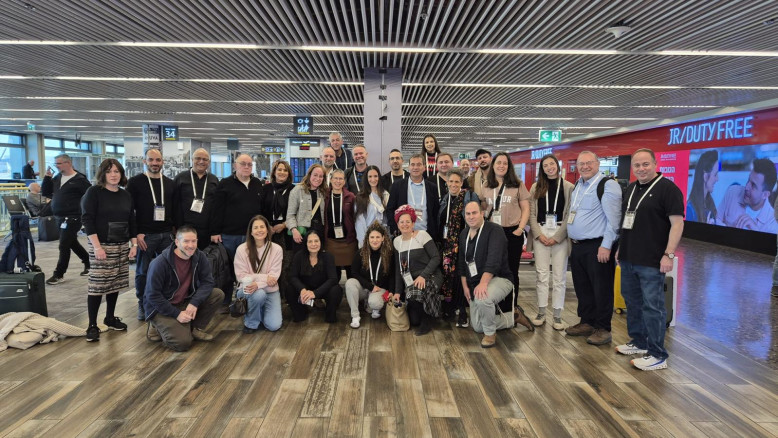
מול החשש הכבד מהחרפת השסע החברתי במערכת הבחירות הקרובה, התכנסו השבוע עשרות משפיענים ודמויות מפתח מכל המגזרים לכנס חירום ייחודי של ארגון "גשר" בקפריסין. המטרה: גיבוש תוכנית פעולה שתמנע את הקרע הבא
רימון הושלך לעבר סלון יופי בצרפת, חמישה נפצעו קל

שישה בני אדם, ביניהם ילד בן 5, נפצעו לאחר שרימון הושלך לעבר סלון יופי בעיר גרנובל. החשודים שמניעם אינם ידועים טרם נתפסו - כך דיווחה המשטרה המקומית
דקות ארוכות של חרדה בראש העין: נוהל פרש טורקי הוכרז בעיר

שלושה חשודים חצו לאזור ראש העין, והוכרז פרש טורקי בגזרה. תחילה דווח שמדובר במחבלים, אך לאחר מכן צה"ל ציין כי מדובר בשב"חים. מהמשטרה נמסר כי הם לא היו חמושים, ונעצרו לחקירה
31 הרוגים, 169 פצועים: פיגוע מחריד אצל השכנה הגרעינית של איראן

גורמי משטרה דיווחו כי מחבל מתאבד פוצץ מטען לאחר שהתקרב לשערי המסגד השיעי באזור טארלאי בעיר, ועדי ראייה סיפרו ל-BBC שלאחר הפיצוץ נשמעו קולות ירי. בעיר הוכרז מצב חירום
72 שעות אחרי ההתפטרות: המשטרה פשטה על ביתו של השר הבריטי הבכיר לשעבר

משטרת בריטניה פשטה על בתיהם של השר לשעבר הלורד פיטר מנדלסון בחשד להדלפת מידע ממשלתי רגיש לג'פרי אפשטיין. החקירה נמשכת, לאחר שכבר גרמה להתפטרותו ממפלגת הלייבור ומבית הלורדים
גם הרפובליקנים זועמים: מה שטראמפ פרסם על ברק ומישל אובמה יזעזע אתכם | צפו

טראמפ עורר סערה לאחר ששיתף סרטון גזעני המציג את ברק ומישל אובמה כקופים. הסרטון הוסר לאחר ביקורת חריפה, כולל מגורמים רפובליקנים בכירים, והבית הלבן טען שמדובר בטעות של איש צוות
ישראל צריכה לחשוש? ההסכמים בין טורקיה לערב הסעודית מתרחבים

רג'פ טאיפ ארדואן הודיע כי החלו העבודות על הסכם שיתוף הפעולה הביטחוני עם סעודיה, הכולל השקעה משותפת בייצור מטוס הקרב הטורקי KAAN. זאת, בנוסף להסכם בשווי שני מיליארד דולר להקמת תחנות כוח סולאריות
זוהרן ממדאני לא יכול להתחמק: עובדי עיריית ניו יורק הקימה קבוצה אנטי-ישראלית

עובדי מחלקת הבריאות של ניו יורק הקימו קבוצת עבודה פנימית שמאשימה את ישראל ברצח עם, כך דווח ב"ניו יורק פוסט". עובדים לשעבר ובכירים מותחים ביקורת על פוליטיזציה ושימוש במשאבי ציבור
יש ממה לדאוג? ארדואן וא-סיסי חתמו על עסקת הנשק הענקית

טורקיה ומצרים חתמו על עסקת ביטחון בהיקף כ-350 מיליון דולר, הכוללת ייצוא מערכת ההגנה האווירית TOLGA והקמת מפעלי תחמושת במצרים, כחלק מהעמקת שיתוף הפעולה הביטחוני לאחר שנים של מתיחות
אירוע חסר תקדים: הבכיר שכולם הכירו בחיזבאללה התפטר מתפקידו

חיזבאללה קיבל את התפטרות הבכיר הביטחוני ופיק ספא, לראשונה בתולדות הארגון. ספא, שניצל מניסיון חיסול ישראלי ונחשב מקורב לצמרת, עוזב על רקע שינויים פנימיים וטענות למצב רפואי מורכב
העזתים במעבר רפיח: "החיים בעזה עדיין יפים למרות ההרס"

על פי הדיווח, כ-50 פלסטינים היו אמורים לחצות את המעבר בכל כיוון מדי יום, אך בפועל המספרים נמוכים משמעותית. השבים העידו על בדיקות מצד כוחות הביטחון הישראליים, ועל צעירים שנכפתו והושפלו - טענות שהוכחשו
חצי מיליון צעירים מאחוריהם: עשרות רכבים ישבשו את כביש החוף

לקראת ההצבעה על חוק הגיוס, ארגון "כתף אל כתף" מתכנן שיירת "רונדו" בכביש החוף במטרה לשבש את התנועה ולהדגיש את דרישת השוויון בנטל השירות. המשטרה מתכוננת לעיכובים כבדים
לא למדנו: חמאס בוחן, וצה"ל נגרר אחרי ארגון טרור

צה"ל תקף תשתיות של ארגון חמאס ברצועת עזה בתגובה לתקרית בה חמאס תקף בירי עמדה של צה"ל. גורמים בצבא מתחו ביקורת על דרך הפעולה שנוקטת ישראל בעזה אל מול התעצמות ארגון הטרור
שליח טראמפ הושתק באמצע נאום - התגובה שלו חשפה את האמת על עזה | צפו

הרב יהודה קפלון, השליח של טראמפ למאבק באנטישמיות, נאם בוושינגטון, הופרע על ידי מפגינות פרו-פלסטיניות, וחשף את פרויקט המים שלו לעזה שנחסם על ידי חמאס ואונר"א, תוך ביקורת חריפה על האו"ם
דובר צה"ל בהודעה לפני כניסת השבת: "נדע לעדכן בכל שינוי במידת הצורך"

צה"ל ממשיך לפעול בכל הגבולות, בהגנה ובהתקפה, כולל תקיפות משמעותיות ברצועת עזה נגד מחבלים בכירים, ומקדם סידור מעמד ושירות חיילים חרדים באמצעות היועץ לרמטכ"ל
השלג שנמס חשף: המתקן האסטרטגי של איראן שחזר לפעילות

גורמים רשמיים במערב ובישראל מצאו מעט סימנים לכך שאיראן עשתה התקדמות משמעותית לקראת שיקום יכולתה להעשיר דלק גרעיני וליצור ראש נפץ גרעיני, ובדיווח של הניו יורק טיימס צוין כי יתכן ושאהרוד נבנה מחדש
50 אלף דולר למידע: אימה של מגישת החדשות הפופולרית עדיין נעדרת

ננסי גאת'רי, אם מגישת NBC סוואנה גאת'רי, נעלמה בביתה באריזונה. דם שלה נמצא במרפסת, מצלמת הדלת נותקה, ו-FBI חוקרת מכתבי כופר. המשפחה פונה לציבור, פרס של 50 אלף דולר הוצע למידע
צה"ל נדרך בגבול הצפון בעקבות זיהוי חדירה - ואז התגלה הטוויסט הגדול

צה״ל הקפיץ כוחות גדולים לגבול הצפון בעקבות זיהוי של חציית הגבול על ידי אדם מלבנון לישראל באזור יראון. צה"ל סגר את הישובים אביבים, מלכיה, יראון ודובב, כאשר לאחר זמן קצר התברר כי מדובר במטיילים ישראלים
עוררו בהלה: מכתבי האיומים שקיבלו מיקרוסופט ואמאזון מהאו"ם נחשפים

תחקיר חושף: שליחת האו"ם לשטחים הפלסטיניים הפעילה "לוחמה כלכלית ופוליטית נגד ישראל" ושלחה מכתבי איומים לחברות ענק כמו אמאזון ומייקרוסופט והזהירה אותן משיתוף פעולה עם ישראל בזמן המלחמה
ראש צוות האבטחה של ראש הממשלה: "יאיר תקף את אבא שלו והוא אולץ לעזוב למיאמי" | פודקאסט "מעריב"

בשיחה עם מיקי לוין בפודקאסט מעריב, עמי דרור, לשעבר ראש צוות האבטחה של ראש הממשלה בנימין נתניהו מדבר על הילדות והבית הדתי שממנו הגיע, על שנותיו לצד נתניהו, ועל שורה של אירועים חריגים ומטלטלים במשפחה
Israeli AI Safety Tool Among TIME’S Best Inventions For 2024
Israeli company Aporia says its artificial intelligence control tool Guardrails has been selected as one of TIME’s 2024 Best Inventions, a list of 200 pioneering innovations redefining the way we live.
Guardrails, which mitigates evolving risks in AI systems real-time, has been recognized as one of the 10 companies in the AI technology category.
The list was created following a thorough process in which TIME’s global editors and correspondents assessed each candidate based on several critical factors, such as originality, efficacy, ambition, and impact.
“We’re incredibly proud to see Aporia’s Guardrails recognized by TIME as one of the year’s best inventions,” said Aporia CEO Liran Hason.
“Aporia is committed to making AI applications safer and more reliable for everyone—from businesses to everyday consumers,” he said.
We’re developing rigorous Guardrail policies, implementing advanced capabilities to ensure compliance with AI regulations in the EU and US, expanding capabilities to secure a broader range of AI systems, and welcoming new customers. Our Guardrails do more than manage glitches; they empower companies to deploy AI that users can trust.”
The company has also been named a Technology Pioneer by the World Economic Forum, and recently announced partnerships with Google Cloud and Microsoft.
The post Israeli AI Safety Tool Among TIME’S Best Inventions For 2024 appeared first on NoCamels.
Editors’ & Readers’ Choice: 10 Favorite NoCamels Articles
For more than a decade, NoCamels has written about every aspect of Israel’s high-tech sector, from medical breakthroughs for treatment of deadly diseases to digital developments for both work and leisure and greentech to preserve our struggling planet.
Here are five favorites from us and five from you, our loyal readers:
Our Picks:
Cancer Cures
With artificial intelligence playing an ever-increasing role in our lives, medtech company OncoHost is using it to help oncologists decide the optimum therapy for their cancer patients.
The startup’s main focus is determining treatment for a form of lung cancer, with its proprietary PROphet platform scanning up to 7,000 proteins in a patient’s blood in order to see how receptive that person would be to immunotherapy.
The platform looks for proteins that are present in the blood of patients who did not respond to immunotherapy but absent for patients who did respond. Click here for more
Life Saver
When Israeli businessman Adam Bismut saw a man lose his life by drowning at the Dead Sea because help was too far away, he was determined to stop such tragedies from happening again.
Bismut developed Sightbit, a drowning prevention platform that uses AI to spot dangers on and in the water, alerting lifeguards to people in peril in real time.
 Sightbit creator Adam Bismut z”l (Photo: Courtesy)
Tragically, the person who devoted his professional life to helping others also gave his life to protect others, as IDF Sgt. Maj. (res.) Adam Bismut fell in battle in Gaza on January 22, 2024. May his memory be a blessing. Click here for more
Water World
Building on a water-from-air concept devised by WaterGen, fellow Israeli startup H2oll also produces drinking water from the atmosphere, but more cheaply, more efficiently and more sustainably – and in any climate.
 The internal workings of the H2oll machine (Photo: Courtesy)
H2oll has added a new element to the existing technology, by way of a concentrated salt solution. Instead of cooling the whole air mass, it extracts and cools only the moisture molecules – around two percent of air content, depending on humidity – and turns them into water.
The company says it aims to address the global water crisis, especially in the developing world, where countries want to avoid expensive infrastructure, or costly bottled supplies. Click here for more
A Voice For The Voiceless
The AI-powered Voiceitt platform is designed to recognize and translate speech by people with an underlying medical condition, disability or age-related condition that means their speech is hard to understand.
 Voiceitt lets people with speech disabilities speak spontaneously and be easily understood (Photo: Courtesy)
It works either as voice to text or voice to synthesized speech, with the latter allowing the user to speak in person in real time, as part of a face-to-face conversation, or in a virtual, online meeting.
The technology is based on machine learning and speech recognition algorithms that are customized to the user, allowing the platform to assimilate each user’s unique way of speaking. It is web based, which means that it can be accessed from any internet-connected device without having to download a program or app. Click here for more
Potato Power
Rumafeed has come up with a way to boost the amount of animal feed produced worldwide by genetically modifying the currently discarded foliage from potato harvests and making it suitable for livestock.
 Potato foliage discarded during harvest could be nutritious feed for livestock (Photo: Depositphotos)
Potato foliage contains glycoalkaloids, which makes it toxic, but by removing this inedible chemical compound, the foliage is transformed from a waste byproduct to a plentiful, viable food source for herds that is rich in nitrogen and protein.
Potato hay could also be a valuable source of income for farmers, fetching as much as $600 per hectare of land where the tubers are grown, with each hectare capable of producing 3.5 tons of it. Click here for more
Your Picks: The Articles You Read The Most
Ice Cream On Demand
A machine invented by Israeli startup Solato uses a secret process to create super-fresh frozen desserts from liquid in just 60 seconds. It whips up and freezes a range of gelato, sorbet, frozen yogurt, smoothies and even iced coffee.
 Solato uses a secret process to create super-fresh frozen desserts from liquid in capsules, in just 60 seconds (Photo: Courtesy)
Solato says it is the first to market with a frozen dessert capsule machine, offering a range of flavors including Amarena cherry and mascarpone, piedmont hazelnut gelato, lychee sorbet, and classics like dark chocolate and vanilla gelato, as well as plain frozen yogurt.
Each cup-sized capsule of concentrate liquid makes a cup of ice cream. The unique code on each capsule is read by the machine to determine how much it needs to freeze it and how much air it needs to add, to increase its volume. The capsule itself, which is biodegradable, can then be used for serving. Click here for more
COVID Spray
An Israeli-founded company in Canada has developed a nasal technology to treat and prevent upper respiratory and topical infections such as COVID-19 and successful Phase 3 clinical trials proved it can reduce viral load in people with mild cases of coronavirus.
 Enovid reduces COVID viral loads (Photo: Gilly Regev/LinkedIn)
Enovid, the nitric oxide nasal spray (NONS) created by Vancouver-based SaNOtize is designed to treat adult patients who have a risk of progression of COVID-19.
The patented platform technology allows for the topical delivery of nitric oxide (a naturally occurring nanomolecule with the formula NO, hence the name) to treat a variety of bacterial, fungal, and viral diseases. Click here for more
Chewing Gum Diet
A chewing gum infused with an ancient sugar-blocking herb may help people lose weight, according to a new consumer study.
 Sweet Victory gum (Photo: Courtesy)
Israeli startup Sweet Victory imbues the Indian botanical gymnema sylvestre into its gum, which blocks the taste receptors for sweetness when it is chewed for just two minutes. The company says that its effects last up to two hours.
Of the 80 participants in a two-week trial, 87 percent reported experiencing weight loss, at an average of 1.3 kilos per two weeks. An additional 80 percent of the participants significantly reduced their consumption of sweets by the end of the trial, and said they had “better control” of their food choices. Click here for more
Screenless Laptop With Virtual Screens
Spacetop, billed as the world’s first augmented reality laptop, looks like the keyboard to a standard 13-inch laptop, minus the 13-inch screen.
 Spacetop offers dozens of virtual screens for its screenless laptop (Photo: Courtesy)
But with a dedicated pair of glasses and just 20 seconds of training, the user can actually see a dozen or more virtual screens. They can toggle between them, resize and reposition them at will, and even zoom in and out.
Sightful, the company behind the design, says Spacetop has been painstakingly redesigned “from the ground up” with no off-the-shelf components. Everything is custom-made and works on Spacetop OS, a proprietary operating system. Click here for more
Sperm Solution
Israeli scientists at the Ben-Gurion University of the Negev (BGU) haven developed an innovative platform to create sperm in a laboratory through a microfluidic system, which contains hundreds of microchannels for fluids to pass through.
 Sperm grown in the lab can provide a solution for men who have been affected by aggressive medical treatment (Image: Depositphotos)
The sperm was grown on a special silicon chip developed in collaboration with researchers at the Technion – Israel Institute of Technology. The chip enables the researchers to grow cells from the testis in the microchip and add fresh cell culture media designed to support cellular growth. A 3D system was also built and integrated to allow the addition of testicular tissue cells.
The innovation is designed to help males who receive aggressive treatment for cancer that can damage sperm-forming cells and result in impaired spermatogenesis, the origin and development of sperm cells within the reproductive organs, leading to fertility problems. Click here for more
The post Editors’ & Readers’ Choice: 10 Favorite NoCamels Articles appeared first on NoCamels.
TAU Team Discovers Mechanism To Eliminate Cancerous Tumors
Medical researchers at Tel Aviv University (TAU) have discovered a way to help the body fight cancerous tumors that are even resistant to prevailing forms of immunotherapy.
The researchers found that reversing a mechanism preventing the immune system from attacking tumors can stimulate the immune system to fight the cancer cells.
The breakthrough was led by Prof. Carmit Levy, Prof. Yaron Carmi, and PhD student Avishai Maliah from TAU’s Faculty of Medical & Health Sciences. The paper was published in the leading journal Nature Communications.
Levy said the discovery occurred at his lab, which studies both cancer and the effects of ultraviolet (UV) radiation from the sun on our skin and body – both of which are known to suppress the immune system.
“Cancer suppresses approaching immune cells and solar radiation suppresses the skin’s immune system,” he explained.
“While in most cases, we cancer researchers worldwide focus on the tumor and look for mechanisms by which cancer inhibits the immune system, here we proposed a different approach: investigating how UV exposure suppresses the immune system and applying our findings to cancer. The discovery of a mechanism that inhibits the immune system opens new paths for innovative therapies.”
The research was recently published in the leading journal Nature Communications.
The post TAU Team Discovers Mechanism To Eliminate Cancerous Tumors appeared first on NoCamels.
Ashdod Port Investing In Startups As Part Of Innovation Strategy
The tech incubator operated by Ashdod Port is investing $2 million in three startups as part of its strategy to foster innovation at the site.
The sum was approved by the port’s board of directors as part of its Corporate Venture Capital (CVC) investment fund, subject to the approval of the Government Companies Authority.
Since its establishment in 2021, the incubator has supported more than 90 startups in various fields, including operations, logistics, cyber and safety.
The three startups were selected following a pilot program lasting an average of six months, during which the technologies being developed were tested in close cooperation with the port’s staff.
The three startups are:
Makalu Optics, which develops groundbreaking LiDAR technology for various applications
Treedis, which develops an advanced digitally compatible solution based on virtual and augmented reality
Flyz Robotics, which developed an autonomous system for miniature drone robots with unique capabilities
“The Ashdod Port Company views investments in technology companies as a strategic move, which will help us meet both the challenges of the current period of time and the global challenges faced by ports all over the world and, in parallel, optimize our competitive ability,” said Shaul Schneider, the chairman Ashdod Port Board of Directors.
“We are confident that this investment will yield optimal results for the Port of Ashdod, for the Israeli economy, as well as for the international port industry.”
The post Ashdod Port Investing In Startups As Part Of Innovation Strategy appeared first on NoCamels.
Forward Facing: What Does The Future Hold For Israeli High-Tech?
The past year has been a period of great upheaval and uncertainty in Israel, yet the high-tech sector has proven steadfast, despite concerns over investment and durability and swathes of the workforce serving in the IDF reserves for long stretches at a time.
And as Israel navigates this time of war on multiple fronts – with its troops fighting in Gaza and Lebanon as well as handling attacks from Iran, Iraq, Syria and Yemen – NoCamels asked leaders in the sector to look forwards and share their thoughts on what the future holds for the national high-tech industry, whose strength and vitality earned the country the moniker “Startup Nation.”
Israeli readiness to embrace innovation, even when it seems somewhat risky, is a long-standing trait that is key to the sector thriving even in wartime – and crucial to it flourishing in the years to come, says Jon Medved, the CEO of Israel’s global investment powerhouse OurCrowd.
“The fact that Israel grows and it continues to grow its tech sector during war is sort of a core element of who we are,” Medved tells NoCamels.
“The reason that we’re so strong in the startup arena boils down, more than any other single reason, to our attitude towards risk. We are people who have learned to live with risk, even though I’m not sure we chose it.”
 Limor Nakar-Vincent: Periods of growth follow cycles of tension (Photo: Eyal Toueg)
In agreement with this sentiment is Limor Nakar-Vincent, the Deputy Executive Director of Business at the Binational Industrial Research and Development Foundation (BIRD), a joint Israeli-American endeavor that brings companies from both countries together on collaborative projects.
Nakar-Vincent tells NoCamels that the decades of conflict that the country has endured has made its people hardy, and spurred innovation and development.
She cites the strong sense of solidarity and a highly adaptable workforce whose members often take on additional responsibilities to cover for colleagues called to reserve duty.
“Israelis are creative and deeply motivated, which helps them navigate challenging times,” she says. “[They] are accustomed to managing through cycles of tension, and historically, periods of growth follow.”
Going Global
Medved credits the diverse essence of Israel – a rich melting pot of Jews from around the world – with its ongoing and future success on the global stage. This “secret sauce,” he says, allows Israelis to retain ties, language skills and familiarity with global commerce and business on a broad scale – all of which are key, too, to its future success.
It is this global outreach that is crucial for investment in the sector in years to come, Medved says, as foreign investors are “the main part of the story in the Israeli Startup Nation ecosystem.”
In fact, he explains, even during the ongoing conflict, Israel reached a record high of 93-percent foreign VC participation in funding rounds for local startups, meaning that just 7 percent of them were solely Israeli efforts.
And as the sector looks to sustain itself and expand in years to come, Medved believes that in the next half decade or so, Israeli startups must now look beyond becoming a unicorn or decacorn (companies valued at $1 billion or $10 billion, respectively) and seek the attainable target of a $20, $50 or even $100 billion valuation, which means a more international approach.
“I predict that 10 years from now, there will be several Israeli companies in that $100 billion range,” he says.
Medtech veteran Mati Gill shares this sentiment, citing a trend of Israeli startups moving into the international arena rather than opting for what he calls “the classical ‘exit’ model” of selling to a larger entity.
“We saw a generation of Israeli startups that went public and grew globally, [while] maintaining their headquarters and R&D in Israel,” says Gill, who today is CEO of the Rehovot-based Aion Labs medtech venture studio, an initiative of the Israel Innovation Authority that works with global pharmaceutical giants on solutions for some of the most challenging diseases facing humanity.
In fact, Gill tells NoCamels, the expansion by Israeli startups into areas outside the classic tech and SaaS space into fields such deeptech and biotech has opened new opportunities for Israeli R&D to mature into industry solutions.
Staying Power
These new opportunities include making headway in the field of sustainability – one of the most innovative and significant in the tech ecosystem – which will create fresh avenues for Israeli startups in the years ahead. This, of course, is alongside other major areas like cybersecurity and fintech, in which local companies have already built a reputation.
“The double bottom line of impact investing – doing well and making money at the same time – is very valid and important,” says Medved.
“Whether it’s in healthcare or climate, access to disabled technologies, foodtech or agtech, transportation, education or financial inclusion, you will see large numbers of Israeli startups on the front lines of this important battleground.”
Gill, who has worked extensively in medtech innovation, also believes that healthcare – which he describes as the meeting point of technology and life sciences – is an area in which Israel is “uniquely positioned” to become one of the most relevant and leading ecosystems.
 Israel is ‘uniquely positioned’ to lead in the healthcare sector, says Mati Gill (Photo: Elad Malka)
“Our strong research and talent capabilities in both sectors, coupled with the entrepreneurial mindset of Israelis have helped birth a new cluster of startups in the tech bio space in Israel,” he explains.
This includes significant fundraising achievements, deals and increased interest from pharmaceutical multinational corporations in the past five years alone, he adds.
Medved also highlights the need to ensure that Israeli innovation in these extremely important areas is made available in “every corner of the planet,” regardless of how economically developed a country is.
To this end, he says, OurCrowd has partnered with the World Health Organization Foundation on a $200 million Global Health Equity Fund to help make these technological advances more equitable.
Meanwhile, says Nakar-Vincent, the ongoing war will likely lead to growth among companies focusing on dual-use technologies, which serve both civilian and military applications.
“This sector has garnered heightened interest, leading to increased funding and expedited development processes,” she says.
In fact, she adds, the experience gained by many Israelis now serving in reserve duty will nurture the establishment of new start-ups in the defense and homeland security spheres.
“It’s essential to consider various forms of support for high-tech companies, especially those facing the ‘valley of death’ but with the potential to commercialize their technologies,” she explains.
Looking beyond new innovation to the challenges of maintaining its well-respected position in the world’s tech sector, Gill believes that regulatory and geopolitical stability are vital, as well as restored trust in the country’s leadership and maintaining an independent judiciary.
The latter refers to the domestic political turmoil over proposed judicial reform in the months preceding the October 7, 2023 mass terror attack by Hamas that saw tens of thousands taking to the streets every week to protest.
Equally important, Gill says, is the ability to produce experienced homegrown talent in the sector and the ability to attract talent from abroad to Israel.
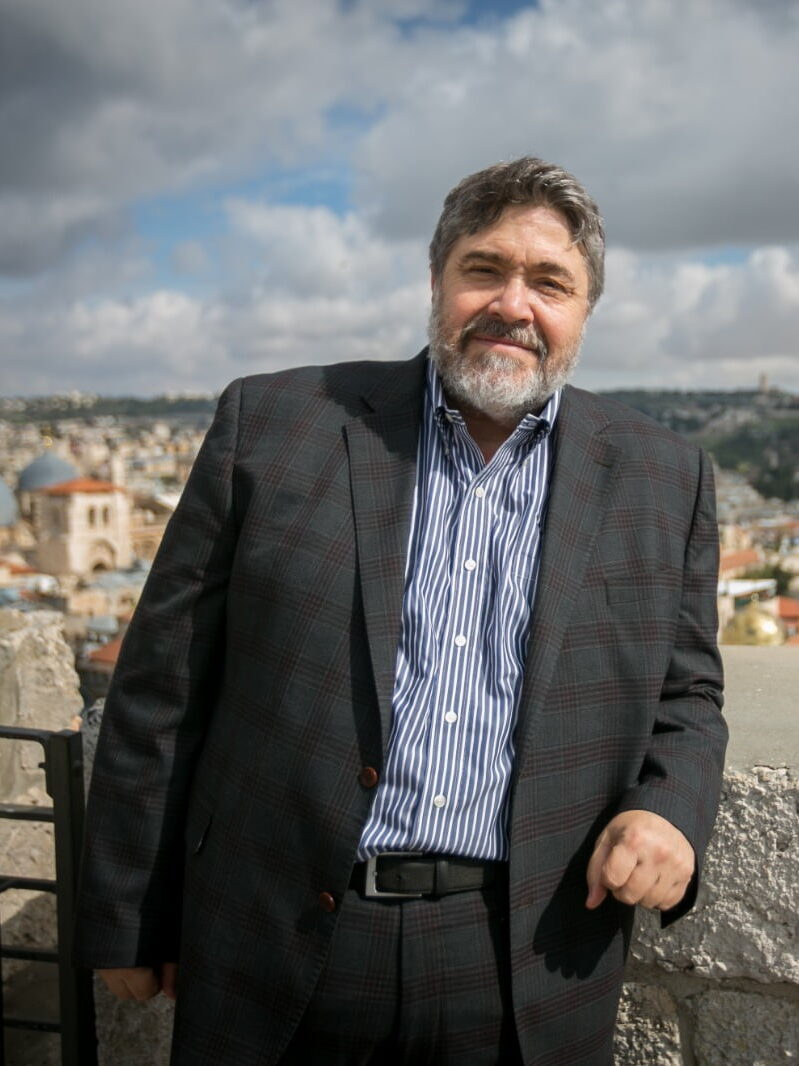 Jon Medved: Israeli startups must discover new funding sources (Photo: Courtesy)
Medved ties expansion in Israeli high-tech to the need to find novel ways of raising money, in particular for startups in the field of artificial intelligence, which Israeli angel investor and former military intelligence officer Alon Arvatz predicted last year would be accelerated due to its use by the army in the current war.
“It turns out that to build these AI startups fast, you need a lot of capital and a lot of money for computing and for GPU farms,” Medved says, referring to sophisticated servers that can quickly perform complex calculations.
Ultimately, say both Medved and Gill, it is experiences of extreme challenge that makes Israelis creative, progressive and determined to succeed, and will continue to do so in the future.
“We are great as a country at staying focused on what matters, delivering results no matter what and adapting to any circumstances – especially when our backs are against the wall,” declares Gill.
“It’s unfortunately been part of our environment for thousands of years that our risk of survival is simply part of the nature of our society,” says Medved.
“As a result, we don’t stop creating. We don’t stop celebrating. We move forward with laughter through tears, and if they think they can stop us, they can’t.”
The post Forward Facing: What Does The Future Hold For Israeli High-Tech? appeared first on NoCamels.
BGU Develops Fast Fact Checking Via News Sources Not People
With conspiracy theories and so-called fake news rampant on social media, in particular during major election periods, researchers at Ben-Gurion University of the Negev (BGU) have developed a method to help fact checkers keep up with increasing volumes of misinformation on these platforms.
A team led by Dr. Nir Grinberg and Prof. Rami Puzis of BGU’s Department of Software and Information Systems Engineering found that tracking fake news sources, rather than individual articles or posts, can significantly lower the burden on fact checkers and produce reliable results over time.
The researchers’ audience-based models outperformed the more common approach of looking at who’s sharing misinformation by large margins: 33 percent when looking at historical data, and 69 percent when looking at sources as they emerge over time.
The authors also showed that their approach can maintain the same level of accuracy in identifying fake news sources while requiring less than a quarter of the fact-checking costs.
“The problem today with the proliferation of fake news is that fact checkers are overwhelmed,” explained Grinberg.
“They cannot fact check everything … [and] we know little about how successful fact checkers are in getting to the most important content to fact check. That prompted us to develop a machine learning approach that can help fact checkers direct their attention better and boost their productivity,” he said.
The team’s findings were published recently in Proceedings of the 30th ACM SIGKDD Conference on Knowledge Discovery and Data Mining.
The post BGU Develops Fast Fact Checking Via News Sources Not People appeared first on NoCamels.
Israel Gives Elbit $200M Contract For Laser Air Defense System
Israeli military technology company Elbit Systems has announced that it has been awarded an approximately $200 million contract by the nation’s Ministry of Defense to supply high-power laser systems for the Iron Beam air defense platform.
The mobile Iron Beam system consists of two pivoting laser guns, a surveillance system to track the incoming projectile and a control center staffed by personnel who issue commands to the system.
The laser gun creates a high-energy beam that can bring down missiles, mortars and drones at a reported maximum range of 10 km. The laser heats its target to incredibly high temperatures very quickly, rendering it obsolete.
According to the contract, Elbit will supply the ministry with its proprietary high-power laser solution in order to provide a robust defense against a variety of threats. The contract also includes the provision of ongoing support services.
“As Israel’s Laser Center and a global leader in high-power laser technology, Elbit Systems congratulates on the significant progress made in the Iron Beam project and is proud of its contribution to its success. The capabilities developed at Elbit Systems represent a leap forward in future defense against various threats,” said Bezhalel (Butzi) Machlis, the president and CEO of Elbit Systems.
The Haifa-based company, which has almost 20,000 personnel working across five continents, says its products allow its clients around the world “to address rapidly evolving battlefield challenges and overcome threats.”
The post Israel Gives Elbit $200M Contract For Laser Air Defense System appeared first on NoCamels.
TAU’s Booze-Proof Hornets Could Help Research Into Alcoholism
Researchers at Tel Aviv University have found that the Oriental hornet is the only known animal in nature capable of consuming alcohol chronically and in high concentrations with almost no negative effects on their health or lifespan.
The researchers hope that the discovery could help future studies into alcoholism and how alcohol metabolizes in our bodies.
The research was conducted under the leadership of postdoctoral fellow Dr. Sofia Bouchebti from the laboratory of Prof. Eran Levin at Tel Aviv University’s School of Zoology and the Steinhardt Museum of Natural History.
The team tested the Oriental hornet’s ability to consume and break down alcohol, and were surprised by the rapid rate at which the insects metabolized it.
They also found that even high concentrations of alcohol had no noticeable effect on the hornets’ behavior and that there was no difference in lifespan for hornets that only consumed alcohol for their entire three-month lives and those that consumed sugar water.
“This is a remarkable animal that shows no signs of intoxication or illness even after ingesting huge amounts of alcohol,” said the research team.
“While alcohol-related research is highly advanced, with 5.3 percent of deaths in the world linked to alcohol consumption, we believe that, following our research, Oriental hornets could potentially be used to develop new models for studying alcoholism and the metabolism of alcohol,” said Prof. Levin.
The study was published in the journal Proceedings of the National Academy of Sciences of the United States of America (PNAS).
The post TAU’s Booze-Proof Hornets Could Help Research Into Alcoholism appeared first on NoCamels.
Israeli, US Firms Team Up To Develop AI Models For Devices
Israeli company Dataloop AI has announced a collaboration with American multinational Qualcomm Technologies, which aims to significantly accelerate AI model development for mobile, automotive, IoT and other computing devices powered by Snapdragon platforms.
Snapdragon is a versatile suite of system-on-chip (SoC) semiconductor products for a range of devices designed and marketed by Qualcomm, including mobile devices, tablets and laptops.
Dataloop enables developers to streamline the entire AI lifecycle through an automated pipeline that includes data curation, labeling, model fine-tuning, and integration with Qualcomm AI Hub, which compiles, optimizes, and profiles the ready-to-deploy model.
“The Qualcomm AI Hub helps enhance the efficiency of AI development. Dataloop’s comprehensive platform simplifies the entire AI lifecycle, while Qualcomm Technologies’ innovations enable models that are optimized and ready for deployment on edge devices, empowering developers to accelerate innovation and bring AI solutions to market faster,” said Dataloop AI co-founder and CBO Nir Buschi.
“Qualcomm Technologies is collaborating with Dataloop to streamline on-device AI deployment,” said Siddhika Nevrekar, senior director of product management at Qualcomm.
“With Dataloop’s automated pipelines and robust data management, developers can effortlessly create powerful AI systems and seamlessly deploy them on-device using our Qualcomm AI Hub.”
The post Israeli, US Firms Team Up To Develop AI Models For Devices appeared first on NoCamels.
Impact Innovation: Israeli Startups That Could Shape Our Future
NoCamels has recently shone a spotlight on Israeli medical technology and green technology that has the potential to change the world.
But there are other equally innovative companies whose remit falls outside of these two categories yet have just as much potential impact on our lives. Here we take a look at 10 of them:
Electric Air Travel
Eviation became the first company in the world to develop an electric plane with its nine-seater aircraft Alice, which it designed from scratch.
In 2022, Alice made a successful eight-minute flight at Moses Lake in Washington State, reaching an altitude of 3,500ft. The company beat the world’s aerospace giants in the race to develop an electric airplane, which in most cases were focusing their R&D on modifying existing petrol planes.
The plane runs on rechargeable lithium-ion batteries that only require 30 minutes to fully charge. It has a top speed of nearly 300 mph, a range of 288 miles and can fly for an hour at a time.
Eviation hopes to launch the plane for short-hop commercial flights in the US in 2027, with the aim of shaping future air travel for both passengers and cargo. Click here for more
Sustainable Sweetness
A heavy impact on the environment makes globally beloved chocolate a costly affair for the planet. But Israeli startup Celleste Bio has found a way to change that with its lab-cultivated beans that create cocoa indistinguishable from the rest.
 Celleste Bio uses lab-grown cocoa beans to create sustainable chocolate (Photo: Depositphotos)
Celleste Bio uses cell culture technology to create the cocoa beans, combined with AI modeling to create optimal growing conditions. The bean cells are used to make the cocoa butter needed to manufacture chocolate, which has the identical chemical profile to the original.
It takes just seven days for the bean cells to mature in their bioreactor so that the butter can be harvested.
And because the process involves just a couple of beans that can be repeatedly reproduced, the Misgav-based company says the lab-cultivated cocoa is grown without ever needing to cut down a single tree again.
“We are the first in the world to have been able to produce chocolate-grade cocoa butter,” said Celleste CEO Michal Beressi Golomb. “We’re really excited about it.” Click here for more
Hunter Drones
In southern Israel, close to the city of Be’er Sheva, Robotican has been developing a drone that can snatch its target out of the sky and even named it after a bird of prey that grapples with its enemies mid-flight.
 The Goshawk floating above its ‘nest’ (Photo: Ariel Gabay)
The Goshawk fully autonomous drone is a counter-UAS (unmanned aircraft system) designed to detect, track and destroy other craft. It sits in a metal box-like device that Robotican has dubbed its “smart nest,” waiting for its opportunity to strike.
Once the radar system spots that a hostile drone has infiltrated the no-fly zone, the nest opens and the Goshawk takes to the air, chases it and catches it in a net.
If the hostile drone is too heavy or if the Goshawk senses other threats, the net is sent plummeting to the ground with its victim trapped inside. Otherwise, it bears it safely to earth unharmed.
According to Robotican, the Goshawk has already intercepted more than 250 enemy drones in its use by the Israel Defense Forces. Click here for more
Beating Bots With AI
Tel Aviv-based Cyabra calls itself a “social threat intelligence” company, whose mission is to fight misinformation and expose online risk to individuals, institutions or even governments.
Cyabra says unlike other cybersecurity companies, it focuses on accounts aiming to cause harm in the social sphere, rather than hackers who pose “classic threats” to infrastructure or hardware.
 Cyabra roots out accounts spreading disinformation on social media (Image: Unsplash)
The company says its unique AI software can root out even the most sophisticated threats, quickly identifying malicious actors using social media and other online spaces such as comment sections, to spread false information.
Hundreds of different behavioral parameters are fed into the Cyabara algorithm, including an account’s online behavior, the accounts that it follows and engages with and those that follow and engage with it.
The company’s three founders are all veterans of the Israeli high-tech sector and two served in information warfare units in the IDF.
“They developed the technical tools and skills to be able to track and fight disinformation, and then they started to use those skills for good,” said Cyabra VP Marketing Rafi Mendelsohn. Click here for more
Taxis In The Sky
Israel’s notorious traffic jams have led two companies to develop drones that can carry passengers in urban areas, by passing the clogged roads below.
Dronery and AIR were both part of the Israel National Drone Initiative (INDI), which five years ago began preparing for the regular use of unmanned flying vehicles to carry goods as well as passengers.
 Dronery’s UAV is designed to carry people through the air for distances of up to 30km (Photo: Mark Nomdar)
Dronery’s Chinese-made, Israeli-adapted craft can carry 220 kg in cargo and fly as far as 30 km, while AIR’s homegrown AIR ONE craft can carry up to 250 kg and for a far greater distance of 160 km.
Successful test flights last year involved taking off and landing in urban areas while carrying mannikins.
“We believe that this whole technology is something that can really help solve urgent problems such as traffic and such as air pollution, and help us move things from place to place in a more efficient and safe way,” said Daniella Partem, who headed Israel’s drone project. Click here for more
To Catch A Hacker
Pentera simulates attacks across an entire organization to pinpoint potentially exploitable gaps that make it vulnerable to potential hacking attempts.
The company takes the perspective of the hackers in order to highlight the security gaps that would be most appealing to them, rather than just searching for any and all weaknesses.
 Pentera approaches cybersecurity from the perspective of the hackers (Photo: Depositphotos)
The system carries out the assessments automatically, without disrupting an organization’s ongoing operations, and focuses on two particular kinds of threats: exploitable gaps in the external attack surface – an organization’s digital footprint that is visible and accessible to anyone – and potential openings for malicious hackers using compromised credentials like passwords.
It identifies corporate passwords and other sensitive information that were leaked online either through the dark web or other resources used by hackers that make it vulnerable to cyberattacks.
“Our goal is to find these exploitable gaps so that security teams can remediate the issues before our adversaries have a chance to use them,” said Pentera’s Senior Director of Product Management Ofer Yavelberg. Click here for more
Man Or Machine?
Can you tell if you are talking to a computer or a real human? It’s not as easy as it might seem.
A game created by AI21 Labs tests users’ skills in discerning the difference between bot and person with the aim of showing just how far artificial intelligence has advanced. And it even fooled its creator Amos Meron.
 The game gives users two minutes to determine if they are talking to a human or bot (Image: Courtesy)
The premise is based on what Alan Turing, the father of modern computing, in the 1950s called the Imitation Game – a time when machines could imitate man so well that it would be difficult to tell from one the other. The test later came to be known as the Turing Test in his honor.
Using an array of large language models (LLMs), including ChatGPT4 and AI21’s own Jurassic-2, the test makes each bot into its own character, with a name, location and date of birth, that has knowledge of recent events and even the current weather.
The test takes two minutes, which Meron calls the sweet spot as anything shorter is not enough interaction but a longer conversation could be boring or expose the flaws in the bot. Click here for more
Cybersecurity In The Actual Clouds
Cyviation says it is the first-ever company to focus on cybersecurity for aircraft, with a software solution that provides multiple levels of safety without having to make changes to the planes themselves.
 Cyvation keeps planes safe from cyberattacks with four levels of protection (Photo: Pexels)
The four-layer system is designed to reduce the risk of cyber attack, help manage such attacks should they occur and support airlines as they implement new and upcoming international regulations regarding cybersecurity in aviation.
The first layer is a scan of an entire craft to create a virtual “twin” that allows the company to analyze any vulnerabilities on different severity levels.
The second is cybersecurity training for pilots, which the company says had not previously existed at all. Similarly, the third layer of protection is security information and event management (SIEM), which trains pilots and crew in how to act should a cybersecurity incident actually occur.
The final layer is a set of patented devices that can detect any attack in real time, allowing the pilot to react swiftly to the threat.
“When we look at cyber training, we don’t look at how you protect your password, we look at how you react when there is an event on the aircraft,” said Cyvation CEO Avi Tenenbaum. Click here for more
Watchers Over The Waves
Drawing on decades of professional experience, two Israeli technology veterans created a new startup to combat cyberattacks on some of the country’s key institutions, including national water company Mekorot.
IXDen’s founders and co-CEOs Zion Harel and Dr. Leonid Cooperman devised entirely new software from scratch with a focus on artificial intelligence and machine learning.
 IXDen protects the infrastructure of Israel’s national water carrier Mekorot from attack (Photo: Courtesy)
Collecting information from sensors placed around the company’s infrastructure, IXDen uses those algorithms to analyze millions of pieces of data every day in order to spot any anomalies that point to suspicious activity or even to just identify a fault in the system.
The water company has around 3,000 sites in 10 regions across Israel, including 700 water pumping stations and 20 desalination sites. The IXDen platform is active at each location, analyzing 300 million pieces of data on a daily basis and feeding it all into one centralized system. Click here for more
The post Impact Innovation: Israeli Startups That Could Shape Our Future appeared first on NoCamels.
Clean Energy Firm Completes Solar Project In North, South Israel
Leading green power company Enlight Renewable Energy has announced the completion of its Solar and Storage Cluster project in Israel, covering 12 locations in the north and the south of the country.
The 12 installations were built in cooperation with multiple agricultural communities in Israel, and have a combined solar generation capacity of 254 MW and energy storage capacity of 594 MWh. While portions of it began commercial operation in 2023 and grid connections continued throughout 2024, the process has now been completed.
The Cluster’s entire output will be sold to Enlight’s supplier division, which markets the electricity directly to customers in Israel’s newly deregulated power market.
The generation volumes of the Cluster currently account for 50 percent of all clean power produced under the new regulatory framework.
“Today we completed the commencement of full commercial operations at the largest group of renewable energy facilities operating in Israel’s deregulated power market,” said Enlight MENA General Manager Gilad Peled.
“The Cluster will generate attractive returns for Enlight, while creating a stable and vital source of income for our partners in the agricultural communities of Israel.”
Enlight is headquartered in Rosh Ha’ayin and operates in multiple countries worldwide, including Italy, Spain, Sweden and the US.
The post Clean Energy Firm Completes Solar Project In North, South Israel appeared first on NoCamels.
Cannabis Therapy Firm: CBD Jab Reduces Pain In Arthritic Dogs
An Israeli company that develops cannabis-based therapeutics says its CBD injections have proven effective in providing pain relief for dogs with naturally occurring osteoarthritis.
According to InnoCan Pharma, a long-term treatment plan consistently demonstrated the LPT-CBD injection’s efficacy in pain reduction and improved mobility, with the effects lasting for several weeks after each treatment.
This, the company says, demonstrates that LPT-CBD can be a viable treatment option for managing chronic pain and enhancing the quality of life in animals.
Two dogs suffering from osteoarthritis were treated for two years or more with LPT-CBD after failing to respond to non-steroidal anti-inflammatory drugs and oral CBD. Both animals showed noticeable pain relief, substantially improved mobility and obvious increased well-being.
“We are thrilled with these findings, which highlight the long-lasting effects of repeated administration of LPT-CBD to treat chronic pain,” said InnoCan CSO Prof. Chezy Barenholz.
“These results support the potential of LPT-CBD as a monthly treatment for chronic pain conditions, providing sustained relief. They position LPT-CBD as a breakthrough solution for managing chronic pain in animals and, by extension, human patients,” he said.
“This compassionate therapy has demonstrated significant efficacy in companion dogs and reinforces our commitment to advance FDA’s Center for Veterinary Medicine (CVM) approval of LPT-CBD for the treatment of chronic pain in dogs,” said Dr. Eyal Kalo, InnoCan’s director of R&D.
The post Cannabis Therapy Firm: CBD Jab Reduces Pain In Arthritic Dogs appeared first on NoCamels.
US Government Funding Development Of Israeli Ebola Treatment
The US government is funding the development of an effective treatment created by Israeli firm RedHill Biopharma for the rare and deadly Ebola virus (EBOV).
The funding comes via the Biomedical Advanced Research and Development Authority (BARDA), part of the US Department of Health and Human Services’ Administration for Strategic Preparedness and Response (ASPR).
A study last year carried out by RedHill found that twice-daily oral doses of its opaganib medication boosted survival from about six days to 11 days in mice infected with Ebola.
Opaganib is a host-directed therapy, meaning rather than destroying the pathogen directly, it makes its local environment less favorable to grow and live in.
The drug is also in development as a treatment for multiple cancers, COVID-19 and viral and inflammatory diseases.
“EBOV is deadly, killing, on average, half of all those who contract it. This year marks 10 years since the West Africa Ebola epidemic in which 11,000 people died, and yet there are still no host-directed, small molecule therapies approved to provide effective and usable treatment strategies,” said RedHill Chief Business Officer Guy Goldberg.
“Currently only Inmazeb, a combination of three monoclonal antibodies, and Ebanga, a single monoclonal antibody, are FDA-approved to treat EBOV, as such there is an urgent medical need for additional effective and easy to distribute and administer EBOV therapies,” he said.
The post US Government Funding Development Of Israeli Ebola Treatment appeared first on NoCamels.
Israeli GreenTech Making Our World A Happier, Healthier Place
With the adverse impact of climate change becoming clearer almost every day, the role of technology in mitigating these devastating effects has never been more important.
Israeli innovation – from clean energy to agriculture technology – has made massive contributions to the world’s efforts to deal with this phenomenon, and NoCamels takes a look at some of the companies that have the potential to make a real difference.
Making A Splash With Clean Energy
Eco Wave Power has become a worldwide phenomenon with its ability to transform water into electricity by using the power of waves.
The company’s unique floating devices are placed in the water, where they rise and fall with the movement of waves, generating energy that is delivered to power stations on land. The power stations then convert that energy into pressure used to spin a generator, thereby producing electricity.
The system is already generating electricity in China, Israel, South America and the US, and the company lately signed an agreement to bring its technology to Taiwan.
“It seems like slowly but surely the world understands the great potential and undeniable resource, which is wave energy,” said EWP co-founder and CEO Inna Braverman.
 Eco Wave Power’s floater technology draws energy from incoming waves by converting their motion into clean energy (Photo: Courtesy)
Click here for more
Air Con Without Electricity
With no wires, no plugs and no greenhouse gasses, Green Kinko has developed the world’s first outdoors air conditioning unit to use liquid nitrogen as a power source.
The Kensho unit quietly emits nitrogen gas at a temperature of -10C (14F) to cool the surrounding area, providing needed relief as the world gets hotter, without contributing to the problem. It even has the option of adding an insect repellent, to keep the mosquitoes at bay while enjoying a cool breeze in the garden.
Liquid nitrogen is already in wide use as a coolant in multiple industries, and the Shefayim based company came up with the idea of using it to cool the air while working on an unrelated project with cryogenic (very low temperature) liquids.
“We have invented a new generation of air conditioner,” said Green Kinko CEO Tal Leizer. “The technology is unique and amazing.”
 The Kensho unit is the world’s first outdoor air conditioner that works without electricity (Photo: Courtesy)
Click here for more
Taking The Pollution Out Of Plastic
UBQ Materials says its thermoplastic material, made from unsorted household waste, is considered to have the lowest carbon footprint in the world.
Each year, the world produces more than two billion tons of household waste, most of which is unrecyclable and sent to landfills, for incineration or dumped in open natural spaces.
The company’s patented technology breaks down the waste into its most basic molecular components and assembles them into the new raw material. It can absorb all kinds of non-sorted household waste, including organic garbage, plastics, papers, cardboard and even dirty diapers.
The process has zero emissions and uses little energy and no water, giving it a carbon footprint 15-20 times lower than that of alternative resins.
“By converting solid waste into a sustainable circular thermoplastic that acts as a plastic substitute, we can stop covering up our waste and start transforming and reusing it in safe, affordable and beneficial ways,” said UBQ International Advisory Board member and former White House climate expert Gina McCarthy.
 UBQ Materials takes household waste and converts it into a bio-based plastic substitute (Photo: Courtesy)
Click here for more
A Breath Of Fresh Air
Using data from thousands of locations worldwide, BreezoMeter’s app gives users real time information on the air quality in their immediate vicinity – even as they move about.
The startup takes data from government air monitoring stations – using more than 50,000 sources globally, including satellite, weather and traffic data. Its AI and machine-learning algorithms are then able to track levels of pollution street by street and hour by hour, and are accurate down to five meters (16 feet).
Its Cleanest Route feature directs pedestrians and cyclists to the least polluted route for them, giving the options a score from 0 to 100, based on air pollution, pollen and smoke in the atmosphere. It also works for motorists, who are actually exposed to higher levels of pollution as they sit behind the wheel.
And so effective is the app, the startup was bought by Google in 2022, in a deal reported to have been worth more than $200 million.
“Our mission is to improve the health and safety of millions of people by reducing their exposure to environmental hazards,” said Tamir Kessel, BreezoMeter’s head of Business Development and Strategy.
 The BreezoMeter Air Quality map tells users how best to avoid pollution in the air (Photo: Courtesy)
Click here for more
Keeping Urban Landscapes Green And Shady
Trees are one of the biggest casualties of human encroachment into natural landscapes. But one company has found a way to allow trees and technology to coexist – to the benefit of urban dwellers and nature.
TreeTube’s proprietary tubes are massive, soil-filled cylinders made from inert plastic material (one quarter of which is recycled), which are fitted together like blocks and placed under roads and walkways alongside the infrastructure of modern life.
The tubes allow the roots of the trees to grow in non-compacted soil, unlike the earth needed for pipes and cables, giving them unfettered access to the ground, air and water they need to survive.
The company works primarily with local authorities and landscape architects, and installing the tubes is a quick and efficient process that takes just several hours. The tubes are already successfully in use in Israel, the Netherlands and Estonia, providing shade, keeping down urban temperatures and even reducing carbon emissions in the air.
“Trees are fantastic filters,” said TreeTube co-founder Jonathan Antebi. “They are one of the utilities that have an actual return on investment to a municipality.
 TreeTube’s plastic-based tubular system is easy to install under sidewalks to let trees flourish in cities (Photo: Courtesy)
Click here for more
Don’t Worry, Bee Happy
As the world’s beekeepers warn of the dangers of rapidly disappearing colonies of the honeymakers, Israeli company BeeHero has created a way of monitoring their hives to ensure that the insects inside are happy and healthy.
Tiny in-hive sensors (about the size of an AirPods case) act as eyes and ears for beekeepers who rely on the bees for honey and pollination of crops.
They gather a wide range of data from inside the hives, including sound, light, temperature, vibration and humidity. The data is analyzed by the AI platform, which alerts keepers to potential issues that require their attention.
The company says its solution is in use in more than 200,000 hives worldwide and in 2022 alone saved the lives of a quarter of a billion bees, while its precision pollination program tells farmers just how many bees they need and where they need them.
“I think what is very, very unique about BeeHero is the understanding… that there must be a way to apply Big Data, algorithms, machine learning and artificial intelligence into a legacy industry,” said BeeHero’s VP Global Strategy Eytan Schwartz.
 BeeHero uses sensor technology to monitor the welfare of bees in hives (Photo: Courtesy)
Click here for more
Meat With Mercy
The world’s first steak created without killing an animal was the work of Israeli startup Aleph Farms, which grows cultured cow cells in the lab to create meals to satisfy any carnivore.
Scientists have warned of the environmental impact of the world’s high demand for meat, which requires massive swathes of land for grazing, which not only is resource heavy but also drives up production costs.
Aleph Farms says its bio-engineering platform, developed in conjunction with the Technion – Israel Institute of Technology, means it can grow steak in the lab without the need for vast tracts of land, water, feed and other resources to raise cattle. Nor does Aleph require antibiotics, whose use in animal feed has exacerbated the growing phenomenon of antibiotic resistance.
The startup uses a combination of six unique, innovative technologies, including the bioreactors in which the cells are grown, which also allow it to drop the production costs of the meat.
“We’re shaping the future of the meat industry — literally,” said Aleph Farms co-founder and CEO Didier Toubia.
 Aleph Farms creates cultivated meat with less resources and animal cruelty (Photo: Courtesy)
Click here for more
The post Israeli GreenTech Making Our World A Happier, Healthier Place appeared first on NoCamels.
Security Firm Wins Prison Service Contract For Electronic Monitoring
Israeli company SuperCom, which provides security solutions for digital operations, has been awarded a five-year contract by the government-run Israel Prison Service (IPS) to deploy its PureSecurity Electronic Monitoring (EM) Suite, alongside its prime partner Electra.
The full-service contract, which is already in effect, includes all EM programs within Israel, including SuperCom’s existing Home Detention Monitoring program and additional GPS Tracking programs.
The program is expected to cover all EM offender programs in Israel, with an estimated 1,500 enrollees and potential for expansion. SuperCom says it will deploy its cutting-edge EM solutions, including PureCom, PureTrack, PureTag, and PureBeacon.
The contract also includes the option for up to four one-year extensions.
“We are deeply honored to support Israel’s public safety infrastructure during these challenging times,” said SuperCom CEO and President Ordan Trabelsi.
“By providing the Israel Prison Service state agency with our advanced electronic monitoring solutions, we reaffirm our unwavering commitment to making Israel safer for all its citizens,” he said.
“We also thank our partner, Electra, one of the most reputable and reliable nationwide security services providers. Together, we offered a winning proposal that combines the most advanced technologies and services to meet the critical needs of the IPS.”
The post Security Firm Wins Prison Service Contract For Electronic Monitoring appeared first on NoCamels.
New Program Supporting Early-Stage Construction Startups In North
CivicLabs, a joint initiative by the Israeli government and private industry to help the high-tech industry in the north, has launched a new program designed to promote startups in the Built Environment (human-created spaces) sector.
The initiative was devised by Baran Group, Israel’s largest engineering company, and the program focuses on early-stage startups in the sector that have demonstrated both technological and business feasibility.
Forty percent of the startups participating in the program are from the north of Israel, where swathes of the area have been devastated by rocket fire from the Hezbollah terrorist group in Lebanon since the day after the massive terror attack by Hamas in the south last October.
Over a period of six to eight months, the program will offer professional guidance, access to funding and investment opportunities, support for technological and business development, access to R&D infrastructure, pilot opportunities with potential customers and networking with global investors specializing in the Built Environment.
The five startups selected for the program so far last week presented their ventures at an event held at Meta’s offices, attended by Alon Stopel, the chairman of the Israel Innovation Authority and chief scientist at the Ministry of Innovation, Science and Technology, along with investors, potential partners and leading industry experts.
“Our vision is not only to provide technological and business support but also to establish a comprehensive connection to the entire ecosystem in the north,” said CivicLabs CEO Yogev Katzir.
“This is crucial during normal times and even more so now. We believe that in this challenging period, breakthrough solutions can emerge that will transform the industry and revitalize the economy in the north. Our goal is to position Israel, particularly the north, as a leading technology hub in the Built Environment sector, thereby developing innovative technologies and strengthening the local economy,” he said.
“The North needs support now more than ever, and at this moment, we are proud to spearhead a significant change in the industry,” said Baran Israel CEO Zohar Nevo.
“The Startup Nation, which has already demonstrated its leadership in various technological fields, is taking another step toward fostering innovation in the Built Environment sectors, which are essential for the ecosystem, independence, and resilience of the Israeli economy, now more than ever.”
The post New Program Supporting Early-Stage Construction Startups In North appeared first on NoCamels.
IAI Launches First US Innovation Center, New Accelerator Program
Israel Aerospace Industries, a world leader in the aerospace and defense sectors, has opened its first American innovation center in Washington, D.C., marking the event with the launch of a new accelerator program.
The new IAI Catalyst program focuses on a number of fields critical to the future of aerospace innovation, among them AI, quantum science, energy and space technology, with the stated aim of becoming an epicenter for aerospace innovation.
IAI says the Catalyst program will host two cohorts every year, each comprising four startups who have passed a rigorous screening process.
The selected startups will be provided with office space, technological and business support from IAI and an investment of $100,000, and will be encouraged to work with IAI engineers on future advanced technologies.
“We are proud to launch the Israel Aerospace Industries Innovation Center in the United States, marking a significant milestone that underscores the deep bond between Israel and the US,,” said Amir Peretz, IAI’s Chairman of the Board of Directors and former Israeli defense minister.
“This center symbolizes the partnership between Israel and America, and the achievements that are reshaping global defense and technology. Together, we will continue to lead, innovate, and shape the future for future generations,” he said.
The post IAI Launches First US Innovation Center, New Accelerator Program appeared first on NoCamels.
Israeli Cybersecurity Startup To Provide Training For IDF
Raanana-based startup Cympire has been selected by the Israel Defense Forces to use its cybersecurity training and assessment platform for training.
Cympire says its military-grade platform provides hyper-realistic training environments and is designed to meet the needs of military, government, enterprise organizations and higher education,
The platform enables users to “train-as-they-fight,” offering mission-critical readiness, as well as online training content and services.
“We are honored to be selected by the IDF for this critical project. Cympire’s platform offers the most advanced capabilities for building cyber defense skills, and we are committed to supporting the IDF in maintaining their leading edge in cybersecurity,” said Cympire CEO Yaniv Shachar.
According to Cympire’s senior advisor US Maj. Gen. Neil S. Hersey, the former Deputy Commanding General – Operations at the US Army Cyber Command, the partnership underscores the company’s ability to meet the demands of elite military cyber units.
“By leveraging Cympire’s platform, the IDF will enhance its ability to counter advanced cyber threats effectively. I am excited to see this technology being utilized in one of the world’s most challenging and dynamic cyber defense environments,” he said.
The post Israeli Cybersecurity Startup To Provide Training For IDF appeared first on NoCamels.
Johnson & Johnson Completes Purchase Of Israeli Startup V-Wave
American pharmaceutical giant Johnson & Johnson has completed its purchase of Israeli medtech company V-Wave, which makes a device to treat heart failure, after the prospective acquisition was announced in August.
The Israeli company has now become part of Johnson & Johnson MedTech.
V-Wave’s proprietary, minimally invasive Ventura Interatrial Shunt (IAS) is designed to treat patients with heart failure. The shunt between the left and right atria in the heart aims to reduce elevated pressure in the left atrium.
It received FDA Breakthrough Device Designation in 2019 and CE mark in 2020, and, according to Johnson & Johnson, has the potential to be the first device of its kind to market.
The American multinational said in August that it would pay up to $1.7 billion for V-Wave. This included a sum of $600 million upfront, followed by further payments totalling some $1.1 billion should V-Wave hit certain regulatory and commercial milestones.
“We’re excited to officially welcome V-Wave to Johnson & Johnson MedTech,” saif Johnson & Johnson Executive VP and Worldwide Chairman Tim Schmid.
“V-Wave’s novel implantable device, the Ventura Interatrial Shunt, offers tremendous promise for patients experiencing heart failure with reduced ejection fraction. This technology has the potential to be the first device of its kind to market. We look forward to working with the talented V-Wave team to bring this transformative innovation to patients.”
The post Johnson & Johnson Completes Purchase Of Israeli Startup V-Wave appeared first on NoCamels.
Weizmann Researchers Create Biodegradable Composite Plastic
Researchers at the Weizmann Institute of Science in Rehovot have created a new composite plastic that degrades easily using bacteria that is cheap, strong and simple to prepare.
Seeking to create a composite plastic that would meet the needs of industry while also being environmentally friendly, the researchers decided to focus on commonplace, inexpensive source materials whose properties could be improved.
They found that molecules of tyrosine – a prevalent amino acid that forms exceptionally strong nanocrystals – could be used as an effective component in a biodegradable composite plastic.
And after examining how tyrosine combines with several types of polymers, they also chose hydroxyethyl cellulose, a cellulose derivative employed extensively in the manufacture of medicines and cosmetics.
When hydroxyethyl cellulose and tyrosine are combined, they form an exceptionally strong composite plastic made of fiber-like tyrosine nanocrystals that grow and integrate into the hydroxyethyl cellulose.
The study was led by Dr. Angelica Niazov-Elkan, Dr. Haim Weissman and Prof. Boris Rybtchinski of Weizmann’s Department of Molecular Chemistry and Materials Science.
As both cellulose and tyrosine are edible, the biodegradable composite plastic can actually be eaten. The researchers say, however, that as the conditions in the lab are not suitable for foodstuffs, they have yet to sample their new material.
The post Weizmann Researchers Create Biodegradable Composite Plastic appeared first on NoCamels.
Israeli Medical Technologies That Could Change The World
The Startup Nation is world-famous for its innovation in a wide range of fields, from cybersecurity that protects from hackers to awe-inspiring defense tech on the ground and in the air that keeps us all safer.
But for many who find themselves facing the greatest battle of all – for their health – Israeli companies have developed truly life-changing medical technology.
We take a look at some of the most significant innovations, which have the potential to really make the world a better and healthier place.
Freezing Out Cancer
IceCure Medical’s ProSense system does what the name of the company suggests – freezing tumors as a treatment for early-stage breast, lung, liver and kidney cancers.
Doctors insert a small needle into the tumor, using liquid nitrogen to freeze it to temperatures as low as -170°C, without harming the healthy tissue that surrounds it. The cells die as they thaw, and are then absorbed by the body.
The system can be used in a doctor’s own surgery with no invasive treatment or general anesthetic, involving no hospitalization or tissue removal that can cause scarring. The ice ball also has an analgesic effect, providing additional numbing and pain relief to the treated area.
Today, ProSense currently has regulatory approval in 15 countries, including Canada, the United States and China.
 IceCure allows physicians to remove tumors by freezing them with liquid nitrogen – with no need for hospitalization (Photo: Courtesy)
Click here for more
Wheelchair That Puts Users Back On Their Feet
The wife of inventor and entrepreneur Dr. Amit Goffer cried when she saw him standing on his own feet for the first time, after almost two decades in a wheelchair, thanks to his UpnRide development.
The unique mobility device gives users the freedom to sit, stand and travel in an upright position, and can lift the user from a sitting to a standing position – and back again – unaided.
Goffer had lost the use of both legs and some movement in his arms when he broke his neck in an ATV accident in 1997, He had already invented the “bionic” ReWalk, a wearable device that allows paraplegics to walk again, and then began developing a solution for people who did not have the upper-body function it requires.
And unlike other similar solutions on the market, FDA-approved UpnRide’s sophisticated technology allows the user to travel upright at 4km per hour regardless of terrain, tackling almost all urban environments. Click here for more
 Dr. Amit Goffer visiting the Western Wall in Jerusalem using the mobility device he invented (Photo: Courtesy)
Delivering An IVF Baby Boom
Israel loves babies. It is the only developed nation on the planet with an above-average number of births per woman and is by far the world leader in IVF procedures.
So it is hardly surprising that a major revolution in the efficacy of IVF treatments should be Israeli.
Tel Aviv-based startup AIVF uses artificial intelligence to select the embryo with the best chance of being successfully implanted into a woman’s womb.
Using massive amounts of biological data, the EMA platform was trained to understand developmental biology in order to detect milestones and parameters in a developing embryo.
The founders created the platform based on the premise that AI would be better than the human eye at the “crucial point“ of evaluating embryos in the lab and determining which of a woman’s fertilized eggs was most likely to be viable.
 The AIVF platform predicts which embryos fertilized using IVF are most likely to result in pregnancy (Photo: Depositphotos)
Click here for more
Tiny Camera Is Canceling Colonoscopies
Perhaps the most famous of Israeli medtech developments, the PillCam is a non-invasive method of detecting disorders in the gastrointestinal (GI) tract.
Developed by Given Imaging (today owned by American multinational Medtronic), the pill-sized camera is ingested by patients, which allows physicians to visualize the esophagus, colon and areas of the small intestine. This is vital for detecting diseases including Crohn’s, obscure gastrointestinal bleeding (OGIB) and even esophageal cancer.
After a 10-hour fast, patients swallow the PillCam that then passes naturally through the digestive system over an eight-hour period. During that time PillCam transmits approximately 50,000 images, which can then be downloaded and reviewed by the physician.
The pill also costs around $800, making it far cheaper than a colonoscopy that can come with a price tag of more than $4,000 and is often far more uncomfortable.
Since acquiring Given Imaging, Medtronic has opened development centers in Jerusalem and Yokneam, where it employs around 750 people.
 The PillCam allows physicians to examine the gastrointestinal tract without a colonoscopy (Photo: Courtesy)
Click here for more
Predicting Strokes With Sensors
Prevention, as the saying goes, is better than a cure, and Avertto’s groundbreaking wearable device alerts people to the dangers of an imminent stroke before it even happens.
The first-ever device of its kind uses cutting-edge pulse wave analysis technology to monitor changes in the blood flow to the brain through the carotid artery, allowing immediate medical steps to be taken to mitigate the risk.
Strokes are most commonly caused by a clot blocking the essential supply of blood to the brain, and according to the World Health Organization are the second leading cause of death and the leading cause of disability across the globe.
Avertto’s device uses sensors placed over the carotid arteries, the two major blood vessels on either side of the neck that provide the blood supply to the brain.
A lower blood flow level indicates potential blockages in the carotid arteries. The device’s AI-based alert system detects these changes and within seconds notifies the wearer, first responders and healthcare providers.
 Avertto’s wearable device monitor changes in the blood flow to the brain via the carotid arteries (Images: Courtesy)
Click here for more
AI Platform Makes Snappy Work Of Diabetic Eye Test
A store-bought camera and a revolutionary AI platform have made simple work of one of the seemingly endless list of tests required by diabetics to monitor their health – with minimum discomfort and in a convenient setting.
AEYE Health’s proprietary software analyzes an image of the eye for diabetic retinopathy – damage to the blood vessels in the retina that can lead to blindness – without having to dilate the pupil in an uncomfortable and incapacitating procedure.
Building the platform, which uses machine learning, involved collecting and analyzing massive amounts of data in order to understand how to differentiate between patients whose eyes needed no immediate further care and those who required a referral to an ophthalmologist.
The method can be used by a family doctor at a pharmacy or even in a patient’s own home, and yields immediate results, avoiding the discomfort and inconvenience that deters many people from having the crucial annual test.
So remarkable is the development that AEYE Health CEO Zack Dvey-Aharon was recently named by TIME Magazine as one of the 100 most influential people in artificial intelligence for 2024.
 The AEYE Health technology allows crucial eye tests to be carried out in a convenient setting (Photo: Courtesy)
Click here for more
Mapping Endometriosis Without Surgery
Women suffering from endometriosis – when tissue similar to the womb lining grows as “lesions” on other parts of the body – have traditionally had to undergo painful and invasive surgery to properly assess the extent of the debilitating disease.
So challenging has been the detection of the disease, Yale Medicine says that it takes between four to 11 years from the onset of symptoms to diagnosis and treatment.
But femtech startup EndoCure has developed an AI-powered ultrasound platform for comprehensive mapping of the lesions, leading to quicker diagnosis and customized treatment options for the one in 10 women of reproductive age worldwide who suffer from endometriosis.
The lesions appear primarily on the ovaries, bowel and other areas of the pelvic region, causing severe pain and affecting fertility.
EndoCure’s system integrates with standard ultrasound equipment, streaming the data using its own software as the area is scanned. It produces 3D imaging that is able to detect lesions smaller than one millimeter, which are extremely hard for current systems to spot.
 Scar tissue on a woman’s reproductive system caused by endometriosis (Image: Depositphotos)
Click here for more
An honorable mention also goes to femtech startup Gynica, which has developed a treatment for endometriosis with cannabinoids, the main component in the cannabis plant.
The startup’s proprietary slow-release suppository makes use of cannabinoids’ anti-inflammatory and analgesic properties, as well as their ability to deter the movement of the endometrium cells to different parts of the body in a three-fold treatment that tackles different aspects of endometriosis. Click here for more
The post Israeli Medical Technologies That Could Change The World appeared first on NoCamels.
IIA Funds Further Israeli R&D Into Crustacean Gene Modification
The Israel Innovation Authority (IIA) has approved a second year of funding for a joint R&D project to develop CRISPR gene-editing technology for crustaceans that will improve key traits such as growth rate, disease resistance and environmental adaptation.
The joint project by sustainable aquaculture company Watershed AC, computational biotech firm Evogene and Ben-Gurion University of the Negev (BGU) focuses on giant freshwater prawn, white leg shrimp and red swamp crayfish.
CRISPR is a powerful gene-editing tool that allows for the modification of DNA with unprecedented precision and ease, making it a valuable tool in various fields of research and biotechnology.
The decision by the IIA – the government agency dedicated to supporting the national tech sector – came after the collaboration partners met their targeted goals in the first year of research.
Using Evogene’s advanced GeneRator AI tech-engine and other tools, Watershed and BGU successfully produced the first edited giant freshwater prawn with selected gene modifications by using CRISPR.
In the second year, the collaboration’s main target is to industrially scale-up CRISPR technology for giant freshwater prawn and expand the obtained application to other two crustacean species.
The collaborators say the global shrimp market, which was worth $40.35 billion in 2023, is projected to grow at a compound annual growth rate (CAGR) of 7.09 percent and the global crayfish market is projected to grow at a CAGR of 31.5 percent during the next eight years,
These growing markets increasingly emphasize the need to expand sustainable aquaculture, the team says, making the technology developed in the frame of the collaboration exceptionally relevant.
The post IIA Funds Further Israeli R&D Into Crustacean Gene Modification appeared first on NoCamels.
Israeli Wave Energy Tech To Create Power In Taiwan
Eco Wave Power, an Israeli company that uses waves to create energy, has signed an agreement to bring its technology to Taiwan.
According to the agreement, the Tel Aviv-based company will sell its first wave energy generation unit to I-Ke International Ocean Energy, a subsidiary of leading maritime engineering company Lian Tat.
I-Ke will provide the full financing for the 100KW pilot project, by buying a turnkey conversion unit from Eco Wave Power, the agreement states. The conversion unit includes all the hydraulic and electric conversion parts, coupled with the smart control and automation system.
This agreement is based on a memorandum of understanding signed between Lian Tat and Eco Wave Power in June 2023, and will leverage the latter’s technology to maximize energy extraction on the Taiwanese coastline.
“The construction of Eco Wave Power’s project is relatively easy, and I believe that it will be a significant stepping stone for the development of green electricity in Taiwan,” said Lian Tat Chairman CY Huang.
“I also think that this will allow Taiwan to break away from existing renewable energy restrictions and develop in the direction of diversified renewable energy,” he said.
“I am certain that Eco Wave Power’s official visit in Taiwan and the signing of this official collaboration agreement between our companies is the beginning of a true friendship and a productive business collaboration,” said Eco Wave Power founder and CEO Inna Braverman.
“I believe that this new collaboration will not only be a win-win collaboration for both parties but will also serve as a pioneering step towards the implementation and adaptation of wave energy all over Asia, as this will be the first onshore wave energy array in the region. So let’s change the world together – One Wave at a Time!”
The post Israeli Wave Energy Tech To Create Power In Taiwan appeared first on NoCamels.
Microsoft Creates AI Tool To Help Preserve October 7 Testimonies
A new AI tool created by Microsoft, in association with a group documenting the events of the Hamas attack on Israel on October 7 of last year, facilitates the preservation of real-time testimonies from that day as part of a collective memory.
Engineers from Microsoft Israel’s R&D department teamed up with Edut 710 to develop the unique tool, which allows anyone to create a personalized ceremony, event or learning session.
The ceremony can include video testimonies, background materials, artwork and texts related to the October 7 attack,and creators end up with a customized PowerPoint presentation of their work.
Edut 710 was founded to preserve the memories of the victims of the mass terror attack in southern Israel, collecting testimonies of survivors in full detail. So far, more than 1,200 testimonies have been collected as part of a project to create a comprehensive national archive. This archive could then be used to teach and discuss the attack even when survivors cannot be physically present.
Browsers of the collective digital memory bank do so with the help of advanced language-learning models (LLMs),which allow it to carry out sophisticated searches across hundreds of testimonies.
“Collaborating with the amazing employees at Microsoft has allowed us to take another step forward in our commitment to the survivors, their stories, and society at large, ensuring that these testimonies reach a wide audience and are not just preserved in archives,” said Itay Ken-Tor, co-founder and Head of Partnerships and Resource Development at Edut 710.
“We are excited by the collaboration and the amazing dedication of the Microsoft volunteers who created such an important and impactful platform in such a short time, and we thank them all,” he said.
“Above all, we are deeply moved by the ability of users to send personal thanks to the survivors whose testimonies they heard. From our experience and consultations with experts, we know how significant this is for them.”
The post Microsoft Creates AI Tool To Help Preserve October 7 Testimonies appeared first on NoCamels.
Water Management Pioneer Unveils Unique New Anti-Leak Platform
Israeli water management pioneer LeakZon has announced the official release of what it says is the first and only dedicated platform designed to significantly reduce water loss rates and enhance the control and clarity of water networks.
The WEAD (Water Efficiency, Anomaly Detection) platform contains an automated algorithm to identify, categorize and address any anomalies in a water system, monitoring the problem and its performance until resolution.
The SaaS solution integrates with any Advanced Metering Infrastructure (AMI) platform, and is the only platform available that supports simultaneous integration with multiple AMI platforms.
The platform, which is available for water utilities, municipalities, smart meter manufacturers and multifamily property owners, also maintains high levels of cybersecurity to safeguard customer data.
Its capabilities include reducing water loss by up to 66 percent; an intuitive dashboard that provides a clear snapshot of entire water networks; and a Virtual District Metered Area (VDMA) that presents a holistic view of water networks.
“We are thrilled to offer utilities the opportunity to enhance their water loss management,” said LeakZon CEO Dan Winter.
“With numerous customers already benefiting from our solution, we are confident that WEAD will help utilities, municipalities, and multifamily property owners increase their revenue and significantly reduce water loss. In light of the global climate crisis, LeakZon has made sustainability one of our top priorities, and we are pleased to be able to make our humble contribution to creating a better and safer world.”
The post Water Management Pioneer Unveils Unique New Anti-Leak Platform appeared first on NoCamels.
Innovative Music Festival Platform Is Helping Israelis To Dance Again
“We will dance again” has become an Israeli mantra of hope and resilience following the massacre at the Nova music festival on October 7, when Hamas terrorists brutally slaughtered 364 people at the dance party and kidnapped dozens more to nearby Gaza.
Vibez, a unique, young platform for music events, is determined to help Israelis do just that – with major input from a famous Israeli DJ whose son was one of the victims of the Nova attack.
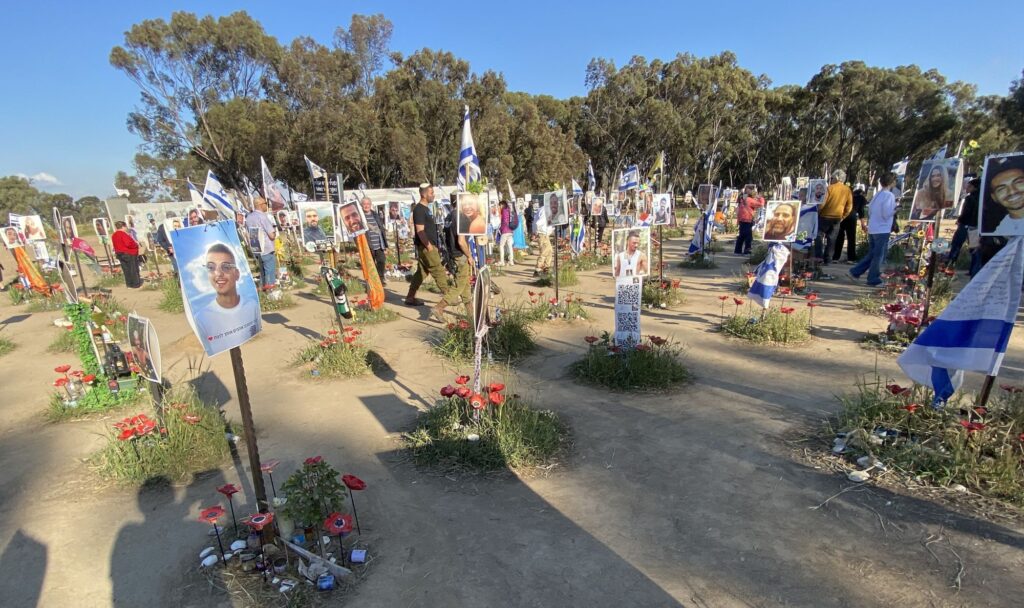 The memorial to the victims of the massacre at the Nova music festival in southern Israel (Photo: Shlomo Roded/PikiWiki)
The platform is available in app and browser form, and operates as a portal for private communities for specific events, which anyone can apply to join. The platform serves as a complete environment for each event, with social media features, member offers and ticket sales.
“We built an ecosystem for advanced communities that does much more than just ticketing,” Dovev explains. “We do the whole aspect of member management.”
And no other platform in the world, he says, has the same range of features as Vibez.
One of the main communities on the platform – with more than 10,000 members – is operated by David Abramov, better known in the Israeli music world as DJ Darwish, who is also a member of the Vibez advisory board.
Abramov’s 20-year-old son Laor was initially declared missing in the chaotic aftermath of the Nova attack and tragically later found to be among the dead.
Launched just two weeks before the massacre at the Nova festival on October 7, Vibez co-founder and CEO Saar Dovev tells NoCamels that it took until mid-March for Israeli events to begin happening again.
Nova was a prime example of a community-based music festival, Dovev says.
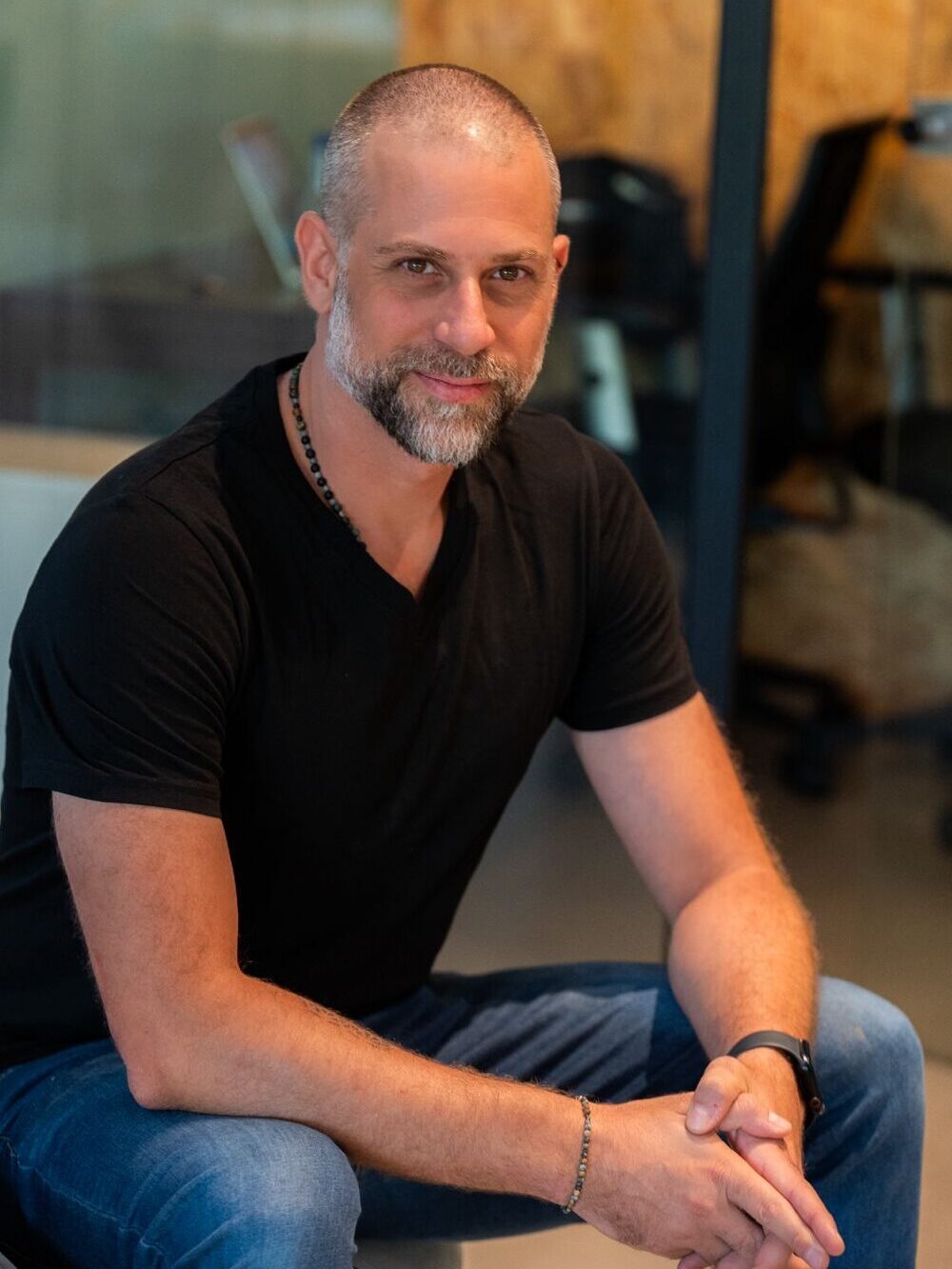 Saar Dovev: We realized that events were building themselves communities (Photo: Courtesy)
Each community – be it created by an individual, specific festival or club – has its own pages on the platform, with listings for upcoming events, messages from the operators and special offers exclusive to that group.
Would-be members ask to join the specific community in order to access their features and, once approved, can interact and receive often exclusive details of upcoming events.
Dovev explains that each community can also define the levels of membership within it, such as premium or VIP, set up event promotions or even just send messages to its members. A social media aspect, allowing members to chat, is also in development.
“We are a little bit like Meetup,” Dovev says, referring to the global forum for people to find others in their immediate vicinity who share their interests, “but for nightlife, festivals, parties – everything to do with culture.”
Dovev set up Vibez in late 2021 with co-founder Yael Dovev, who is the company COO and also his wife, whom he fondly refers to as his “partner in crime.”
An experienced entrepreneur in the event industry, Dovev had created ticketing platform EventBUZZ more than a decade ago, but came to realize that as events of all kinds were building communities around themselves, they would need a dedicated home to manage all their interactions.
“Communities became a big thing everywhere, in every segment of life,” he says.
The founders funded the development of the platform themselves, with no external investment and a small team to write the code and develop the software themselves.
“I’m very proud of the fact that we are a bootstrap company, and we reached the milestone that we have reached,” Dovev says, adding that Vibez “didn’t spend a shekel on marketing.”
That milestone includes some 100,000 users in Israel and an app that he says has been downloaded by more than 10 percent of that number – making it the 15th most popular app in the country in less than a year.
 The Vibez app has become one of the most popular apps in Israel (Photo: Courtesy)
Although currently operating primarily in Israel, the platform has also expanded internationally with events in Finland and Thailand, and has already established itself as a firm fixture in the latter.
Vibez is also hopeful that a large music festival in Europe will be using the platform in the near future, and has its sights set on the US, where it has already registered the company.
Although the emphasis is on music events, Dovev says the platform is suitable for any kind of cultural experience.
“If it has culture, if it has music, sound, art, movement, it’s relevant for us,” he says.
The post Innovative Music Festival Platform Is Helping Israelis To Dance Again appeared first on NoCamels.
Israel Sending 20 Green Tech Firms To UN Climate Conference
The Israel Innovation Authority (IIA) has announced the 20 Israeli climate tech companies that will be featured at the United Nations COP29 Climate Conference set to take place in Baku, Azerbaijan in November.
The 20 companies operate in a diverse range of sectors related to green tech – including renewable energy; water; advanced agriculture; and smart transportation – and each has its own innovative solution to combating the global climate crisis.
The various companies were chosen in order to showcase the impact of Israeli innovation in this ecosystem, and will be present at the Israeli pavilion inside the event’s main Blue Zone hub.
COP29 will be the UN’s 29th climate conference, the largest event of its kind in the world. More than 100 heads of state and over 40,000 participants – including members of governments, the private sector, academia and financial institutions –
are expected to attend this year’s conference, which will focus on reducing greenhouse gas emissions and adapting to climate change, with an emphasis on innovative and sustainable solutions.
The Israeli companies selected are:
Airovation Tech: Developed a unique technology for capturing and storing carbon dioxide from the air, enabling industries such as fertilizers, cement and steel to significantly reduce carbon emissions
CarbonBlue: Removes carbon dioxide from ocean water, allowing it to absorb more CO₂ from the atmosphere without requiring water pre-treatment
Rewind: Developed a carbon dioxide removal method involving the storage of biomass in the 2km deep, oxygen-depleted waters of the Black Sea
Momentick: Uses advanced sensors and artificial intelligence to provide precise and autonomous capabilities for detecting and quantifying methane and other greenhouse gas emissions worldwide
Senecio Robotics: Tackles the global mosquito epidemic by developing an AI-powered robotic platform that releases sterile males, dramatically reducing mosquito populations in vast areas
TextRe: Specializes in converting synthetic textile waste into sustainable recycled materials used in various applications in the plastics industry.
Treetoscope: Presents advanced irrigation optimization technology in agriculture, reducing water waste and promoting efficient use of renewable water sources
BlueGreen Water Technologies: Purifies polluted lakes by combining innovative materials and technologies to treat stagnant water sources and rivers
SolCold: Developed a unique nanotechnological coating that cools buildings under sunlight without the need for electricity, making it a perfect solution for extremely hot regions
EZPack: Provides off-grid water solutions for rural areas, with technologies that supply clean water for drinking and agriculture even in harsh conditions
NGV: Offers technology to reduce carbon emissions from polluting industries while creating sustainable products, enabling over an 80-percent reduction in emissions throughout the lifecycle
Envomed: Developed a solution for the treatment of hazardous medical waste, focusing on environmental preservation and reducing pollutant emissions
Reep Technologies: Removes ink from paper in a way that allows paper reuse, reducing pollution in the printing industry
H2OLL: Provides technology to extract drinking water directly from the air, a unique solution for areas with water shortages
Salicrop: Develops environmentally friendly fertilizer alternatives that help plants adapt to harsh climatic conditions
ANINA Culinary Art: Offers unique packaging solutions for healthy, eco-friendly meals that are ready to eat within minutes
CI Sensing: Developed a revolutionary solution for monitoring greenhouse gas emissions based on Optical Gas Imaging technology, which helps energy companies reduce emissions and enhance safety against leaks
Marine Edge: Provides optimization solutions for shipping companies, reducing fuel consumption and pollutant emissions
Terra: Developed technology for managing and monetizing carbon removal for farmers
The post Israel Sending 20 Green Tech Firms To UN Climate Conference appeared first on NoCamels.
Rehabilitation Nation: Israeli Innovation On Road To Healing
One year after the brutal mass attack by Hamas terrorists on southern Israel, and the country is still dealing with the subsequent and ongoing war in Gaza, driving Hezbollah from the northern border, and attacks by Iran and its other proxies in Iraq, Syria and Yemen.
But during the past year, Israelis have displayed the resilience, determination and creativity that has helped them overcome the threats they have faced since the creation of the state in 1948 and for which they have a worldwide reputation.
So too has the national innovation ecosystem risen to the occasion, displaying the same tenacity that earned it the moniker Startup Nation, and using it to rehabilitate the country during the greatest challenge of its 76-year history.
Perhaps in the realest sense of the word rehabilitation, Sheba Medical Center – Israel’s largest and internationally ranked hospital – is developing the most groundbreaking surgical techniques to improve the lives of Israeli veterans who were wounded in the line of duty.
The soldiers underwent what Sheba said were life-changing procedures by Israeli and top global surgeons, with the aim of helping them to reclaim their sense of empowerment and independence.
The foreign surgeons also worked with their Israeli counterparts on these new techniques, in a joint project by Sheba and Brothers for Life, a non-profit organization providing critical and immediate aid to wounded IDF veterans.
The innovative techniques will now be used to operate on IDF veterans such as Sergeant O., who lost his right leg after stepping on an IED during a mission in the West Bank in January, and who has since experienced severe pain due to nerve damage.
Sergeant O. was set to undergo surgery at Sheba to ease the pain, a procedure to be led by Dr. Jason Souza, Director of the Orthoplastic Reconstruction and Advanced Amputation Program at Ohio State University.
“We are humbled and honored to serve those who have served us. It is our duty to help veterans rebuild their lives and enable them to look ahead to a future filled with hope and possibilities,” said Dr. Avi Avitan, head of Sheba’s Outpatient Rehab Clinic.
“Our network of healthcare professionals, including surgeons, physical therapists and prosthetists assists patients along every step towards recovery, providing support in every way possible. They fought their battle on the front line, and now it is our turn to fight alongside them in their journey to recovery and rehabilitation,” he said.
Brothers for Life today works with 2,000 wounded IDF veterans and its co-founder and executive chairman Gil Ganonyan, who was also wounded in battle, anticipates that more veterans will look to the organization for support in the coming months.
“We are fully committed to continuing our vital mission of supporting the physical and mental recovery of our heroes, putting the puzzle pieces back together to build a stronger, more resilient future,” Ganonyan said.
Coping with the wounds of the past year also means healing the mental scars, and Israel’s innovation ecosystem has also been hard at work in this sphere too.
Medical cannabis company SyqeAir – which created the world’s first inhaler with metered doses for pain management – has developed an online questionnaire to recognize early symptoms of post-traumatic stress disorder (PTSD) and recommendations for professional help for anyone suffering from mental distress.
 The number of Israelis dealing with PTSD has almost doubled in the past year (Photo: Pexels)
According to the Israeli Center for Suicide Research, the number of Israelis dealing with PTSD has almost doubled in the past year from 16 percent to 30 percent. Furthermore, a survey by the University of Haifa also found that approximately 60 percent of the population not directly affected by the war are experiencing acute stress disorder (ASD), which when left untreated has the potential to develop into PTSD.
SyqeAir’s questionnaire asks respondents about their recent emotions and behaviors, and the degree of their intensity, which may reveal symptoms characteristic of PTSD.
The completed questionnaire is analyzed for signs of symptoms characteristic of PTSD. If such signs appear, the respondent is recommended to contact a professional for a full diagnosis and treatment advice.
The questions are based on a self-report survey used by the National Center for PTSD at the US Department of Veterans affairs, which assesses 20 symptoms of post-traumatic stress.
According to SyqeAir, its data shows a 350 percent increase in victims of hostilities being treated with medical cannabis, of which 56 percent are being treated for PTSD.
The data also shows a 150 percent increase in members of the security forces being treated with medical cannabis, of which 57 percent are dealing with PTSD from the ongoing conflict.
“Professional estimates suggest that by the end of 2025, between 1.5 to 2 million individuals may be suffering from post-traumatic stress disorder (PTSD),” said SyqeAir CEO Hagit Kamin.
“Our newly developed digital tool aims to raise awareness about post-traumatic symptoms and offers an early self-identification solution for those in need of help and professional guidance to improve their well-being,” she said.
“Considering the rapid increase in the number of people experiencing PTSD, we recognize the critical need to provide the general public with an initial identification tool to promote awareness and enable individuals to seek treatment as early as possible.”
Young Israelis are also innovating for better medical solutions, with students at Afeka College of Engineering creating new technologies for emergency medical services in the wake of the October 7 attacks.
The top three winning entries were an AI-powered platform to streamline patient medical history, thereby reducing time to treatment; a smart bandage that helps prevent sepsis by detecting an infection based on the changes in a patient’s pH levels; and a drone that can deliver medical equipment to remote areas.
The unique solutions for emergency care were created during the Tel Aviv college’s third annual 24-hour hackathon, and is an issue of great importance to Afeka, which has seen 42 percent of its study body serving in the Israel Defense Forces during the course of the war.
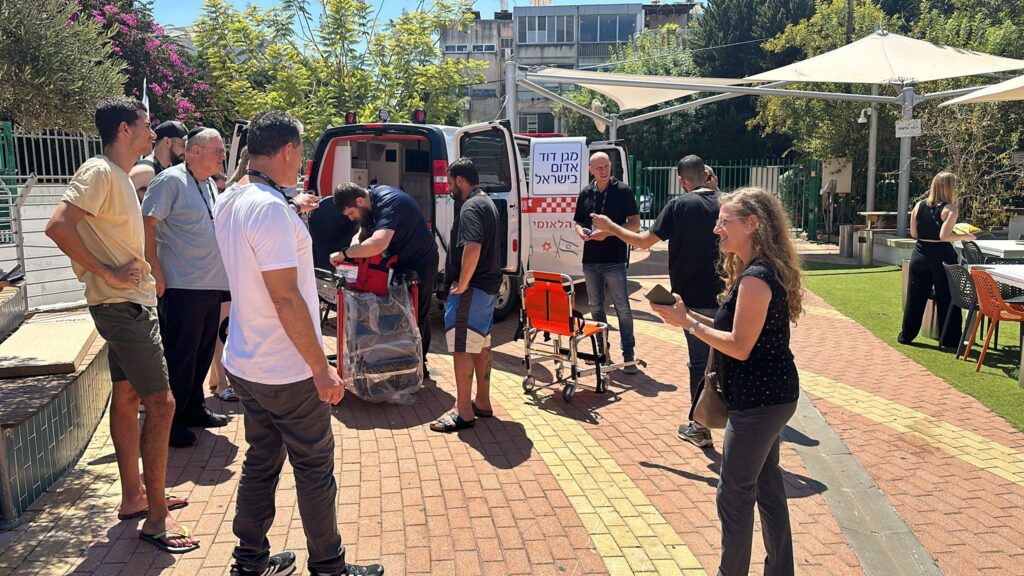 Afeka students beside a Magen David Adom ambulance during the college’s hackathon for medical care innovation (Photo: Courtesy)
The event, dubbed “the MDAthon,” was held in conjunction with Magen David Adom, Israel’s national rescue service, and included multidisciplinary teams of students and alumni, emergency responders and industry professionals.
“The demand for skilled engineers has never been greater, especially during these critical times,” said Afeka President Prof. Ami Moyal.
“Our students will be the leaders and innovators that drive future success, will drive our economy, and ensure Israel’s continued success on the global stage.”
The post Rehabilitation Nation: Israeli Innovation On Road To Healing appeared first on NoCamels.
Israeli Test To Tell If Infection Bacterial Or Viral Successful In Trial
Israeli medical diagnostic company MeMed has announced the successful completion of the first randomized controlled trial in the US of its test to differentiate between bacterial and viral infections.
The test could reduce the amount of use of antibiotics, which do not work on viral infections but whose prescription for them plays a part in the growing problem of antibiotic resistance in bacteria.
The company says the trial of the MeMed BV test successfully demonstrates its clinical utility in promoting appropriate antibiotic use, highlighting its potential to improve patient outcomes and healthcare decision making. It also called the trial a critical step toward making the test the standard for distinguishing bacterial and viral infections.
The randomized controlled trial was conducted across 11 Emergency Departments (EDs) and Urgent Care Centers (UCCs) in the US and Israel, and included 260 adult patients with clinical suspicion of lower respiratory tract infection (LRTI).
The first small-scale analysis of data from the trial showed a 62 percent relative reduction in unnecessary antibiotic prescription rates, while follow-up data indicated no significant increase in the rate of return ED/UCC visits within 7 days.
“The results of this trial build on a decade-long series of studies involving thousands of patients, demonstrating the high performance of the MeMed BV technology,” said MeMed co-founder and CEO Dr. Eran Eden.
“This trial marks a significant step forward by generating interventional data and showcasing the test’s actual impact on patients. We are committed to further expanding on these findings, with several additional utility and real-world studies underway,” he said.
The post Israeli Test To Tell If Infection Bacterial Or Viral Successful In Trial appeared first on NoCamels.
Tel Aviv University Ranked 7th In World For Global Entrepreneurship
Tel Aviv University (TAU) has been ranked seventh worldwide and first outside the US in the 2024 Pitchbook Ranking for global entrepreneurship.
The annual ranking, published by renowned business data research company Pitchbook, tracks startups raising capital in the US, using the number of entrepreneurs among an institution’s alumni to compile the top 50 universities.
TAU says the achievement was driven by 893 alumni with bachelor’s degrees who have founded 755 companies over the past decade, raising $29.8 billion in total capital.
While TAU joins world-famous US universities such as Stanford, MIT and Harvard in the top 10, it places higher than Yale, Columbia and Princeton, who were ranked 11th, 13th and 14th respectively.
Pitchbook singled out three companies founded by TAU alumni that have each raised over $1 billion: Generate ($4.3 billion); Lendbuzz ($1.2 billion); and Next Insurance ($1.1 billion).
“TAU continues to be Israel’s main entrepreneurial university and a global leader in producing alumni who become entrepreneurs, found companies, raise venture capital and drive economic progress,” said Prof. Moshe Zviran, the university’s Chief Entrepreneurship & Innovation Officer.
“TAU’s 7th place in the Pitchbook ranking is another testament to the exceptional quality of our alumni and the impact of our entrepreneurial ecosystem on campus, which actively promotes this mindset,” he said.
Three other Israeli universities made the list: the Technion – Israel School of Technology in Haifa, which was ranked 16th; the Hebrew University of Jerusalem, which was ranked 30th; and Ben-Gurion University of the Negev, which was ranked 47th.
The post Tel Aviv University Ranked 7th In World For Global Entrepreneurship appeared first on NoCamels.
Shabbat Shalom!
Israel selects its song for Eurovision
<p><i>(Arutz Sheva-Israel National News' North American desk is keeping you updated until the start of Shabbat in New York. The time posted automatically on all Israel National News articles, however, is Israeli time.)</i></p>
US sanctions Iran’s oil network as officials meet in Oman
<p><i>(Arutz Sheva-Israel National News' North American desk is keeping you updated until the start of Shabbat in New York. The time posted automatically on all Israel National News articles, however, is Israeli time.)</i></p>
IDF troops conducting searches in Karmei Tzur
Suspected terrorist infiltration in the community of Karmei Tzur in Judea
Podcast: Yitro recognizes the one true G-d of Israel
<p><i>(Arutz Sheva-Israel National News' North American desk is keeping you updated until the start of Shabbat in New York. The time posted automatically on all Israel National News articles, however, is Israeli time.)</i></p>
Benghazi attack suspect transferred to US to face murder charges
<p><i>(Arutz Sheva-Israel National News' North American desk is keeping you updated until the start of Shabbat in New York. The time posted automatically on all Israel National News articles, however, is Israeli time.)</i></p>
Top Hezbollah official steps down in rare resignation
<p><i>(Arutz Sheva-Israel National News' North American desk is keeping you updated until the start of Shabbat in New York. The time posted automatically on all Israel National News articles, however, is Israeli time.)</i></p>
WSJ report: Iran rejects US demand to halt enrichment in Oman talks
<p><i>(Arutz Sheva-Israel National News' North American desk is keeping you updated until the start of Shabbat in New York. The time posted automatically on all Israel National News articles, however, is Israeli time.)</i></p>
Podcast: Greatest of the true spiritual seekers
<p><i>(Arutz Sheva-Israel National News' North American desk is keeping you updated until the start of Shabbat in New York. The time posted automatically on all Israel National News articles, however, is Israeli time.)</i></p>
With Mamdani, progressive Jews are now agreeing instead of protesting at mayor’s interfaith breakfast
At last year’s mayoral interfaith breakfast, Rabbi Sharon Kleinbaum came equipped with a literal message.
It was a sign that read, “Mr. Mayor: show mercy to our immigrant friends!” Kleinbaum, a prominent progressive leader who is senior rabbi emerita of the LGBTQ+ synagogue Congregation Beit Simchat Torah, held the sign above her head during Eric Adams’ remarks, silently protesting a mayor who she felt was letting down the immigrant community following Donald Trump’s inauguration.
A year later, at Zohran Mamdani’s first interfaith breakfast on Friday, Kleinbaum returned — but without a sign.
There was no need for a demonstration, Kleinbaum said in an interview, because she didn’t have to put pressure on Mamdani.
“I’m willing to work with any mayor who’s mayor of our city — and I’m thrilled that Mayor Mamdani’s values align with my religious conviction that immigrants are an essential part of our city,” she said.
Mamdani’s interfaith breakfast brought more than 300 religious leaders to the New York Public Library’s flagship building for scrambled eggs and coffee. A few of them spoke or led prayers. The focus was in large part on protecting immigrants amid ICE’s growing presence in the country, a presence that Mamdani said is antithetical to the biblical concept of “welcoming the stranger.”
The morning also embodied the shifting landscape under Mamdani’s mayorship, in which progressive Jews and Jewish organizations are playing a more central role in New York City politics. Those groups range in viewpoint from liberal Zionist to the anti-Zionist ones that Mamdani protested alongside during his time as a State Assembly member.
“This particular breakfast felt very authentic,” said Rabbi Emily Cohen, spiritual leader of the Reconstructionist West End Synagogue, in an interview. “From the very get-go, the director of the Public Library was able to speak out about ICE and the importance of reading. In past years, even that speech has felt very limited in its scope.”
This year’s sponsors included left-wing group Jews for Racial and Economic Justice, the liberal-leaning Nexus Project and the New York Jewish Agenda, the progressive organization whose director, Phylisa Wisdom, was recently tapped to lead Mamdani’s Office to Combat Antisemitism.
Major Jewish organizations including UJA-Federation of New York, the Jewish Community Relations Council of New York and the Anti-Defamation League did not sponsor, after having done so each of the last three years.
Jewish Voice for Peace, the anti-Zionist organization, was represented at the breakfast for the first time since the annual tradition was started by Mike Bloomberg. Rabbi Andy Kahn, director of the anti-Zionist American Council for Judaism, and Jamie Beran, who heads the progressive group Bend the Arc, were also in attendance.
Meanwhile, Cohen delivered remarks in which she called JFREJ her “political home” and recounted being arrested at a recent ICE protest — a risk that she felt compelled to take “on a spiritual level.”
“Religion is often characterized as a home for the right, but I am continually inspired by the religious left,” said Cohen, who was part of the “Rabbis for Zohran” campaign video.
Mamdani framed his speech around the idea of “welcoming the stranger,” and said that people can “rely on our faith to offer an embrace of one another.” He offered an example of how the Hebrew Bible calls for protecting vulnerable neighbors.
“I think of Exodus 23:9, the words of the Torah, ‘Thou shalt not oppress a stranger, for ye know the heart of a stranger, seeing ye were strangers in the land of Egypt,’” Mamdani said. “Few have stood so steadfast alongside the persecuted as Jewish New Yorkers.”

Zohran Mamdani speaks during his first Interfaith Breakfast, an annual tradition hosted by the mayor. (Joseph Strauss)
Mamdani named examples of Jewish allyship in Michael Schwerner and Andrew Goodman, a pair of civil rights activists who were killed by the Ku Klux Klan; and Rabbi Abraham Joshua Heschel, who marched alongside Martin Luther King. He also named Yip Harburg, who wrote “Somewhere Over the Rainbow” and, Mamdani said, “uplifted Americans waiting on bread lines during the Great Depression.”
The mayor had begun his remarks by shouting out the handful of elected officials in attendance including Brad Hoylman Sigal, the Jewish Manhattan borough president.
The loudest ovations were reserved for the politicians occupying the most progressive lane: Brad Lander, the former city comptroller who is Mamdani’s most prominent Jewish ally; and Shahana Hanif, a City Council member in Brooklyn whose participation in pro-Palestinian protests has drawn backlash from some constituents.
Mamdani also acknowledged the absence of Arthur Schneier, a 95-year-old Orthodox rabbi who was supposed to lead a prayer but was absent due to an illness, and offered his “hopes for a quick recovery.”
Schneier is the senior rabbi of Park East Synagogue, which was the site of a pro-Palestinian protest in November that sparked efforts to ban protests outside houses of worship, and intensified fears of growing antisemitism under an anti-Zionist mayor. A Mamdani spokesperson responded by saying that he “discouraged” the language used at the protest, and that the Nefesh b’Nefesh event was a misuse of a “sacred space.” Schneier’s son, Rabbi Marc Schneier, said on Thursday that he would boycott the breakfast because of Mamdani’s anti-Zionism.
Jewish representation at the breakfast was not limited to progressive or outwardly pro-Mamdani groups.
Rabbis Joseph Potasnik and Diana Gerson from the New York Board of Rabbis were seated at the mayor’s table, despite not sponsoring the event. JCRC’s vice president for the Center for Shared Society, Matt Abrams Gerber, was also present. Rabbi Elliot Cosgrove, who spoke out against Mamdani during the election, attended, as did Flatbush Jewish Community Coalition chairman Josh Mehlman.
“At a time when antisemitism is rising precipitously, it’s important to show up with the interfaith community,” Potasnik said after the event. “We can’t fight antisemitism alone.”
Immigrant protection was the issue at the forefront of the breakfast, rather than other hot-button issues like combating forms of hate like antisemitism and Islamophobia. Mamdani announced an executive order that would push back against ICE, and pamphlets instructing immigrants on their rights were distributed in 10 languages, including Yiddish. It was a contrast from last year’s breakfast, where the mayor’s only acknowledgement of immigrants’ safety came when he read Kleinbaum’s sign.
“I think that each administration has its own culture and its own vibe,” said Cohen. “The vibe of the previous administration was not in line with the values and priorities of my beliefs — and the current administration is.”
--
The post With Mamdani, progressive Jews are now agreeing instead of protesting at mayor’s interfaith breakfast appeared first on Jewish Telegraphic Agency.
From far corners of the Jewish world, the women of Chabad gather in freezing Brooklyn
It was close to 90 degrees back home in Dar es Salaam, Tanzania, on Friday, but Chani Aziza said she was thrilled to be freezing on a sidewalk in Brooklyn.
Aziza was one of thousands of women affiliated with the Chabad-Lubavitch movement who gathered in Crown Heights this week for the movement’s annual gathering of female emissaries.
Aziza, who moved to Dar es Salaam with her husband and two children three years ago as Chabad’s first emissaries there, is used to cooking all of their center’s food from scratch. No kosher prepared foods are available in Tanzania.
Now, as she braved frosty temperatures to pose in Chabad’s signature group photos, she said she was looking forward to visiting the many kosher establishments in the area, including the sushi restaurant Noribar.
“My friend just told me, like, enjoy it, you can eat whatever you want,” said Aziza. But she said the gathering had a more serious upside, too: “It’s fun also to come here to take power, see all this amount of shluchos, everyone in different places and different challenges.”

People gather outside of a kosher ice cream shop in Crown Heights, Brooklyn, on Feb. 6, 2026. (Jewish Telegraphic Agency)
The women in Crown Heights, hailing from over 100 countries where the Chabad movement maintains a presence, were taking a rare break from the front lines of serving as what is often the only Jewish presence in their communities. As their husbands fulfill rabbinic duties, female emissaries take on a wide range of responsibilities, from managing their Chabad centers’ educational programming to supporting community members through crisis to making sure Shabbat meals are prepared — often while raising their own families far from extended support networks.
“We give the entire year. Our lives are all about giving, and today it’s about filling up our cup to make sure that we are receiving,” said Dinie Rapoport, who serves on the executive committee for the conference. “The goal of this conference is for us to come and to be renewed and rejuvenated, to be able to continue this mission, spreading Judaism throughout the world.”
Beyond the host of programming offered during the conference, including a visit to the gravesite of the Chabad-Lubavitch movement’s late leader and several panels and workshops, many of the emissaries said they were excited for the chance to connect with peers.
“I was so looking forward to this year,” said Devorah Leah Kalmenson. “You get so much energy just from coming and just seeing people and, like, they take care of you.”
Kalmenson moved to Leeds, England, three years ago when she was 22 to help lead the Chabad center’s youth programs, including five day camp sessions per year.
“I have two boys, so a lot of times the hours end up being when my kids are sleeping and just getting the schedules out and the planning and registration,” she said.

Perel Krasnjansky (L), Dinie Rapoport (M) and Devorah Leah Kalmenson (R) pose inside the Chabad movement offices on Feb. 6, 2026. (Jewish Telegraphic Agency)
The Chabad movement currently operates 500 Jewish day camps in locations around the world as well as six overnight camps. The camp sector of the Orthodox movement’s programming is expanding amid a push to engage more young families.
While Kalmenson said she had experience helping her parents run the Hebrew school and camps at the Chabad center in Vilnius, Lithuania, she said she had received training from CKids, the Chabad movement’s youth programming arm.
“I did a lot of different workshops and programs, and CKids is also very good with educating how to run things and how to work with kids, discipline, I did an early childhood course and things like that,” said Kalmenson.
Kalmenson said she had also often relied on the guidance of other female emissaries as she navigated the challenges of running childcare programming.
Perel Krasnjansky was 25 when she first moved to Honolulu in 1987 to serve Hawaii’s only Chabad center at the time. She quickly started a Hebrew school which currently has 45 students enrolled. She said she still works anywhere from 12 to 18 hours a day, seven days a week.
“It was like landing on the moon, and in 1987, don’t forget, there was no internet, there was no WhatsApp, there were none of these supportive networks,” said Krasnjansky. “I have to say it was extremely challenging, it was extremely lonely.”
But Krasnjansky said female Chabad emissaries today had access to a level of connection and support that simply didn’t exist when she first went out, a shift she said had transformed the experience of serving in far-flung communities.
“Today, the young girls that do go out as far out as they go, they don’t have that extreme sense of loneliness we did in the ‘90s, that sense of being cut off and unmoored from everything you’ve ever known and loved,” said Krasnjansky.
The gathering took place in the shadow of two recent Chabad traumas, coming just over a week after a man was arrested for ramming his car repeatedly into Chabad’s world headquarters, the backdrop of the group photograph at 770 Eastern Parkway. A month earlier, two gunmen had killed 15 people at a Chabad Hanukkah party in Sydney.
Rabbi Mendel Kotlarsky, the coordinator of the International Conference of Shluchos, said Chabad had partnered with the NYPD and Counterterrorism Bureau to arrange security for the event, and had been “scouring social media” for “mischievous activity.”
“Obviously, in a year like this, the last few years, security is a top item across the board internationally for all of our events,” said Kotlarsky. “It’s a new reality that we live in.”
The danger, he said, “at the same time, recommits us to making sure that we give them the best experience when they come here, that these ladies can go back home to Bondi Beach or to the most remote places in the world, whether it’s Cambodia or Ghana, and be able to stand proud and share the Jewish message.”

Chana Kavka (R) and Laya Slavin (L) pose outside of the Chabad headquarters in Crown Heights, Brooklyn, on Feb. 6, 2026. (Jewish Telegraphic Agency)
Laya Slavin, co-founder of the Sydney-based nonprofit Our Big Kitchen, said many of the female emissaries from Sydney had not come to the Crown Heights gathering in the wake of the Bondi massacre because of the amount of work needed at home.
She said she had debated making the trip herself before eventually deciding to come, saying she had taken inspiration from Rabbi Eli Schlanger, the emissary in charge of Chabad of Bondi who was killed during the attack.
“I had missed my flight, and I said to my husband, that’s it, I missed my flight, I’m not coming, I’m not meant to be here,” said Slavin. “There is so much to do in Sydney. I mean, as I was flying, we have 50 volunteers baking 500 challahs to deliver out on Bondi Beach. I’m like, what am I doing here? I need to be in Sydney. But then again, you have that message from Rabbi Eli.”
--
The post From far corners of the Jewish world, the women of Chabad gather in freezing Brooklyn appeared first on Jewish Telegraphic Agency.
Marshall Weinberg, 95: The JTA president who didn’t know what a blog was — but knew right from wrong
When several dozen family and friends gathered last month for a memorial service in New York to celebrate the life of Marshall Weinberg — a New York stockbroker and philanthropist who shared a mentor and seven-decade friendship with Warren Buffett — I knew exactly what story to tell.
It was the spring of 2010, at one of my first board meetings as the relatively new editor in chief of the Jewish Telegraphic Agency, there to give an update on our editorial strategy.
“Now wait a minute,” Marshall interrupted with a wave of the hand. In his trademark booming voice, he asked: “Am I the only one here who doesn’t know what a blog is?”
Yes, this white-haired almost octogenarian was the only one in the room who didn’t know a blog from a bagel. What was this guy doing on our board?
Later in the meeting I got my answer.
Like many organizations in the wake of the 2008 financial meltdown, JTA’s outlook was bleak. But we were on the verge of bouncing back, as we closed in on a sizable grant from a foundation that had never supported us. Unfortunately that opportunity suddenly collapsed when the foundation’s chairman offered us an additional smaller grant to do an ideologically driven hit job on a specific organization — and we declined.
One JTA board member expressed dismay that the staff had made this costly decision without seeking board guidance. Several more veteran board members pushed back, arguing that editorial independence required the staff to make these types of journalistic calls.
The argument went on for several very tense minutes – until Marshall suddenly raised his hand and slammed it on the table.
“We wouldn’t do it for a million dollars!”
Conversation closed.
Marshall, who died at 95 in his Upper East Side apartment on Sept. 20, was clueless about blogs, and for that matter smartphones and social media. What he did know — channeling his namesake, the crusading civil rights lawyer Louis Marshall — was right from wrong, the causes he cared about and how to step up when it mattered most.
Marshall served on the board of JTA and its eventual parent organization, 70 Faces Media, for about 45 years, including as president in the early 1990s. Flash forward two decades after his presidency — well into the early 2010s — he was still JTA’s largest individual donor, a distinction he would complain about, lamenting the failure of his fellow board members to do more. When I excitedly told him in 2014 that several of them had finally surpassed him in order to support the merger that created 70 Faces Media, he immediately raised his gift to match the new benchmark.
Marshall was an only-in-New York character, a man of immense wealth who spent freely on culture, travel and, most of all, his philanthropic causes — while living for 65 years in the same one-bedroom rent-controlled apartment that definitely looked its age. He loved food and could afford to eat anywhere but was usually happiest with something basic, like roast chicken or a corned beef sandwich. And was it just me, or did he always seem to be wearing the same dark blue sweater with a small insignia from his beloved alma mater, the University of Michigan?
During his undergraduate years in Ann Arbor, Marshall developed a lifelong love of philosophy, which he decided to pursue as a graduate student at Harvard. But then, he told me, one of his professors warned him that he needed to find a better way to make a living, so he switched to Columbia Business School. It was there that he and several other classmates, including Buffett, became disciples of Ben Graham, one of the most influential investors of his time, who as the father of “value investing” pioneered the use of rigorous financial analysis and intense focus on long-term fundamentals to identify under-valued securities.
Marshall would later recall in a documentary how Graham changed his life with one line. “Ben Graham opened the course by saying, ‘If you want to make money in Wall Street you must have the proper psychological attitude. No one expresses it better than Spinoza,’” Marshall recounted, adding that he nearly fell off his chair and then perked up at the mention of the 17th-century Jewish rationalist philosopher. “I remember exactly what [Graham] said. He said: ‘You must look at things in the aspect of eternity.’”
In a letter read at Marshall’s memorial, Buffett reminisced about the class and the friendships that emerged from it.
“I met Marshall 74 years ago when we were both attending Ben Graham’s class at Columbia,” Buffett wrote. “It was a small group, only about 15 to 20 students. It was the most remarkable learning experience that I have ever had. Ben was a great teacher, combining wisdom, imaginative illustrations and humor in his weekly appearances on Thursday afternoons during the spring semester. Out of those sessions, I made at least five lifelong friends, Marshall among them. Subsequently he became a charter member of what I call the ‘Graham Group.’”
For about 45 years, they met every 18 months or so, with Marshall and Buffett attending every gathering.
“Among our members, Marshall became universally liked and admired. He was a friend to all and a confidant to many,” Buffett wrote. “Marshall was generous in every way, both monetarily and on a deeper one-on-one human basis. He never lost a friend. He had a strong social conscience, but never came across as personally judgmental or overbearing in his beliefs. And for all of the years that I knew him, he practiced those beliefs.”
Buffett’s letter was read by philanthropist and former shoe company executive Jane Weitzman, one of Marshall’s best friends, who served with him for decades on the boards of both JTA and the American Jewish Joint Distribution Committee. Exercising her prerogative as the emcee, she corrected the record on one point.
“Now who am I to disagree with Warren Buffett? However, that [Marshall] never came across as personally judgmental … we know a little bit better,” she said, to the laughing agreement of everyone in the room.

Marshall Weinberg stands outside the Dr Harold and Anna Weinberg Child Development Institution, a JDC project at Sheba Medical Center for the care of Israeli children with disabilities, in Israel in 1974. (Courtesy JDC)
After finishing at Columbia, Marshall joined and spent his career at the investment firm Herzfeld & Stern. As a 42-year-old broker, he was interviewed by The New York Times about his approach to investing, which had all the markers of a Graham disciple.
At least when I knew him, in his final two decades of life, Marshall never bragged about his best stock picks. Instead he was constantly talking up his philanthropic portfolio, a range of causes including the JDC, the University of Michigan, and the Center for Reproductive Rights.
Having never married or had children of his own, Marshall’s relationships with the fundraisers, select staff and fellow board members at the organizations he supported took on added importance in his life.
“We’re here today to remember a giant,” said Alexandra Shklar, a senior development director at the JDC, where Marshall served on the board for 50 years and was one of the largest lifetime donors, supporting the needs of impoverished Jews around the world. “Not only a giant in generosity of leadership, but a giant in spirit. Marshall Weinberg was a tzadik, not in an abstract or poetic sense, but in a very Jewish sense of the word, someone whose life aligned values with action, and responsibility with compassion.”
What made Marshall special, she added, was the “How.”
“He didn’t just give, he showed up,” she said. “He asked hard questions, and he pushed back. He listened closely, and he inspired others to follow.”
Shklar confessed that she hadn’t always understood what Marshall meant when he attributed his business success to a focus on the infinite. But, during discussions at JDC around various global crises, it became clear. “When others felt overwhelmed by the present moment, Marshall would say calmly and with conviction, ‘Think long term – this is just a moment of time, and this shall pass, too.’ He never minimized suffering, but he never let the present erase the future. That is not just optimism, that is wisdom.”
Peggy Burns, who worked with Marshall during her time at the University of Michigan, highlighted his groundbreaking philanthropic investments in different academic fields at the school, including major gifts to launch new undergraduate and graduate programs in cognitive science that anticipated the future importance of artificial intelligence.
Most importantly, she used her remarks to set the record straight: No, Marshall wasn’t always wearing the same sweater. She supplied him with two new ones every year.
Marshall’s nephew, Adam Weinberg, the former director of New York’s Whitney Museum, talked about Marshall’s parents, his extended family and reverence for his maternal grandfather, Rabbi Zvi Hirsch Masliansky.

Rabbi Zvi Hirsch Masliansky, pictured in an undated photograph, was a prominent rabbi in Europe and then the United States; he delivered a farewell lecture in 1895 before leaving England. (National Library of Israel/Getty Images)
Masliansky was a teacher, orator, writer and activist, beloved across Europe in the late 1800s and then for four decades in America after being forced to flee the Russian authorities. Marshall would often recall to me the thousands who turned out for his grandfather’s funeral, with a cross-denominational roster of the country’s most prominent rabbis and the future president of Israel, Chaim Weitzman, serving as pallbearers.
“While he was only a teenager when his grandfather Masliansky died, his influence was lifelong and Marshall often channeled Zvi Hirsch as a speaker and moral leader,” Adam Weinberg said. “I’m convinced that booming voice must have come from Masliansky who didn’t have amplification in those days and when he had to speak to 5,000 or 10,000 people at the Educational Alliance he had to speak loudly.”
Apparently, he lovingly quipped, Marshall forgot that we had microphones today.
The gathering closed with remarks from sociology professor Lenore Weitzman, who echoed several speakers in thanking Marshall’s caregivers; his lawyer, Nina Krauthamer, and Ellen Goetz, a friend he knew from his support of the Center for Reproductive Rights, for all the ways they cared for him over the past few years as his health and facilities declined.
Weitzman recounted her introduction to Marshall’s power as a fundraiser, at a cocktail party for recent college graduates more than 60 years ago sponsored by the United Jewish Appeal. He was there to warm up the crowd and inspire them to give. “Marshall talked about what was happening to poor Jews in Eastern Europe and how important it was to help,” she said. “I had grown up thinking a good Jew was about going to Shabbat services, observing Jewish holidays and supporting Israel. But here was someone who was talking about Jews beyond Israel, Jews who were suffering in countries I knew nothing about.”
And, again, it was about the How.
“He cried. He actually cried when he talked about visiting Jews who didn’t have enough money to buy matzah for Pesach and those in countries where they’re not even allowed to practice Judaism,” she recounted. “I don’t think I had ever seen a man cry in public, and I don’t think I had ever seen or heard a man who was so emotional about his love and his concern for his people.”
As a result of the many ways he translated that passion for his people into action, Marshall’s memory is already a blessing. May those of us who benefitted from his good deeds keep it that way by carrying on all of the important work that he supported and loved.
--
The post Marshall Weinberg, 95: The JTA president who didn’t know what a blog was — but knew right from wrong appeared first on Jewish Telegraphic Agency.
Credit Suisse had many more bank accounts with Nazi ties than previously known, investigation finds
The financial services company Credit Suisse had hundreds more bank accounts with Nazi ties than it had previously revealed, a new investigation reported this week.
The findings were discovered when independent investigators audited UBS, the Swiss bank that acquired Credit Suisse in 2023.
“What the investigation has found to date shows that Credit Suisse’s involvement was more extensive than was previously known, and it underscores the importance of continuing to engage in research efforts about this horrific era of modern history,” Neil Barofsky, a lawyer overseeing the inquiry, testified before the Senate Judiciary Committee Tuesday.
Barofsky’s report found 890 accounts potentially linked to Nazis: 628 individuals and 262 legal entities.
The investigation also found that Credit Suisse provided support to the “ratlines” that enabled Nazis to escape Europe and enter Argentina, opening and maintaining accounts for the Argentine Immigration Office.
Specifically, Barofsky said in his testimony, Credit Suisse provided funds “to finance bribes, obtain fraudulent travel documents, and pay for living expenses and transportation for fugitives, including perpetrators of the Holocaust.”
Barofsky’s investigation into UBS also found multiple previously unreported instances of the forced sale of property owned by Jews during the Holocaust. It also found that Credit Suisse held accounts for the German foreign office during the Holocaust, which dealt with the deportations of Jews.
Last May, Argentina declassified more than 1,800 documents related to the ratlines at the behest of the Simon Wiesenthal Center, named for the late Nazi hunter. Barofsky’s research into Credit Suisse’s involvement in the ratlines is ongoing, he said.
The findings represent a potentially explosive capstone to years of investigation into Credit Suisse’s Nazi ties.
Jewish organizations have long claimed that in addition to playing a key role in financially supporting Nazi Germany, Credit Suisse has held onto money looted from Jews long after the war. In 1999, the Swiss bank paid Jewish groups and Holocaust survivors a settlement of $1.25 billion in restitution for withholding money from Jews who had tried to withdraw their funds.
In 2020, the Simon Wiesenthal Center, a Jewish advocacy group, alleged that the bank had also hidden information about its ties to Nazis who fled to Argentina.
The bank hired Barofsky the following year to investigate its record but fired him in 2022, angering U.S. lawmakers including Sen. Chuck Grassley, now chair of the Senate Judiciary Committee. In 2023, as the top Republican on the Budget Committee, Grassley charged that Credit Suisse was obfuscating its Nazi ties, saying, “When it comes to investigating Nazi matters, righteous justice demands that we must leave no stone unturned. Credit Suisse has thus far failed to meet that standard.” Barofsky was soon rehired.
Tuesday’s hearing grew heated when Barofsky said the bank was still interfering with his investigation. He argued that his investigation could not be completed without access to 150 documents related to a 1998 restitution settlement between UBS and Holocaust survivors, which Barofsky says may contain the names of specific account holders he is investigating.
Robert Karofsky, president of UBS Americas, alleged Tuesday that giving Barofsky access to those documents could violate attorney-client privilege.
“Materials from the 1990’s are not within the scope of the Ombudsperson’s oversight, which is meant to be focused on Credit Suisse’s history and World War II-era conduct,” Karofsky said.
Still, Barofsky said, his report will be incomplete without those documents.
“I will be unable to provide assurance in my final report that the investigation has truly left no stone unturned,” he said.
--
The post Credit Suisse had many more bank accounts with Nazi ties than previously known, investigation finds appeared first on Jewish Telegraphic Agency.
Former Moscow rabbi says he rebuffed proposal to convert a million Russians discussed in Epstein files recording
When newly released audio recordings revealed former Israeli Prime Minister Ehud Barak discussing mass conversion and selective immigration with Jeffrey Epstein, disgraced financier and the convicted sex trafficker, the reaction in Israel was swift and deeply political.
Israel’s current prime minister, Benjamin Netanyahu, accused Barak of seeking to “select” Jews for immigration and charged that Israel’s political left was trying to “replace the people” after failing at the ballot box — an echo of contemporary conspiracy theories about immigration that appear to have been treated as a serious idea at the time.
The recordings, released this week as part of the U.S. Justice Department’s latest disclosure under the Epstein Files Transparency Act, capture Barak in a wide-ranging conversation with Epstein, who died in federal custody in 2019. The audio appears to date to around 2013, when Barak — a longtime leader in the liberal Labor Party — was 71 years old and transitioning into the private sector.
In the recording, Barak argues that Israel should weaken the Orthodox rabbinate’s control over conversion and open the door to large-scale conversion as a demographic strategy.
“We have to break the monopoly of the Orthodox rabbinate — on marriage and funerals, the definition of a Jew,” Barak says. “Open the gates for massive conversion into Judaism. It’s a successful country. Many will apply.”
Over more than three hours, Barak speaks candidly about population trends in Israel, the West Bank and Gaza, warning that without a two-state solution, Jews could lose their demographic majority.
“It will be an Arab majority,” Barak says of the territories. “It’s a collective blindness of our society.”
Barak also expresses concern about the growing proportion of Arab citizens within Israel, noting that Arabs made up about 16% of the population four decades ago and roughly 20% today. He contrasts that growth with the ultra-Orthodox Jewish population, which he says is expanding more rapidly.
As a counterweight, Barak proposes immigration, conversion and minority inclusion. He praises the Druze and Christian minorities as highly integrated and points to immigrants from the former Soviet Union as prime candidates for conversion.
“We can control the quality much more effectively, much more than the founding fathers of Israel did,” Barak says. Referring explicitly to immigration from North Africa, he adds: “They took whatever came just to save people. Now, we can be more selective.”
Barak lauds the post-Soviet aliyah of the 1990s, which brought more than 1 million Russian-speaking immigrants to Israel, and says the country could “easily absorb another million.” He recounts telling Russian President Vladimir Putin that Israel about this idea and joking about mixed Russian-Israeli names in the military as evidence of rapid integration.
The remarks drew sharp criticism from Pinchas Goldschmidt, who spent more than three decades leading Moscow’s Jewish community before leaving the country after Russia’s invasion of Ukraine in 2022. In an interview, Goldschmidt said the recording echoed conversations he encountered repeatedly during his years in Russia.
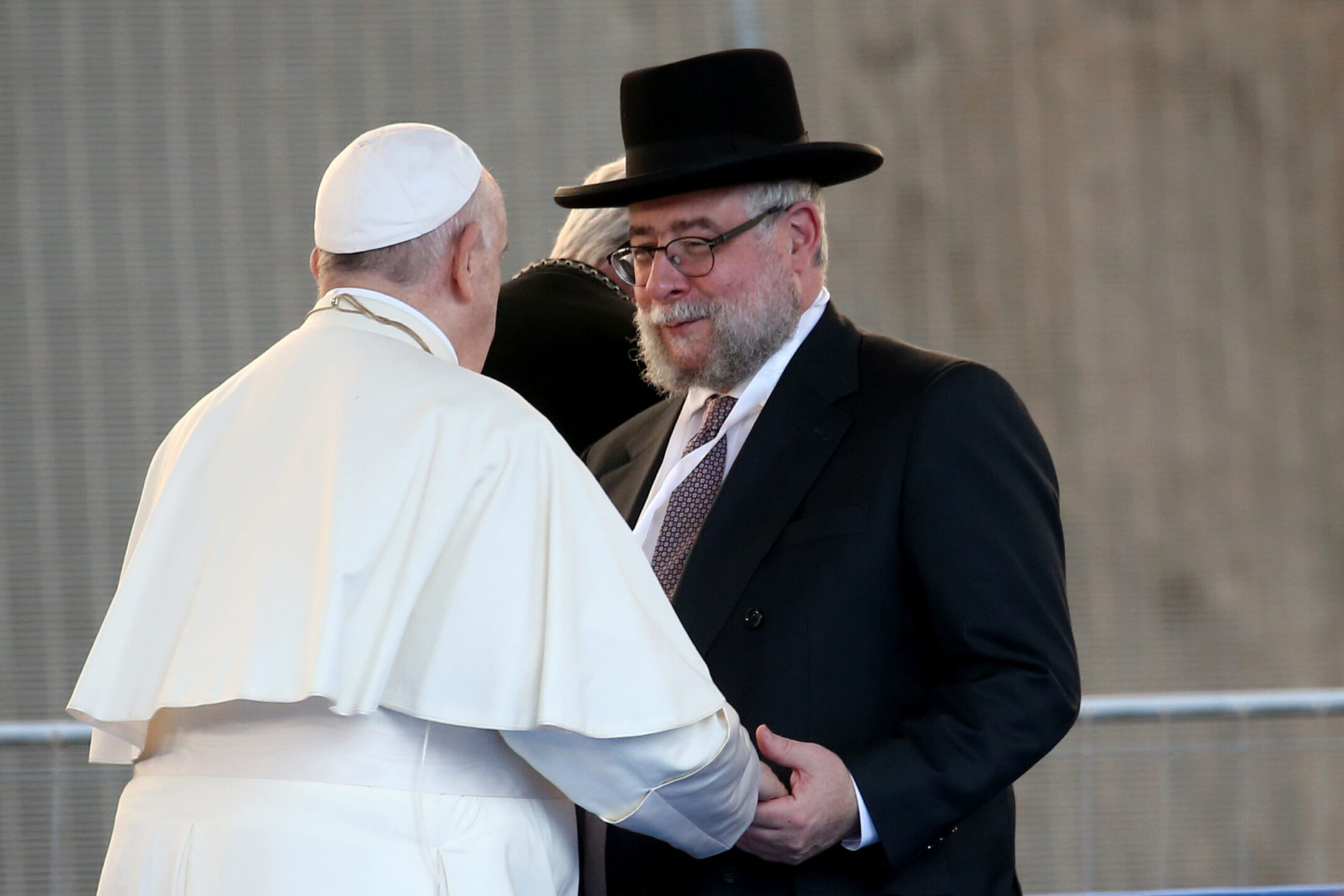
Pope Francis greets Rabbi Pinchas Goldschmidt during an International Meeting for Peace in Rome, Oct. 7, 2021. (Franco Origlia/Getty Images)
“I spent 33 years in Moscow, and there was talk like this,” Goldschmidt said. “Not necessarily among the heads of the agencies dealing with aliyah, but among employees and officials who felt this was their opportunity to stop Israel from becoming a Levantine country.”
Goldschmidt said those attitudes occasionally surfaced in direct encounters with Israeli political figures. He recalled a meeting with former Israeli minister Haim Ramon, who asked whether Orthodox rabbinical courts could convert large numbers of non-Jewish immigrants from the former Soviet Union.
“He came to me with a number,” Goldschmidt said. “He mentioned 100,000.”
Goldschmidt said his response was categorical. “Halacha doesn’t speak in numbers,” he said, referring to Jewish law. “There is no number on the top and no number on the bottom. Halacha speaks about standards and conditions. If 1 million people are ready to convert according to Jewish law, then we will convert 1 million people. And if they are not ready, we will not convert even one.”
Goldschmidt said the meeting took place after Ramon had left government following a sexual misconduct scandal but emphasized that it was not a casual exchange.
“It was more than a conversation,” he said. “It was not a conversation over tea. If he came to see me officially, with a question like that on the table, then it meant something.”
For Goldschmidt, Barak’s claim in the recording that he discussed such matters with Putin was particularly striking. “Why do you have to speak to Putin about converting a million Russians?” he asked. “People can leave Russia without permission. The person he needed to speak to was me.”
Goldschmidt said Barak’s framing of conversion and immigration would be widely perceived in Israel as offensive. “Anyone from Middle Eastern backgrounds would hear this whole conversation as extremely racist,” he said. “And anyone who is traditional or religious would also find it very offensive.”
In his comments, Netanyahu also said Barak’s close relationship with Epstein proved that Epstein did not work for Israel or its intelligence services, saying it would make no sense for an Israeli asset to be closely associated with one of the government’s most vocal opponents.
Barak’s ties to Epstein — including repeated meetings years after Epstein’s 2008 conviction — have been reported previously, and there is no evidence of criminal wrongdoing by Barak.
--
The post Former Moscow rabbi says he rebuffed proposal to convert a million Russians discussed in Epstein files recording appeared first on Jewish Telegraphic Agency.
Hochul picks Adrienne Adams, first NYC Council speaker not to visit Israel, as running mate
A version of this piece first ran as part of the New York Jewish Week’s daily newsletter, rounding up the latest on politics, culture, food and what’s new with Jews in the city. Sign up here to get it in your inbox.
 Jewish leaders react to Hochul’s running mate pick
-
Some Jewish lawmakers and activists are criticizing Gov. Kathy Hochul’s choice to join her reelection ticket as lieutenant governor, Adrienne Adams.
-
Like Hochul, Adams is a moderate Democrat. But some insiders have chided her for insufficiently advocating for Israel.
-
As speaker of the New York City Council from 2022 to 2025, Adams was the first person in the role who did not lead a delegation to Israel. She also ruffled some pro-Israel lawmakers by drafting a resolution urging a ceasefire in Gaza in 2024, which was abandoned after pushback.
-
“It’s a disappointing pick,” an anonymous Jewish community leader told Jewish Insider. “There were definitely picks that had a much stronger relationship with the Jewish community.”
-
Michael Nussbaum, a Queens member of the Jewish Community Relations Council, told The New York Post he found Adams “acceptable” but was disappointed that she never visited Israel.
-
Other Jewish leaders have heaped praise on Adams. “Inspired choice,” said David Greenfield, head of the Metropolitan Council on Jewish poverty and a former Democratic city councilman. “Adrienne is awesome and will make a great Lieutenant Governor.”
-
Hochul’s current, estranged lieutenant governor Antonio Delgado is challenging her from the left in a long-shot primary bid. Delgado recently said the United States should halt all arms sales and “diplomatic cover” to Israel.
 Holocaust survivor rejected from middle school talk returns
-
Holocaust survivor Sami Steigmann, who was rejected in November from speaking at a Brooklyn middle school because of his support for Israel and Zionism, ultimately gave the talk on Thursday.
-
Steigmann said at a press conference that his presentation focused on combating hate. “Did I say anything about Palestine, did I ever mention it? No,” he said, according to The New York Post.
-
He also added to a remark about Holocaust education, “Israel is disproportionately vilified.”
-
Steigmann recently met with Mayor Zohran Mamdani, who offered to help him find new housing, ahead of Holocaust Remembrance Day.
 Jewish Gen Z activist runs for State Assembly
-
Will Sussman, a 26-year-old Jewish Republican who made his name as a student activist against antisemitism, has launched a campaign for New York State Assembly on Long Island. Read about how Sussman arrived on the political stage in a report from our Teen Journalism Fellowship.
 Culture corner
-
Photographer Bill Aron has debuted “The World In Front of Me,” a retrospective of his images documenting Jewish life in New York and beyond since the 1970s. The exhibit is on view at the American Jewish Historical Society until June 4.
 Yiddish Dad Hats x Manischewitz
-
Two Jewish brands — one historic, the other an upstart — are collaborating with a pop-up shop this Sunday from 10 a.m. to 2 p.m. on the Lower East Side.
--
The post Hochul picks Adrienne Adams, first NYC Council speaker not to visit Israel, as running mate appeared first on Jewish Telegraphic Agency.
Robert Kraft’s ‘Sticky Note’ Super Bowl ad lands as ‘combat antisemitism’ consensus shatters
For the third straight year, Robert Kraft’s anti-antisemitism foundation is airing an ad during the Super Bowl, trying to bring the message of tolerance to the masses.
Several things have changed since the first ad in 2024: This year, Kraft’s New England Patriots are competing, too.
His foundation has changed its name, from the Foundation to Combat Antisemitism to the Blue Square Alliance.
And in the most recent development, a sharp backlash has emerged against the brand of advocacy that Kraft has undertaken, with voices on the right lately decrying efforts to combat antisemitism as ineffective and misguided.
“What we call the fight against antisemitism, which consumes tens of millions of dollars every year in Jewish philanthropy and has become an organizing principle across Jewish organizations, is a well-meaning, but mostly wasted effort,” the center-right commentator Bret Stephens said in a major “State of World Jewry” address on Sunday in New York.
It is into this context that the ad “Sticky Note” — a $15 million spend — is landing. In the ad, a teenager walks through the halls of his high school as his classmates snicker and whisper. Arriving at his locker, he sees that someone has stuck a note to his backpack. “DIRTY JEW,” it reads.
The boy startles and freezes. Just then, a hand places a blue square over the offending note. A much taller boy, Black with an afro, has stepped in, and he has a message: “Do not listen to them.”
The Jewish boy expresses his gratitude, and the classmate continues: “I know how it feels.” He puts a blue sticky note on his own shirt. Then, as the Jewish boy balls his fists and considers taking on the bullies, the classmate urges him to turn around and head the other direction, saying, “They’re not worth it, bro.” The pair walk away arm in arm, introducing themselves. The Jew is David, and his new friend is Bilal.
Words on the screen convey a startling statistic, followed by a call to action: “2 in 3 Jewish teens have experienced antisemitism. Share the # and show you care.”
The ad has elicited excoriating reactions since it premiered online this week, with a range of commentators panning it as “disconnected” from the real experiences of contemporary Jewish teens, who more frequently encounter antisemitism online and in the context of anti-Israel activism; a “waste of money”; and a cliched portrayal of Jewish weakness.
Liel Liebowitz, the Tablet columnist, wrote that while he respects Kraft, “it’s almost impossible to imagine a more retarded ad.” (The epithet, which had fallen out of favor, has recently resurged on the right, dismaying people with disabilities and their advocates.) He suggested Jews should instead be projecting a message of strength and resilience.
“If I had ten million dollars to spend on a Super Bowl ad, I’d just show a bunch of exploding beepers, dead Hamas and Hezbollah leaders, hot Israeli girls with guns, and the caption ‘F–k Around, Find Out,’” Liebowitz wrote on X, in comments he expanded into an essay. “But hey, why go with Jewish power and pride when quivering victimhood mixed with the worse of social media clicktivism is exactly what some committee of overpaid PR pros and professional Jewish org types thought would work wonders.”
Shabbos Kestenbaum, a Harvard alum who became an outspoken conservative Jewish voice after Oct. 7, dinged the ad along the lines of Stephens’ speech.
“American Jews: If you are spending millions to ‘fight antisemitism’ instead of building Jewish life, you are both out of touch with the needs of Gen Z Jews and have not learned the lessons of post-October 7th Jewry,” Kestenbaum wrote on social media. “Fund Jewish Day Schools, not Super Bowl ads.”
Others took aim at the ad’s message — and in turn with the mission of Kraft’s organization, which distributes blue-square pins that allow wearers to signal opposition to antisemitism. “All you have to do is post a blue square, and you’re good. You don’t have to confront anti-Zionism or the neo-Nazi right. All you have to do is post a square that says literally nothing,” tweeted the pro-Israel influencer Isaac de Castro. “How does this help combat antisemitism?”
The Patriots-Seattle Seahawks matchup is the third straight Super Bowl to feature an ad from Kraft’s organization. In 2024 the group’s 30-second spot, featuring a speechwriter for Martin Luther King Jr., was believed to be the first-ever Super Bowl ad to focus on antisemitism. Last year, it returned with a commercial starring Tom Brady and Snoop Dogg encouraging viewers to stand up to “all hate,” with no reference to Jews. (It ran alongside an ad by the rapper Ye as he hawked swastika T-shirts.)
Kraft’s ads have drawn mixed reviews from Jewish groups and leaders. Jewish conservatives have criticized prior ads for not focusing enough on Jews, even as some voices including the American Jewish Committee have called the messaging powerful.
Not everyone is totally down on this year’s ad. Some have noted that even as online antisemitism may be more prevalent, the real-life version can indeed be palpable in schools.
“It isn’t perfect, but at least it’s clear about the issue it’s addressing (unlike previous years’ attempts),” Rachel Steinhardt, a Jewish mother of children who attend public school in California, wrote on Instagram. “Jewish kids deal with antisemitism often in public schools. This ad represents that (even if unrealistically). People should know.”
Others who may have been inclined to criticize the ad have instead scoured “Sticky Note” for a narrative they can get endorse. “When I first watched this commercial I was annoyed. ‘Oh great, another example of wasted Jewish philanthropy and off-target Jewish activism,'” tweeted Jake Donnelly, an influencer who identifies as “Irish-Jewish-American-Israeli.” But then he remembered that David had in fact been gearing up to take on his bullies.
“There was no pleading for help from the Jewish student. There was no groveling. And there wasn’t even a sign that the student couldn’t take the hate. Nah. He stood in the pocket, ready for the fight,” Donnelly wrote. “That’s a message I’m down with. That’s a message I can get behind. American Jews are done with the bulls–t and we’re ready for the fight. Allies or not, we’re ready for the fight.”
--
The post Robert Kraft’s ‘Sticky Note’ Super Bowl ad lands as ‘combat antisemitism’ consensus shatters appeared first on Jewish Telegraphic Agency.
Harrison Bader, Dean Kremer headline as Team Israel announces its World Baseball Classic lineup
A pitcher for the Minnesota Twins whose father-in-law is an Israeli-American pharmaceutical executive and political activist is one of the new additions to Team Israel ahead of next month’s World Baseball Classic.
With sixth edition of the international tournament exactly one month away, all 20 competing countries have now revealed their 30-man rosters. Team Israel, which qualified by winning a game in the 2023 Classic, announced its lineup on Thursday.
Those competing for Israel include a number of MLB players as well as some younger newcomers — though perhaps the biggest Jewish star in baseball, Chicago Cubs third baseman Alex Bregman, is instead playing for the U.S. team.
Suited up in blue and white will be San Francisco Giants outfielder Harrison Bader, the highest-profile addition to the roster, as well as Tommy Kahnle and Matt Bowman, MLB veterans who previously had no reported ties to the team.
For the WBC, players who are eligible for citizenship of a country are eligible to represent it in the tournament, regardless of their actual citizenship status. In Israel’s case, that typically includes mostly American Jews — and occasionally those married to American Jews — who are eligible for Israeli citizenship under the country’s Law of Return.
Bowman’s wife, Eve Levin, is an attorney whose father Jeremy Levin is a prominent businessman who lived in Israel as a young adult and once ran Teva Pharmaceuticals, the country’s largest company. Jeremy Levin is also a political activist who has lobbied for Democratic candidates and progressive policies in the United States as well as in support of democracy in Israel, running on a slate in last year’s World Zionist Congress elections. (Eve Levin’s maternal grandfather was also a businessman; he transformed his Jewish family’s hosiery business into the company that operates T.J. Maxx.)
Bowman and Eve Levin — who was on the legal team that exacted a historic judgment against Fox News last year — met at Princeton University, where he played baseball. He recently signed a minor league contract with the Twins, marking his third stint with the club in a career that has included affiliations with nine different teams. Most of his play has come in the minor leagues, but he has pitched in at least 16 MLB games.
Brad Ausmus, the New York Yankees bench coach who held that same role for Israel last time, will manage Team Israel next month. He managed Israel in the 2013 WBC qualifiers, in which Israel narrowly missed out on the tournament. Longtime big leaguers Kevin Youkilis (bench coach), Mark Loretta (third base coach) and Jason Marquis (bullpen coach) will join Ausmus’ staff.
Some previous Team Israel players have forgone affiliation this year — most notably Texas Rangers designated hitter Joc Pederson.
Simon Rosenbaum, who previously played for Team Israel and now serves as its general manager, said building the team is “always a rollercoaster ride.”
“We’re excited about the team we’ve been able to put together, especially because of how much more interest we’ve gotten from players talking to each other about their past experience playing with us,” said Rosenbaum, who also serves as the director of baseball development for the Tampa Bay Rays. “We look forward to competing in a challenging pool and hope that we’re a team our fans can be proud of.”
Here is the full roster (asterisk denotes returning Team Israel member):
Pitchers: Charlie Beilenson, Josh Blum, Matt Bowman, Harrison Cohen, Daniel Federman*, Jordan Geber, Tommy Kahnle, Rob Kaminsky*, Dean Kremer*, Max Lazar, Carlos Lequerica, Josh Mallitz, Eli Morgan, Ryan Prager, Ben Simon, Robert Stock*, Zack Weiss*
Infielders: Cole Carigg, Jake Gelof, Spencer Horwitz*, Assaf Lowengart*, Noah Mendlinger*, Matt Mervis*, Benjamin Rosengard, C.J. Stubbs*, Garrett Stubbs*
Outfielders: Harrison Bader, Troy Johnston, Zach Levenson, RJ Schreck
Israel is competing in Pool D in Miami. After exhibition games against the Miami Marlins and the New York Mets, here is the team’s schedule for the first round (all times ET):
- March 7 (7 p.m.): Israel vs. Venezuela
- March 8 (7 p.m.): Nicaragua vs. Israel
- March 9 (12 p.m.): Dominican Republic vs. Israel
- March 10 (7 p.m.): Israel vs. Netherlands
--
The post Harrison Bader, Dean Kremer headline as Team Israel announces its World Baseball Classic lineup appeared first on Jewish Telegraphic Agency.
Protests roil Australia ahead of Israeli President Isaac Herzog’s planned visit
Israeli President Isaac Herzog’s planned visit to Australia this weekend, which was scheduled in the wake of the Bondi massacre in December, has drawn widespread opposition and planned protests, including from some Jews.
Following Herzog’s invitation to visit the country by Australian Prime Minister Anthony Albanese, some Labor party members and pro-Palestinian groups called for the invitation to be rescinded.
Those calls have reached a fever pitch in recent weeks, with Australian human rights lawyer Chris Sidoti calling on Albanese to rescind the invitation or arrest Herzog on arrival for inciting “genocide.”
Australia’s minister of foreign affairs, Penny Wong, defended the visit in an interview with ABC radio, telling the station that it was the wishes of the Jewish community following the December terror attack on a Hanukkah celebration in Sydney that killed 15.
“We have the Australian Jewish community who have been targeted in an overtly antisemitic terrorist attack. We have had 15 Australians die, we have families mourning, and this was a request from the Jewish community for President Herzog to visit,” said Wong, herself a staunch a critic of Israel.
In an interview with the Sydney Morning Herald published Friday, Herzog called Sidoti’s statements “another lie and another distortion of the facts,” adding that he was visiting the country to “visit my sisters and brothers of the Jewish community to console and pay our respects to the grieving families and to the community.”
Herzog is expected to visit the country from Sunday to Thursday and is slated to meet with Albanese as well as the survivors and the families of the victims of the shooting.
Multiple groups have petitioned for Herzog’s possible arrest. On Thursday, Human Rights Watch cited a U.N. Commission of Inquiry report accusing Herzog and other Israeli leaders of “direct and public incitement to commit genocide” in calling on Albanese to consider deploying local laws to prosecute him.
“While showing appropriate concern for the Jewish community, the Australian government should not shy away from denouncing and pushing for an end to the Israeli government’s longstanding serious violations of human rights and international humanitarian law,” the human rights NGO said.
The progressive Jewish Council of Australia lodged a legal complaint last week calling for Herzog to be “arrested or barred from entering Australia.”
The complaint, which was jointly filed with the Hind Rajab Foundation and the Australian National Imams Council, alleges that Herzog “incited genocide and aided and abetted war crimes, rendering him unfit to enter the country under Australian law.”
Widespread protests against Herzog’s visit have been planned throughout Australia by the Palestine Action Group, including in Sydney, where New South Wales Police have announced restrictions on protests, citing the behavior of some protesters who “continue to incite violence and cause fear and harm.”
New South Wales Police have deployed thousands of officers to ensure the mandate is upheld. They have also warned that they will arrest protesters who breach the restrictions in place.
While officials said during a press conference earlier in the week that there was “no particular known threat” to Herzog known by police, a 19-year-old Sydney man was granted bail on Thursday after he being charged with making online threats to Herzog.
The executive director of the Australia/Israel and Jewish Affairs Council, Colin Rubenstein, condemned the protest efforts as the group issued a rebuttal on Friday to claims against Herzog.
“We are disturbed and saddened by the groups and individuals determined to politicise this visit by labelling it ‘divisive’ and attempting to misrepresent Herzog’s words after October 7,” he said in a statement. “Our view is that, after Bondi, Herzog’s visit is not only appropriate, but an essential part of the healing process — and we are very confident we represent the overwhelming majority of Australian Jews in saying as much.”
--
The post Protests roil Australia ahead of Israeli President Isaac Herzog’s planned visit appeared first on Jewish Telegraphic Agency.
Human Rights Watch’s top Israel-Palestine staffer quits over shelved report criticizing Israel
The former executive director of Human Rights Watch is defending the group after two staffers quit over allegations that a report accusing Israel of a “crime against humanity” was blocked from publication.
Omar Shakir, the director of Human Rights Watch’s Israel-Palestine team, and assistant researcher Milena Ansari tendered their resignations after they said the organization refused to publish a report concluding that Israel’s denial of the “right of return” for Palestinian refugees amounted to a “crime against humanity.”
“I’ve resigned from @hrw after 10+ yrs—most as Israel/Palestine Director—after HRW’s new ED pulled a finalized report on the right of return for Palestinian refugees on eve of its release & blocked for weeks its publication in a principled way,” Shakir tweeted earlier in the week.
He linked to an article about the resignations in Jewish Currents. Shakir, who formerly worked as a legal fellow for the Center for Constitutional Rights, which has long engaged in pro-Palestinian legal advocacy, is on Jewish Currents’ advisory board.
In a resignation letter obtained by Jewish Currents, Shakir wrote, “I have lost my faith in the integrity of how we do our work and our commitment to principled reporting on the facts and application of the law.”
Multiple former Human Rights Watch staffers panned Shakir and his critique, including Ken Roth, the group’s former executive director and himself a vociferous critic of Israel. Roth’s replacement, Philippe Bolopion, was named in November.
“The new @HRW director was right to suspend a report using a novel & unsupported legal theory to contend that denying the right to return to a locale is a crime against humanity,” tweeted Roth, whose father was a Jewish refugee from Nazi Germany. “It had been rushed through the review process during a leadership transition.”
Danielle Haas, who served as the senior editor at Human Rights Watch from 2009 to 2023, criticized Shakir sharply in a post on X.
“‘Nourish a wolf,’ Aesop said, ‘and it will eat you.’ For years, @hrw tolerated, placated, excused, and incubated @OmarSShakir as BDSer-turned-Israel/Palestine director. Now it’s their turn to get the ideological mob treatment,” wrote Haas. “His old tricks used v. others, now turned v. them: petitions, division, politics. Appeasement always bites you in the end.”
Shakir served as the lead researcher and author of a 2021 Human Rights Watch report that argued that Israel’s treatment of Palestinians had crossed the threshold into apartheid. The report was widely criticized by Jewish groups at the time. In 2019, he was deported from Israel in accordance with a law that banned entry to foreigners who publicly call for boycotting the Jewish state or its settlements.
NGO Monitor, a Jerusalem-based pro-Israel advocacy group, wrote in a post on X that the internal dispute at Human Rights Watch served as “a reminder of what happens when an NGO promotes the most extreme activists to positions of influence.”
The episode is casting light on the issue of Palestinian refugees, who many pro-Palestinian advocates believe should be able to return to the homes and communities their families left in 1948. Such a right is widely seen as both out of step with international precedent and a tactic to undo a Jewish majority in Israel.
While Human Rights Watch has long supported a right of return for Palestinian refugees, Shakir told Jewish Currents that the group is more hesitant when applying that principle in practice.
“The one topic,” he said, “even at Human Rights Watch, for which there remains an unwillingness to apply the law and the facts in a principled way is the plight of refugees and their right to return to the homes that they were forced to flee.”
In a statement shared with Jewish Currents and the New York Times, Human Rights Watch stated that the report “raised complex and consequential issues” and its publication was “paused pending further analysis and research.”
“In our review process, we concluded that aspects of the research and the factual basis for our legal conclusions needed to be strengthened to meet Human Rights Watch’s high standards,” the group said.
--
The post Human Rights Watch’s top Israel-Palestine staffer quits over shelved report criticizing Israel appeared first on Jewish Telegraphic Agency.
A maligned marker honoring a French Nazi sympathizer is off NYC’s streets — for now
Menachem Rosensaft was pleasantly surprised this week to learn that a historical marker honoring a Nazi collaborator that has been a bane of his existence for years had been removed.
Then panic set in: Could New York City really be planning to reinstall the plaque honoring Pierre Laval, the Vichy prime minister during World War II who was executed for treason?
“It’s one thing of making a decision to remove something,” Rosensaft told the Jewish Telegraphic Agency. “It’s quite another to make a conscious decision, of doing the work in order to replace it and put it back.”
For years, Rosensaft — general counsel emeritus of the World Jewish Congress and the son of Holocaust survivors — has lobbied against the plaques honoring Laval and Philippe Pétain, hero of the French army during World War I and later head collaborator with the Nazi regime. They are two of 206 names embedded on a half-mile stretch of Lower Broadway known as the “Canyon of Heroes.”
Rosensaft published an essay several years ago urging the removal of the plaques. He wrote another last month in conjunction with International Holocaust Remembrance Day.
What he didn’t know at the time was that Laval’s name had been removed back in November after city officials deemed it a tripping hazard. The cold snap and winter weather have wreaked havoc on the pavement, causing more than a dozen markers in total to be removed.
They could return. The Alliance for Downtown New York, the nonprofit that installed the plaques, plans to eventually replace them, the New York Times reported. The Mayoral Advisory Commission on City Art, Monuments, and Markers has previously fended off calls to remove the markers.
In 2017, following the white supremacist Unite the Right rally in Charlottesville, Virginia, then-Mayor Bill de Blasio tweeted that his administration would remove all hate symbols from city property — starting with the Philippe Pétain plaque downtown. (The plaque is still in place.)
But in 2018, the monuments commission recommended that the Pétain plaque remain where it is — though it advocated for “re-contextualizing them in place to continue the public dialogue.” The commission also recommended the removal of all official references to the name “Canyon of Heroes,” so as not to mischaracterize the markers as a “celebration” of any historical figures.
In 2023, following a national reckoning over Confederate statues that saw many of them torn down, then-Manhattan Borough President Mark Levine, who is Jewish, attended a Holocaust Remembrance Day event where he said it was “unacceptable” that Laval’s and Pétain’s names remained on the marker. Levine also sent a letter to the city’s Public Design Commission calling on the city to remove the plaques.
JTA has reached out to Mark Levine’s office — he is now the city’s comptroller — and City Hall for comment on the current situation.
The Alliance for Downtown New York contends that the removal of any of the plaques is a form of erasing history.
“Trying to render history free of mistakes, free of contradictions and horror, risks sanitizing our past and perhaps makes us more likely to repeat those mistakes,” Andrew Breslau, a representative from the Alliance for Downtown New York told The New York Times this week when it broke the news that Laval’s name had at least temporarily disappeared.
Before they became war criminals responsible for the deaths of more than 75,000 Jews, Laval and Pétain were honored in ticker-tape parades in 1931. Laval was even named Time Magazine’s “Man of the Year” that same year for his management of the Great Depression in France.
Rosensaft concedes that an additional plaque with the full context of who these men were would be “better than nothing.” But he said he would not give up advocating for their full removal.
“Controversial is one thing,” Rosensaft said. “And being convicted war criminals, both sentenced to death — one executed, the other had his sentence commuted — who were responsible for sending over 70,000 Jews, deporting them from France and sending them to their death is in a separate category.”
--
The post A maligned marker honoring a French Nazi sympathizer is off NYC’s streets — for now appeared first on Jewish Telegraphic Agency.
Latest Epstein files release unleashes wave of antisemitic conspiracy theories on social media
A bank account named for an ancient god in Israel. A “synagogue of Satan.” References to “goyim” that hint at a Jewish-run global cabal. The mystery of Israeli Prime Minister Benjamin Netanyahu’s alleged visit to China.
These are among the latest antisemitic conspiracy theories to be born from the Jeffrey Epstein files, following the document dump that has occupied online commentators for days.
Since the financial advisor and sex trafficker’s arrest by federal authorities in July 2019 and death by suicide a month later, antisemitic conspiracy theories about him have circulated widely, often invoking his Jewish identity and connections with Jewish and Israeli leaders.
But the Justice Department’s newly released batch of Epstein files on Friday, which contained over 3 million pages of documents, has taken things to a new intensity.
“If you think Epstein was just some rich pedo, you’re missing the big picture,” wrote the X account Clandestine, which has more than 734,000 followers. “Epstein was part of the satanic global elite that pull the strings from the shadows. Epstein was a Deep State puppet master.”
Mike Rothschild, a writer who researches antisemitic conspiracy theories on the far right, said the amount of material available in the files made them fertile ground for misinterpretation and confirmation bias.
“Whatever your particular brand of conspiracy theory is, there’s something in the files for you,” Rothschild told the Jewish Telegraphic Agency. “One of the problems that we’re having is that there is so much information and there’s no filter for it.”
Among the real revelations in the documents are a variety of exchanges of relevance to the broader Jewish world. Those include revelations that various Jewish nonprofits had courted Epstein for donations even after his conviction, evidence of Epstein’s financial ties with several Orthodox yeshivas, and new details about his well-known relationship with former Israeli Prime Minister Ehud Barak.
Some of the emails also show Epstein referencing the High Holidays and deploying Jewish phrases like “goyim” in a disparaging manner.
“This is the way the jew make money.. and made a fortune in the past ten years„ selling short the shippping futures„ let the goyim deal in the real world,” wrote Epstein in a 2009 email to the cognitive psychologist and onetime Trump University executive Roger Schank.
In another email dated August 2010 to Jewish entertainment publicist Peggy Siegal, discussing a party guest list, Epstein wrote, “No, goyim in abundance- jpmorgan execs brilliant wasps.”
Some of the largest conspiracist personalities seized on the new document dump, claiming that it confirmed their longstanding beliefs about secret Jewish control.
“Remember the end of last year when I was called antisemitic for telling you this is the literal, religious worldview of many people in power?,” Candace Owens, right-wing commentator turned conspiracist, wrote in a post on X responding to a photo of an email where Epstein used the term. “Type in ‘goy’ or ‘goyim’ in the Epstein files and be sure to tag a Christian who needs to wake up and leave the Zionist cause.”
In an hour-long livestream titled “BAAL SO HARD: The Epstein Files,” Owens referred to Jews as “pagan gypsies” and repeated the neo-Nazi conspiracy that B’nai Brith was behind the “ritualistic murder” of Mary Phagan, whose killing sparked the antisemitic lynching of Leo Frank in 1915.
“The Epstein files create an opportunity for us to discuss this, to hear the way they speak about us behind closed doors exactly how Sigmund Freud spoke, it’s racist,” said Owens during the stream, which had reached 2 million views on YouTube Thursday. “I want to make it clear that this is for them a religious philosophy, a racist perspective that we are goyim, meaning cattle, that are meant to be herded and ruled over.”
On Sunday, Owens posted on X, “Yes, we are ruled by satanic pedophiles who work for Israel,” adding “This is the synagogue of Satan we are up against.”
It isn’t just leading antisemitic personalities but rank-and-file social media users who have sought to paint the data dump as an indictment of Jewish power.
“Normies: ‘let’s not jump to any antisemitic conclusions, we don’t know why Epstein did these terrible things.’ Epstein: ‘I love trafficking children, manipulating markets, and don’t believe goyim are human. Also this is all because I am Jewish,’” wrote an Eastern Orthodox Christianity influencer on X.
The Nexus Project, an antisemitism watchdog group, condemned the proliferation of antisemitic Epstein conspiracy theories in a series of posts on X, writing, “The Epstein files are real. The antisemitism they’re fueling is also real. And right now, the second part is getting almost no attention.”
“Jeffrey Epstein was a monster. His crimes were real. His victims deserve justice and are being revictimized right now by the DOJ,” the Nexus Project wrote. “Turning his private emails into proof of a Jewish conspiracy is pure antisemitism. And it is spreading faster than anyone is willing to say.”
Rothschild said he believed the files were “reinforcing stuff that these people already are pushing out.”
“If you are predisposed to believe Candace Owens’ theory that Israel is behind everything bad that’s ever happened, you’re going to find it in the Epstein files, even if it’s not there, because there’s so many mentions and there’s so much intrigue swirling around about it, because it’s just all this raw material you can kind of use it to make whatever you want,” said Rothschild.
New conspiracy theories also stemmed from an email exchange where Epstein requested money be wired to a bank account that some concluded was titled “Baal,” the name of an ancient Canaanite god.
“BREAKING: 
 EPSTEIN NAMED HIS BANK ACCOUNT BAAL,” wrote AdameMedia, a popular right wing X account that frequently posts conspiratorial content. “Baal is a demonic being that was worshipped in ancient israel by some hebrews before they converted to Judaism. Child sacrifice is a ritual of Baal worshippers, usually through burning, like lsraeI did to Gaza. Archaeological discoveries have found thousands of urns with cremated infant and small children remains. Now we have evidence of Epstein’s circle kiIIing and even eating children.” (Similar files say “bank name” where this one says “baal,” suggesting an error.)
Others across the ideological spectrum extended longstanding theories about Epstein’s ties to Israel.
On Friday, the right-wing anti-Israel personality Tucker Carlson hosted Cenk Uygur, the progressive co-creator of The Young Turks, for a podcast interview titled “Cenk Uygur: Epstein, JFK, 9-11, Israel’s Terrorism and the Consequences of Opposing It,” during which the pair claimed that Epstein was an agent of the Israeli intelligence agency Mossad. (In July, Carlson received pushback from former Israeli Prime Minister Naftali Bennett after he said Epstein worked for Mossad.)
“Jeffrey Epstein was much more powerful than we realized. He could set up a meeting with almost any world leader. He can get almost anyone into the White House. Again, Ehud Barak has trouble getting into the White House, Epstein makes a call, boom, he’s in the White House. Israeli spy stays over at Epstein’s house,” said Uygur. “There’s just no question about it. He is definitely intelligence and in every turn he’s looking to help one country and it’s Israel. American media says shut up.”
Left-wing Twitch streamer Hasan Piker also repeated the claim that Epstein was working for Israel in a post on X Sunday.
“Benjamin netenyahu [sic] is in the files and former pm ehud barak has such an extensive relationship w esptein [sic] they might as well call it the israel files what the fuck are you talking about,” wrote Piker in another post on X, responding to influencer Eyal Yakoby’s claims that Israeli Prime Minister Benjamin Netanyahu was not named in the files.
The DOJ’s Epstein database includes 659 search results for “Netanyahu,” but the vast majority of the documents that appear under the search include news articles forwarded to and from Epstein relating to the Israeli leader.
“Going by sort of the raw number of mentions in an email database is not helpful, because there’s no context for it,” said Rothschild. “If there’s 630 mentions of Netanyahu, but 100 of them are just forwarded articles, and 100 of them are people responding to Epstein saying how much they hate Netanyahu, that doesn’t mean anything. It just means that you have this number and people run with it, because people are taking these things and turning them into proof for whatever conspiracy they already believe in.”
On X, another conspiracy theory took hold after users claimed that an email sent from China to Epstein in April 2009 coincided with a trip by Netanyahu that same month. (The article cited said Netanyahu met with the Chinese foreign affairs minister in Jerusalem, not China.)
“Benjamin Netanyahu was in China and it seems likely that he was the man sending Jeffrey Epstein torture videos,” wrote Jake Shields, a far-right influencer and former MMA champion, in a post on X.
Other emails appeared to tie Epstein to Russia, leading to speculation that he had provided intelligence to the country and prompting calls for an investigation by the Polish prime minister.
Some conspiracy theorists online rejected the idea that Epstein might have been a Russian asset, instead suggesting it is a distraction being offered to take the heat off Israel.
“The memo went out, and the media is trying to say that Jeffrey Epstein worked for the KGB,” said the TikTok influencer “contraryian” in a video posted Tuesday that has amassed more than 30,000 likes. “He might have had multiple passports, but he talked to Israeli politicians, Jewish businessmen, and repeatedly invokes his Jewish identity.”
In response to a New York Post article about Epstein’s alleged Russian affiliations, one X user with 300,000 followers and a stream of antisemitic posts claimed that the coverage was evidence of a “Jewish controlled media.”
“Jeffrey Epstein- ‘I work for the Rothschilds, Israel, and world Jewry.’ Jew York Post- ‘Epstein probably worked for the Russians….,’” the post, read. “You don’t hate the Jewish controlled media enough.”
In a podcast episode Monday, Jewish conservative pundit Ben Shapiro, who has previously criticized conservative rivals for linking Epstein with Mossad, said there was not evidence in the files that Epstein was blackmailing people “on behalf of a foreign power or a cadre of powerful people who are attempting to shape global policy.”
Rothschild, the conspiracy theory expert, said everything he has seen reflects deep-seated antisemitic animus among conspiracy theorists.
“Antisemitism is huge in these circles, it always has been,” he said. “Whether it’s just outright attacks on Jews, or the sort of more crouched globalists, European bankers, you know, antisemitism is a huge part of that world.”
But he emphasized that not all claims about Epstein amount conspiracy theories — which is why the drumbeat of antisemitism can continue unabated.
“Jeffrey Epstein was part of a cabal. I mean, it’s not like the Elders of Zion sitting around in a dark room, you know, deciding on the fates of nations, but it’s pretty clear that Epstein was at the center of a gigantic conspiracy,” said Rothschild. “That’s not a theory. That has nothing to do with Judaism. It has everything to do with greed and perversion.”
The consequences, he said, are bad for the Jews and for everyone else.
“Anything that calcifies our politics and our discourse even more, I think is very dangerous,” Rothschild said. “Certainly there’s always going to be a danger that it falls disproportionately on the Jewish community. I think it’s probably making life difficult for actual survivors of trauma like this to get people to pay attention to them.”
--
The post Latest Epstein files release unleashes wave of antisemitic conspiracy theories on social media appeared first on Jewish Telegraphic Agency.
Republican senator in Louisiana launches probe into Mamdani’s reversal of Israel executive orders
A version of this piece first ran as part of the New York Jewish Week’s daily newsletter, rounding up the latest on politics, culture, food and what’s new with Jews in the city. Sign up here to get it in your inbox.
 Republican senator probes Mamdani’s appeal of Israel-related orders
-
A Republican senator has launched a probe into Mayor Zohran Mamdani’s repeal of his predecessor’s orders related to antisemitism and Israel, The New York Post reported.
-
Bill Cassidy, a Republican senator from Louisiana, questioned whether nixing the orders would impede the enforcement of civil rights law in a letter to Mamdani on Wednesday.
-
“Decisions by your administration that weaken established safeguards for Jewish students in New York and are out of alignment with federal executive orders warrant careful scrutiny,” Cassidy said in the letter.
-
Cassidy, who chairs the Senate Health, Education, Labor and Pensions Committee, also said that $2.2 billion in federal funding for New York City’s Department of Education was on the line.
 Mamdani taps liberal Jewish leader to helm antisemitism office
-
Mamdani picked Phylisa Wisdom, head of the progressive advocacy group the New York Jewish Agenda, to run the Mayor’s Office to Combat Antisemitism on Wednesday.
-
Wisdom has criticized Israel’s conduct in Gaza, but unlike the anti-Zionist mayor, her organization supports Israel’s right to exist as a Jewish state.
-
Mamdani retained the antisemitism office created by his predecessor, Eric Adams. He revoked Adams’ executive orders that banned boycotting Israel and codified the International Holocaust Remembrance Alliance’s definition of antisemitism, which treats some forms of Israel criticism as antisemitic.
-
Wisdom aligns with Mamdani in opposing codification of the IHRA definition. Unlike Mamdani, NYJA does not support the movement to boycott Israel.
-
Wisdom’s appointment was praised by Jewish elected officials including Rep. Jerry Nadler, Comptroller Mark Levine and his predecessor, Brad Lander.
-
The last person to helm the antisemitism office, Moshe Davis, said he was “concerned” about Wisdom’s ability to take over and questioned her “trust across the Jewish community.” Marc Schneier, senior rabbi of the Hampton Synagogue and a Mamdani critic, also criticized Wisdom’s opposition to the IHRA definition of antisemitism.
 Mamdani hosts interfaith breakfast without major Jewish groups
-
Mamdani is set to host the mayor’s interfaith breakfast on Friday, an annual tradition that brings together hundreds of religious leaders — but Jewish involvement will look different this time around, our reporter Joe Strauss has learned.
-
At least three groups who have sponsored the last few editions of the event — UJA-Federation of New York, the New York Board of Rabbis and the Anti-Defamation League — are not sponsoring this year’s.
-
UJA and the New York Board of Rabbis did not confirm why they are not sponsoring, nor whether the mayor’s office reached out about sponsoring; a City Hall spokesperson did not respond to requests for comment.
-
Scott Richman, the regional director of ADL New York and New Jersey, said the ADL “was not invited to attend.” He later clarified that the group had first declined to sponsor the event.
-
The left-wing group Jews for Racial and Economic Justice confirmed it will co-sponsor the event, which it has never previously done. NYJA is also sponsoring, and Wisdom is expected to make her first public appearance as director of the antisemitism office.
-
Schneier is boycotting the event, but Rabbi Elliot Cosgrove, a prominent critic of Mamdani during his campaign, is attending.
 Mamdani to endorse Hochul
-
Mamdani is set to endorse Gov. Kathy Hochul for reelection this week, lending her inroads with progressive NYC voters and further solidifying their unlikely partnership.
-
The move returns Hochul’s favor of endorsing Mamdani during the mayoral election. At the time, Hochul acknowledged their “disagreements,” as she is moderate, capitalist and a supporter of Israel.
NYC Health Department staffers accuse Israel of genocide
-
Employees at the NYC Department of Health have formed a “Global Oppression and Public Health Working Group,” which they said was spurred by Israel’s “genocide” in Gaza, according to The New York Post.
-
“We really developed in response to the ongoing genocide in Palestine,” one member said at the group’s first meeting on Tuesday.
-
In a slideshow, organizers said they sought to better understand the impact of global oppression on “the health and well-being of priority communities in NYC vis-à-vis trauma, violence and discrimination.”
Chabad women gather in NYC
-
The International Conference of Shluchos, a gathering of more than 4,500 Chabad women emissaries from over 100 countries, launched on Wednesday in NYC. The conference runs until Monday, Feb. 9.
-
Following a recent incident of a car ramming into Chabad’s world headquarters in Crown Heights, organizers met with law enforcement to coordinate safety protocols ahead of the gathering.
-
“The safety of the participants is our top priority,” said Rabbi Mendel Kotlarsky, who is coordinating the conference.
--
The post Republican senator in Louisiana launches probe into Mamdani’s reversal of Israel executive orders appeared first on Jewish Telegraphic Agency.
Canadian Jewish groups decry axing of antisemitism envoy in favor of ‘rights, equality and inclusion’ advisory council
Canadian Jewish groups are denouncing a government decision to replace the country’s antisemitism and Islamophobia envoys with a new “Rights, Equality and Inclusion” council.
The new advisory council, announced by the Canadian government on Wednesday, is billed in a press release as aiming to “foster social cohesion, rally Canadians around shared identity, combat racism and hate in all their forms, and help guide the efforts of the Government of Canada.”
The press release said appointees would be “prominent Canadians from academia as well as experts and community leaders” named at some point in the future.
“The new Advisory Council on Rights, Equality and Inclusion will help build a more inclusive and united Canada; one grounded in our shared values, with a strong focus on community involvement, and rooted in the belief that far more unites us than divides us,” Marc Miller, the Canadian minister of identity and culture, said in a statement.
The announcement comes more than six months after the country’s last antisemitism envoy, Deborah Lyons, resigned abruptly, saying she was exhausted by “the fact that it was hard to get people to speak up” about antisemitism in Canada. The antisemitism role also included responsibility for Canada’s official Holocaust remembrance.
Last month, Simon Wolle, the CEO of B’nai Brith Canada, called for the position to be filled immediately amid rising antisemitism, telling reporters, “The absence of the position undermines Canada’s international reputation and signals a lack of commitment to fighting antisemitism.”
Richard Robertson, B’nai Brith Canada’s director of research and advocacy, said in a statement that the new advisory council “must prioritize combating antisemitism,” adding that “urgent action is required to confront the problem head-on and without delay.”
In 2024, B’nai Brith Canada reported that there had been 6,219 reported cases of antisemitic incidents in Canada, an all-time record for the country. Canada is home to approximately 393,000 Jews with the majority residing in Toronto, according to the 2022 American Jewish Year Book.
Noah Shack, the CEO of the Centre for Israel and Jewish Affairs, said in a statement that his organization expected “immediate concrete action on solutions that the Jewish community has long advocated for, including support for security and addressing the sources of hate.”
“It is crucial that the government’s new approach and the composition of the advisory council are designed to achieve meaningful outcomes in combatting the unprecedented wave of antisemitism and extremism in Canada,” continued Shack.
The restructuring comes nearly a year into the tenure of Prime Minister Mark Carney, a liberal elected amid a backlash against U.S. President Donald Trump. It comes amid broad concerns about whether Jewish interests can be accommodated adequately within a general inclusion framework.
Other Canadian Jewish groups offered stronger denunciations of the new approach. The Jewish Heritage Centre of Western Canada wrote in a post on Facebook that it had received the news that the antisemitism envoy role would be slashed with “tremendous disappointment and concern.”
The Abraham Global Peace Initiative similarly decried the decision, writing in a post on X that the “outright deletion of the office raises fundamental questions about how Canada intends to meet its international obligations to preserve Holocaust memory and combat antisemitism.
“With the office now abolished, it is unclear who will be responsible for implementing this mandate, ensuring accountability, or coordinating national policy at a time of unprecedented antisemitism,” the post continued. “The absence of a dedicated body also brings into question how the memory of the Holocaust will be preserved in Canada.”
The U.S. antisemitism envoy under Trump, Yehuda Kaploun, has used his role to promote Trump’s immigration crackdown.
--
The post Canadian Jewish groups decry axing of antisemitism envoy in favor of ‘rights, equality and inclusion’ advisory council appeared first on Jewish Telegraphic Agency.
As Tucker Carlson criticizes Israel from inside it, US Ambassador Mike Huckabee agrees to appear on his show
Right-wing pundit Tucker Carlson and Mike Huckabee, the U.S. ambassador to Israel, said they will conduct an interview after Carlson published a video from the Middle East that included harsh criticism of Huckabee.
The planned sit-down, hashed out publicly over social media, comes as Carlson has troubled the Jewish world and fractured the conservative movement by using his influential podcast to increasingly entertain antisemites and conspiracy theories about Israel. He has reserved his particular ire for “Christian Zionists,” of which Huckabee, a Baptist minister who aligns himself with the pro-Israel hard right, is a leading figurehead.
“Instead of talking ABOUT me, why don’t you come talk TO me?” the ambassador, and Carlson’s former Fox News colleague, wrote on X early Thursday in response to a Carlson video filmed in Israel and Jordan that purports to reveal how Israel treats Christians and declares that “Huckabee fails Jerusalem’s Christians.”
Huckabee added, “You seem to be generating a lot of heat about the Middle East. Why be afraid of the light?”
When Carlson agreed to an interview an hour later (“I’d love to”), Huckabee responded, “Look forward to the conversation[.]”

US Ambassador to Israel Mike Huckabee speaks during the FOZ Ambassadors Summit in Jerusalem, December 7, 2025. (Yonatan Sindel/Flash90)
Huckabee, a key evangelical Trump ally and stalwart Israel backer, is reaching out to Carlson at a notable moment. Carlson has recently emerged both as the right’s harshest Israel critic and as the source of its larger divide over antisemitism, particularly since his friendly interview last fall with avowed white nationalist and Holocaust denier Nick Fuentes.
Many conservative leaders, including Sen. Ted Cruz (who’s faced harsh grilling from Carlson over his own support for Israel) and Orthodox Jewish pundit Ben Shapiro, have called on the GOP to distance itself from Carlson. Yet he maintains good relationships with President Donald Trump and Vice President JD Vance, and has sway over right-wing powerbrokers such as the Heritage Foundation and Turning Point USA. He has also forged close ties with Qatar.
Carlson’s latest video, framed around the treatment of Christians in Israel, calls for American Christians — long a key pro-Israel constituency — to stop supporting Israel. He also accuses Huckabee of ignoring such concerns.
“Why not go ahead and talk to Christians and find out their side of the story?” Carlson muses. “Why aren’t American Christian leaders like Mike Huckabee or Ted Cruz, people who invoke the Christian Bible to justify what they’re doing, why haven’t they done this?”
Huckabee has in fact spoken out against what he says is persecution of Christians in Israel since his appointment.
Carlson then interviews the Anglican archbishop of Jerusalem, who suggests that Christian Zionism is “a trap” for Jews “because they’re all supposed to convert to Christianity or die.” Much of Carlson’s report focuses on the treatment of Palestinian Christians by Israelis, including settlers who have raided Christian villages in the occupied West Bank. He also mentions Israeli military strikes on Christian holy sites and a Christian hospital in Gaza. (Palestinian Christians remain a minority in the heavily Muslim territories, and the brunt of Israeli attacks have fallen on Muslim residents and sites.)
“It’s a story of Christians being oppressed in Jerusalem by a government that American Christians pay for,” Carlson says. His report is heavily sympathetic to Jordan, where he claims Christians live more freely than in Israel.
If the interview goes through, Huckabee would be the first sitting member of the Trump administration to appear on Carlson’s show since the controversy over his Fuentes interview. He has visited the White House multiple times so far this year.
--
The post As Tucker Carlson criticizes Israel from inside it, US Ambassador Mike Huckabee agrees to appear on his show appeared first on Jewish Telegraphic Agency.
These major Jewish groups have sponsored the NYC mayor’s interfaith breakfast before. Not this year.
Zohran Mamdani is set to host the mayor’s interfaith breakfast on Friday, keeping alive an annual tradition that brings together hundreds of religious leaders — but Jewish involvement in the event will look different this time around.
That’s because at least three groups who’ve sponsored the last few editions of the event — UJA-Federation of New York, the New York Board of Rabbis and the Anti-Defamation League — are not sponsoring this year’s.
UJA and the New York Board of Rabbis did not confirm why they are not sponsoring, nor whether the mayor’s office reached out about sponsoring; a City Hall spokesperson did not respond to requests for comment.
But a local ADL director said that the group was not given a choice.
“For years, ADL has proudly sponsored the NYC Mayor’s annual Interfaith Breakfast as a vital opportunity to build bridges and foster understanding across New York City’s diverse faith communities. This year, ADL was not invited to attend,” said Scott Richman, regional director of ADL New York and New Jersey.
He continued, “While a breakfast itself does not ultimately matter, protecting every Jewish New Yorker does. We call on Mayor Mamdani to serve the entire Jewish community, especially in this time when violent antisemitism is surging.”
After this story was first published, the ADL clarified that it had declined to sponsor the event before failing to receive an invitation.
Mamdani has had a contentious relationship with the ADL, which established a “Mamdani monitor” that would serve as a public tracker of his policies and personnel appointments, and whose leader, Jonathan Greenblatt, inaccurately accused Mamdani of having never visited a synagogue.

Demonstrators, including Rabbi Sharon Kleinbaum, right, hold up a sign in support of immigrants as New York City Mayor Eric Adams speaks during the annual Interfaith Breakfast at the New York Public Library, Jan. 30, 2025. (Yuki Iwamura/AFP via Getty Images)
While it’s unclear whether Mamdani’s team invited other groups like UJA and NYBR, what is apparent is that the event, and the Jewish groups involved in it, reflect a broader shift in which progressive-leaning Jewish organizations have a greater role in New York City politics than they did under Adams.
Left-wing group Jews for Racial and Economic Justice confirmed that it will co-sponsor the event, which it has never previously done. New York Jewish Agenda, a progressive advocacy group, is also sponsoring — and its outgoing leader, Phylisa Wisdom, is expected to make her first public appearance as executive director of the Mayor’s Office to Combat Antisemitism.
Rabbi Marc Schneier, a vocal critic of both Mamdani and his choice of Wisdom, said he is declining the mayor’s invitation to attend.
“I will not attend a public forum in support of a mayor who continues to bifurcate Israel from the Jewish community,” he said, adding that he would be “aghast” if groups like the UJA, NYBR and ADL “were to support this interfaith breakfast” because of Mamdani’s anti-Zionism.
Others who have been critical of Mamdani are still planning to attend.
Elliot Cosgrove, the senior rabbi of Park Avenue Synagogue who spoke out against Mamdani during the election, said he intends to go. He said he was unaware of the event’s past or present sponsorship.

Rabbi Joseph Potasnik of the New York Board of Rabbis speaks at the 2016 Interfaith Breakfast, hosted by Mayor Bill de Blasio. (Albin Lohr-Jones/Pacific Press/LightRocket via Getty Images)
The Jewish Community Relations Council of New York and Sephardic Community Federation have been among the sponsoring groups in past years. Neither organization responded to questions about whether they were involved this year, nor did a Mamdani spokesperson.
The mayor’s interfaith breakfast, which was established as an annual tradition by Mike Bloomberg in 2002, usually draws more than 300 religious leaders from around the city. It’s been the subject of political dissent in the past, such as when about a dozen Muslim leaders boycotted Bloomberg’s breakfast amid accusations of police surveillance of Muslim communities.
Adams made headlines at the breakfast in 2023 when he dismissed the need to separate church and state. He gave a “campaign-style speech” last year that focused on his upbringing and ability to face criticism as mayor.
A press release from City Hall for this year’s event did not include a list of sponsoring organizations or speakers but said that the breakfast, held at the New York Public Library’s flagship building, would “bring together faith leaders from across the five boroughs to honor the city’s religious, spiritual, and cultural diversity.”
This story was updated after publication with new information about the ADL’s lack of participation.
--
The post These major Jewish groups have sponsored the NYC mayor’s interfaith breakfast before. Not this year. appeared first on Jewish Telegraphic Agency.
Jewish leaders escalate concerns about unclear political conditions on federal security grants
The federal government distributes hundreds of millions of dollars each year to houses of worship to protect them from violent attacks, such as the synagogue arson in Jackson, Mississippi, last month or the car ramming at the Chabad headquarters in Brooklyn last week.
But would a synagogue that declares itself a sanctuary for refugees — and refuses to cooperate with Immigration and Customs Enforcement — be eligible for that funding under the Trump administration? What about a congregation that runs afoul of the administration’s anti-DEI push by offering programs aimed at making Jews of color, Jews with disabilities or LGBTQ Jews feel more welcome?
After more than six months of inquiries by Jewish organizations and members of Congress, the answer remains unclear: The federal government has not provided a definitive explanation of what conditions will apply to the funding. With the application deadline now passed, congregations that applied despite the uncertainty are waiting to find out whether they will receive an award.
“We are facing real threats against our communities,” Amy Spitalnick, the CEO, Jewish Council for Public Affairs, said in a statement. “Yet — as we’ve been warning for months — we’re now seeing this vital program thrown into chaos and politicized in dangerous ways — from the delayed rollout, to confusing and contradictory guidance, to new conditions that force communities to choose between their values and their security.”
The latest effort to keep the security funding untethered from ideological or political conditions came Thursday in a letter signed by a bipartisan group of members of Congress set to be sent to Kristi Noem, the U.S. secretary of homeland security, who oversees the program.
The letter was organized by Jewish Federations of North America, which for the first time is publicly calling to remove the conditions.
In the letter, lawmakers urge DHS to keep the Nonprofit Security Grant Program focused on its core purpose and free of unrelated policy requirements.
“In this time of rising antisemitic terror attacks and violence against diverse faith-based institutions, we believe it is crucial that NSGP remains a critical resource for all who seek to worship in safety and free from partisan politicization,” the letter says.
According to Eric Fingerhut, JFNA’s president and CEO, some Jewish institutions decided not to apply for the funding this year, though there is no estimate of how many.
“We continue to encourage every Jewish institution with heightened security needs to apply for these funds,” said in a statement. “We have also heard from our community that the current terms and conditions have had the unintended effect of deterring some organizations from applying, which is why we believe they should be updated appropriately.”
The letter follows a more forceful appeal sent last month by members of the Congressional Jewish Caucus — which is composed entirely of Democrats — organized by the Jewish Council for Public Affairs. That letter raised similar concerns about political and ideological conditions being attached to the grants.
The Department of Homeland Security has not responded to the Congressional Jewish Caucus letter has not answered requests for comment from the Jewish Telegraphic Agency since August.
Created more than 20 years ago, the program provides grants to nonprofits deemed at high risk of terrorism or extremist violence, helping them pay for “target hardening” and other physical security upgrades. Eligible expenses typically include cameras, access controls, alarms, locks and protective barriers. Congress allocated $274.5 million in each of the last two years and raised funding to $300 million for 2026. In 2024, lawmakers also approved a one-time $400 million infusion to address a surge in threats against houses of worship and nonprofit organizations following Hamas’ Oct. 7, 2023, attack on Israel.
Demand has far outpaced available funding. In 2024, roughly 7,600 applicants sought nearly $1 billion in grants, and only 43% were approved. Jewish institutions have historically comprised a significant share of the recipients.
When the federal nonprofit security grants were first proposed in 2004, they triggered a sharp debate inside the Jewish community: the Union for Reform Judaism, the Anti-Defamation League and the American Jewish Committee opposed the idea on church-state grounds, warning that direct federal support for houses of worship risked crossing a constitutional line.
That argument was echoed by prominent Jewish lawmakers during Senate consideration of the “High-Risk Non-Profit Security Enhancement Act.” Sen. Carl Levin backed an amendment to bar aid for security improvements to houses of worship, and Sen. Frank Lautenberg argued that even with safeguards, federal funding for religious sites “crossed a line,” citing a letter from Reform and Reconstructionist leaders that said such aid “seriously weakens the wall separating church and state.”
Over time, however, particularly as threats against Jewish institutions intensified, opposition within the Jewish community largely subsided. For many, the urgent need to protect lives outweighed earlier worries. The program was increasingly described by Jewish leaders and lawmakers as a rare bipartisan success: a lifesaving initiative that strengthened security at synagogues and other institutions without leading to government interference in religious affairs.
That consensus began to fray last year under the Trump administration, which introduced new grant terms that Jewish groups say extend beyond security into matters of values and policy.
The revised rules require grant recipients to make broad certifications related to immigration enforcement and diversity practices, prompting concerns that synagogues could risk losing funding for declaring themselves sanctuaries, declining to cooperate with immigration authorities, or offering inclusion-focused programming.
In August, an open letter signed by faith-based groups criticized the revised grant conditions and urged organizations to reconsider participation in the program as long as the conditions are in place.
“We are unified in refusing to capitulate to conditions that would require us to sacrifice the safety and dignity of our community members, neighbors, and partners in order to receive funding,” the letter said.
Signatories included progressive Jewish advocacy groups such as Bend the Arc: Jewish Action, Jews for Racial & Economic Justice and, Jewish Voice for Peace, as well as congregations such as Kolot Chayeinu in Brooklyn, Kehilla Community Synagogue in Oakland, and Temple Beth El in Stamford, Connecticut.
Groups like JFNA and JCPA that have long championed the program took a different tack. They advised Jewish institutions and congregations to apply for funding while they worked behind the scenes to push for changes, noting that if the conditions were still in place when grants were offered, applicants could then decline the money.
In November, DHS told JCPA that the immigration cooperation requirements do not apply to nonprofit security grants, though the official funding notice has not been revised to reflect the change and the applications nevertheless required applicants to disclose whether their work or mission involves supporting immigrants. Language barring what the administration defines as “illegal DEIA” activities remains in effect.
The uncertainty is underscored by a government FAQ that asks whether accepting nonprofit security grant funding could allow the federal government to impose restrictions “in any other area of policy that may contradict the religious and/or other beliefs” of a recipient. Rather than offering a clear answer, the guidance advises applicants to consult legal counsel — a response advocates have flagged as concerning.
A related dispute is also unfolding in federal court. In October, a judge in Rhode Island ruled in Illinois et al. v. FEMA that the Trump administration could not require states to cooperate with federal immigration enforcement as a condition of receiving certain homeland security grants, ordering those requirements stripped from grant agreements.
But a subsequent DHS memo notes that the ruling applies only to the 21 states and jurisdictions that sued, and that the administration will reinstate the conditions if it prevails on appeal.
--
The post Jewish leaders escalate concerns about unclear political conditions on federal security grants appeared first on Jewish Telegraphic Agency.
Most US Jews do not identify as ‘Zionists,’ even when they support Israel, JFNA survey finds
Only one-third of American Jews say they identify as Zionist, even as nearly nine in 10 say they support Israel’s right to exist as a Jewish and Democratic state, according to a new survey conducted by Jewish Federations of North America.
The findings of the survey reveal that American Jews do not have a mutually agreed-upon definition of Zionism — with those identifying as anti-Zionist and those identifying as Zionist ascribing sharply different meanings to the term.
For example, about 80% of anti-Zionist Jews say “supporting whatever actions Israel takes” is a tenet of Zionism, while only about 15% of self-identified Zionists share the belief, according to the survey.
The survey marks the most detailed assessment of the sentiments of American Jews about Zionism by a major Jewish organization in the United States, finding that 14% of Jews ages 18 to 34 identify as anti-Zionist and that the only demographic with a majority of self-identified Zionists was millennials between 35 and 44.
The survey comes as tensions following the Oct. 7 attack, Israel’s war in Gaza and the election of New York City Mayor Zohran Mamdani have put a sustained spotlight on the tenor of American Jewish support for Israel — and divided Jewish communities.
The divisions, JFNA is concluding based on the data, are real but often overstated — a matter of concern as Jewish communities and institutions decide whether and how to engage with Jewish critics of Israel.
“If we misread the trend about ‘Zionism’ to mean that large numbers of Jews, especially young Jews, are turning against the existence of Israel itself, we will draw the wrong conclusions and take the wrong actions,” Mimi Kravetz, JFNA’s chief impact officer, wrote in an essay about the survey’s findings. “We risk responding with anger when the moment calls for steady leadership, pulling away when the moment calls for connection, and defensiveness when the moment calls for listening and understanding.”
Kravetz’s comments add JFNA, the umbrella organization of hundreds of local Jewish federations in the United States and Canada, to an emerging group of Jewish leaders calling to open dialogue with Jews who have recently taken stands against Israel or in support of its opponents. JFNA would continue to define itself as Zionist, Kravetz noted, “in large part because we adhere to the historic definition,” but she conceded that the term had undergone “definition creep.”
Conducted in March 2025 by the research firm Burson, the survey posed a variety of questions to more than 1,800 Jewish and more than 4,100 total respondents about their relationship to Israel and Zionism, as well as about their beliefs about the definition of Zionism.
It was new territory for studies of American Jews. While a major 2021 survey of American Jews by the Pew Research Center had polled Jews on their relationship to Israel, that survey had avoided the use of the word “Zionism.” Other major Jewish groups that conduct population surveys have in the past typically avoided closely interrogating Jewish opinions about Zionism. JFNA’s venture into this territory came as part of the umbrella group’s series of post-Oct. 7 Jewish trend studies, which have also revealed what the group has termed a “surge” of Jewish engagement.
Overall, more than 70% of Jewish adults who responded to JFNA’s survey agreed that “I feel emotionally attached to Israel,” and 60% said Israel made them proud to be Jewish. At the same time, nearly 70% also agreed that “I sometimes find it hard to support actions taken by Israel or its government.”
One of the survey’s big sticking points emerged around self-identified Zionists. Only 37% of Jews surveyed said they identified as Zionist, while 7% labeled themselves anti-Zionist and another 8% said they were non-Zionist. Another 18% said they weren’t sure, while 30% said none of the labels described them.
At the same time, 88% of surveyed Jews believed that “Israel has the right to exist as a Jewish, Democratic state” — traditionally one of the most historically accepted definitions of Zionism. Seven percent of Jews disagreed with that sentiment, equal to the number who consider themselves anti-Zionist.
Related: What we talk about when we talk about ‘Zionism’: A roundtable (2024)
Respondents were also quizzed on what views they believed constituted “a part of Zionist beliefs.” Among Jews, 36% said Zionism only meant “the right of the Jewish people to have a Jewish state.” More than one in four Jewish respondents said they thought Zionists were expected to be “supporting whatever action Israel takes,” and 35% said Zionism meant “believing Israel has a right to the West Bank and Gaza Strip.”
Smaller numbers of Jews indicated that they thought “believing Palestinians are a made-up population” and “believing Jews are superior to Palestinians” were also core Zionist tenets.
To Kravetz, these results indicate that some Jews “are not rejecting Israel’s existence or the idea of a Jewish state. They are reacting to an understanding of Zionism that includes policies, ideologies, and actions that they oppose, and do not want to be associated with.”
That is especially true for younger Jews, according to the survey, which shows stark differences along age lines. Less than half of Jews under 44 agreed that “in general, Israel makes me feel proud to be Jewish.” The lowest share of Jews who agreed that Israel has a right to exist as a Jewish and Democratic state came from the same age group — though even then about three in four, a sizable majority, agreed with the statement.
Uneasiness in describing oneself as Zionist held true across nearly every age range, with only around 35% of Jews in most demographics using the term to describe themselves.
Of the Jewish respondents, 37% were Reform, 17% were Conservative, 9% were Orthodox and 30% identified as other or as no particular denomination. Survey results shared with JTA broke down respondents by age range, but not by other factors such as denomination; individuals were randomly assigned to receive certain questions.
The debate over Zionism remains fraught. The last few years have seen increased demonization of “Zionists,” alongside shifting definitions of the term, among progressives and far-right figures on social media and college campuses. At the same time, new advocacy groups like The Jewish Majority and the Movement Against Antizionism have called for shunning those expressing anti-Zionist or anti-Israel sentiment from Judaism’s big tent.
Still, more Jewish researchers are looking to better understand the intra-Jewish divide over Zionism and the various ways Jews understand the term.
For The Sake of Argument, an organization that promotes “healthy arguments” and works with several mainstream Jewish groups including JFNA, recently undertook its own interview series with Jewish anti-Zionists. Co-directors Robbie Gringas and Abi Dauber Sterne plan to soon publish findings from their conversations with about 30 participants.
“It’s great that people are starting to talk about the elephant in the room,” Gringas told JTA from Israel. “We, the Jewish world, don’t yet know what to do with this. And in the meantime, we have to find a way to not break each other’s hearts as much as we have been.”
The pair’s main takeaway from their interviews, Gringas said, was that Jewish anti-Zionists were “sad, if not brokenhearted, about the ways in which they not only find no expression for their Judaism, but also find the Judaism that they’re meeting very challenging.” He added, “The people we met were very knowledgeable about Israel and about Judaism. They were rich human beings.”
The fact that more institutional Jewish groups are interested in learning about what motivates Jewish anti-Zionism is a positive step, Gringas said, adding that it fits the current challenges of the Jewish moment.
“We need to recognize that the world’s changed. We’re in a different time,” he said. “We’re not in a transition. We’re in a rupture. And we need to confront it and think about it carefully.”
--
The post Most US Jews do not identify as ‘Zionists,’ even when they support Israel, JFNA survey finds appeared first on Jewish Telegraphic Agency.
Mamdani taps leader of progressive Zionist group to helm Office to Combat Antisemitism
Zohran Mamdani officially has picked his antisemitism czar — and he’s chosen the leader of a progressive Jewish group that, unlike him, supports Israel’s right to exist as a Jewish state.
Phylisa Wisdom, who has led the advocacy group the New York Jewish Agenda since 2023, was named executive director of the Mayor’s Office to Combat Antisemitism on Wednesday afternoon.
“I am honored and humbled to take on this role in Mayor Mamdani’s administration at a truly pivotal moment for the Jewish community,” Wisdom said in a statement. “New York City has long been a beacon of hope for the Jewish community. We will continue to ensure that Jewish safety and belonging remains at the core of this administration’s vision for a more livable city.”
Mamdani wrote in a statement that he is “thrilled to welcome” Wisdom into the administration.
“Phylisa is a respected leader and powerful voice in the fight against antisemitism in New York City, Albany and across the country,” Mamdani said. “Day in and day out, across all five boroughs, we will work together to root out antisemitism and build a New York City where Jewish New Yorkers are safe, respected, and free.”
A number of Jewish elected officials, including Rep. Jerry Nadler, Comptroller Mark Levine and his predecessor, Brad Lander, have congratulated and praised Wisdom since the announcement.
“@phylisajoy is the perfect person for the job,” tweeted Lander, Mamdani’s most prominent Jewish ally and a co-founder of NYJA. “I’ve had the blessing to watch her lead @NYJewishAgenda in many critical moments.”
Speculation had been building over who Mamdani would appoint since his first day on the job, when he announced that he would retain the office created last year by his predecessor, Eric Adams, even as he repealed Adams’ anti-BDS executive order. Jewish leaders have closely watched Mamdani’s moves to monitor whether and how he might import his longstanding opposition to Israel into his leadership of the city.
By tapping Wisdom, he is choosing someone to the left of Adams’ antisemitism czar, Moshe Davis, but with no track record of anti-Zionism.
On its website, NYJA says it is made up of “liberal and progressive Zionists,” and that it is “committed to the idea of Jewish self-determination and to the right of all people to live in free and just societies.” The group opposes the movement to boycott Israel.
Wisdom had been rumored to be in the mix over the last couple of weeks. Some Orthodox Jewish leaders voiced concern because of Wisdom’s past work for Yaffed, an organization that presses for increased oversight of secular education in New York’s Hasidic and haredi yeshivas. Wisdom spent a year as Yaffed’s director of development and government affairs before joining NYJA in 2023.
“The leader of the Office of Antisemitism cannot have a contentious relationship with the Chassidic yeshiva community,” wrote Yaacov Behrman, a Chabad PR liaison, on X in January.
“And in New York, a large share of antisemitic hate crimes target Chassidic and Yeshivish Jews,” he wrote without naming Wisdom. “It is difficult to understand how someone who has spent years publicly antagonizing yeshivas could build the relationships or provide the reassurance needed for the community most often targeted by antisemitic attacks.”
A collection of 13 pro-Israel Jewish organizations and institutions — including NYC Public School Alliance, End Jew Hatred, Progressives for Israel and Hannah Senesh Community Day School in Brooklyn — petitioned Mamdani to pick somebody “in the mold of” Davis.
“The individual selected must be able to command trust even among those who may not share their personal views,” they wrote.
Davis, in a statement of his own, said he was “concerned” about Wisdom’s ability to take over and questioned her “trust across the Jewish community.”
Wisdom is “fantastic at bringing people together, across many lines of difference,” Lander wrote in his tweet on Wednesday, adding, “She loves what an extraordinary & diversely Jewish place New York City is, and she’ll work hard every day to keep it that way.”
A San Diego native who now lives in Brooklyn, Wisdom started her position at NYJA just a few months before Hamas’ Oct. 7, 2023, attack on Israel. Her grandmother was a Ladino-speaking Sephardic Jew who was raised in the Bronx.
In 2024, Wisdom told the New York Jewish Week that NYJA was playing “a key role in helping liberal New York Jews navigate the complexity of this very difficult post-Oct. 7 world, where many on the political poles are trying to divide us and insisting that one must be simply pro-Israel or pro-Palestine.”
She has indicated that she is aligned with Mamdani in opposing the codification of the International Holocaust Remembrance Alliance’s definition of antisemitism, which characterizes some forms of Israel criticism as antisemitic. Mamdani repealed Adams’ executive order adopting the definition.
Wisdom has called on universities not to adopt the IHRA definition of antisemitism.
“And I am calling upon every university to NOT adopt the IHRA definition but instead make like the Biden administration & adopt an approach that uses some of IHRA and @NexusProjectUS’s definitions,” she wrote in 2024. “The author of the IHRA definition himself has said it’s not for legal codification.”
Wisdom’s stance on the definition drew immediate criticism from Marc Schneier, senior rabbi of the Hampton Synagogue who has been a vocal critic of Mamdani.
“The leader of the Office to Combat Antisemitism must understand a basic truth. Israel cannot be bifurcated from Judaism,” he said in a statement. “Ms. Wisdom’s opposition to the IHRA definition of antisemitism, adopted by 50 nations worldwide and 37 of 50 states in America, calls that understanding into question.”
The executive director of the Office to Combat Antisemitism, as outlined in Mamdani’s executive order, is tasked with identifying and developing “efforts to eliminate antisemitism and anti-Jewish hate crime,” and establishing a task force with representatives from agencies including the Office for the Prevention of Hate Crimes, police department, and New York City Commission on Human Rights.
Jews are the target of a large proportion of hate crimes in New York City. The NYPD reported 31 alleged antisemitic hate crimes in January, an average of one per day and a 182% increase from last January.
--
The post Mamdani taps leader of progressive Zionist group to helm Office to Combat Antisemitism appeared first on Jewish Telegraphic Agency.
Palestine Action activists acquitted in Israeli defense firm break-in, drawing criticism from British Jewish leaders
A British jury has acquitted six activists from the British group Palestine Action who were charged with breaking into the U.K. site of an Israeli defense company, eliciting criticism from British Jewish groups and leaders.
The defendants — Charlotte Head, 29, Samuel Corner, 23, Leona Kamio, 30, Fatema Rajwani, 21, Zoe Rogers, 22, and Jordan Devlin, 31 — were accused of driving a prison van into Elbit Systems’ factory, an Israeli-based military technology company, on Aug. 6, 2024, and causing damage to the building’s property and using sledgehammers as weapons.
After deliberating for 36 hours and 34 minutes, the jury said on Wednesday that it was unable to reach verdicts for criminal damage charges against all six defendants.
The jury was also unable to reach a verdict for charges faced by Corner, who was accused of causing grievous bodily harm with intent for hitting a police sergeant with a sledgehammer.
The incident took place nearly a year before the defendants’ organization, Palestine Action, was banned under the Terrorism Act in July after its activists broke into a Royal Air Force base and spray-painted two planes to protest Britain’s support for Israel. Now, people expressing support for Palestine Action or participating in its activism can be charged with terrorism.
The ruling drew praise from some British lawmakers and the Irish rap group Kneecap, whose member was charged under the Terrorism Act in May for displaying a Hezbollah flag at a concert in London last year.
But Jewish groups and figures in the United Kingdom lamented the acquittal.
The Board of Deputies of British Jews, the largest Jewish organization in the United Kingdom, said in a statement that it was “concerned by the troubling verdicts acquitting members of Palestine Action.” Alleging that the group had targeted “businesses linked to the Jewish community in London and Manchester,” the group called for a retrial on the charges in which the jury did not reach a verdict.
“While it is important to respect the integrity of the judicial process, there is a serious danger of perverse justifications being used as a shield for criminality,” the statement continued. “It cannot be the case that those who commit serious criminal acts, including violent assaults, are able to evade the consequences of their actions.”
In an op-ed published in The Telegraph titled “The Palestine Action acquittals are telling British Jews they have no future here,” former Jewish Chronicle editor Stephen Pollard argued that “the message of the case is this: you can smash the spine of a police officer and so long as you are doing it because of ‘Palestine’, you can walk home free.”
“That decision, I believe, may come to be seen as the single most significant case in the history of Anglo-Jewry since 1945,” continued Pollard. “It shows that the game is up. We can no longer rely on the criminal justice system. And when the law is no longer there to protect us, who or what will?”
--
The post Palestine Action activists acquitted in Israeli defense firm break-in, drawing criticism from British Jewish leaders appeared first on Jewish Telegraphic Agency.
Father of Manchester Yom Kippur Attacker Sparks Outrage With Antisemitic Posts Praising Hitler, Hamas

People gather near the scene, after an attack in which a car was driven at pedestrians and stabbings were reported at a synagogue in north Manchester, Britain, on Yom Kippur, Oct. 2, 2025. Photo: REUTERS/Phil Noble
The father of the terrorist who perpetrated last year’s deadly Yom Kippur attack in Manchester is again drawing outrage after posting an antisemitic message praising Adolf Hitler and asserting that Jews “got what they deserved.”
“Israel is a state that grew on the skulls of our people in Palestine,” Faraj al-Shamie wrote in a post on Facebook. “The state that was born has, since its establishment, insisted on killing, destroying, and uprooting people.”
“Jews and their Muslim cousins lived in peace and harmony for hundreds of years, and Islam granted them security and good treatment — until Hitler came and did what they deserved,” he continued.
According to his social media profiles, al-Shamie is a surgeon who has worked with multiple nongovernmental organizations, including the International Committee of the Red Cross, operating in conflict zones including South Sudan, Afghanistan, and Mali.
“Look at history — no people or group has survived after building its life on murder, racism, destruction and displacement. No oppressor remains. The oppressed will inevitably prevail,” al-Shamie wrote in a post on Facebook.
“Israel will not be an exception to this history, and no matter how strong it becomes, it will not be able to change the laws,” he continued.
Last year, his son — identified by police as Jihad al-Shami, 35 — carried out a deadly attack on Yom Kippur, the holiest day in Judaism, driving a car onto the grounds of the Heaton Park Hebrew Congregation synagogue in Manchester, northern England, before launching a stabbing spree that killed two Jewish men and left at least three others critically injured.
The attack occurred as the congregation gathered to observe Yom Kippur and ended seven minutes later, when police shot the assailant dead.
Shortly after the assault, al-Shamie attempted to distance his family from his son’s actions, publicly expressing solidarity with the victims and their families.
“We fully distance ourselves from this attack and express our deep shock and sorrow over what has happened. Our hearts and thoughts are with the victims and their families, and we pray for their strength and comfort,” he wrote in a post on Facebook at the time.
However, al-Shamie has a long history of promoting violence and antisemitic hatred, actively participating in pro-Hamas demonstrations and praising the Palestinian terrorist group’s actions online.
He even praised the Hamas-led invasion of and massacre across southern Israel on Oct. 7, 2023, calling the terrorists “heroic.”
“The scenes broadcast by Hamas prove that Israel will ultimately be destroyed. Such men prove that they are men of God. Guard your weapons well and aim them precisely. May God protect Palestine and the heroic people,” al-Shamie wrote in a post on Facebook in the wake of the atrocities.
“Release the elderly and children. What you have done so far is a miracle by all standards. Do not harm them in a moment of anger. They have no place in war,” he continued.
He further added, “May God grant you victory, support you, and guide you to the right path in a battle that history will record as the beginning of the liberation of Al-Aqsa, God willing.”
German Authorities Identify Neo-Nazi Suspect in 1970 Munich Jewish Center Arson Attack That Killed 7

An installation in downtown Munich commemorating the Feb. 13, 1970, arson attack on a Jewish community center in which seven elderly people died. Photo: @springermunich/X
After reopening the long-dormant investigation into the 1970 arson attack on a Munich Jewish community center that killed seven elderly residents, German authorities have identified a new suspect with ties to neo-Nazi ideology and a history of serious criminal activity.
Fifty-five years later, the long-forgotten Feb. 13, 1970, attack, which took place during a wave of terrorism against Israeli and Jewish targets, remains unsolved.
Last year, senior German prosecutor Andreas Franck was appointed to lead the new probe after a witness came forward with new and “credible” information about possible perpetrators, prompting authorities to reopen the investigation.
According to the German news outlets Bild and Der Spiegel, law enforcement has named Bernd V. as a possible suspect, describing him as a man with a “Hitlerian obsession” and a decades-long criminal record in the 1960s and 1970s marked by violent offenses and overt antisemitism.
Even though he died in 2020 at age 76 and can no longer be held responsible for the horrific crime, investigators remain convinced he was the likely perpetrator.
Authorities uncovered his trail in early 2025 when a witness reached out to the Munich prosecutor’s office, explaining that a close relative had once been part of Bernd V.’s gang and had disclosed its secrets.
According to the witness testimony, on the night of the fire, his relative was with Bernd V. and another accomplice in a failed attempt to rob a jewelry store in Munich’s Gärtnerplatz.
Following the botched robbery, 26-year-old Bernd V. grew increasingly enraged, hurling antisemitic insults and singling out the Jewish community center, threatening to set it ablaze.
Even though investigators cannot corroborate the witness testimony directly, since all involved are deceased, Munich authorities continued their investigation, uncovering old court files and eyewitness accounts that matched Bernd V., including a cellmate’s statement in which he allegedly confessed to the crime.
Bernd V. was born and raised in southern Munich, and police described him as prone to violence. In his own court testimony, he said he had been taught to hold a strong admiration for Hitler.
In February 1972, Bernd V. was sentenced to six and a half years in prison for multiple crimes, including arson attacks and robberies. At the time, however, the court was unaware that he might also have been responsible for the fire at the Jewish senior residence.
On the night of the arson attack, a group of individuals set fire to a four-story building that housed a community center, a retirement home, and a synagogue, with 50 people inside, leaving 13 injured. Police later ruled the attack as arson after finding a gasoline can in the stairwell.
Five men and two women were killed in the attack: Regina Rivka Becher (59), David Jakubowicz (59), Rosa Drucker (59), Georg Eljakim Pfau (63), Leopold Arie Leib Gimpel (69), Siegfried Offenbacher (71), and Meir Max Blum (71). Among the victims, Jakubowicz and Pfau were survivors of Nazi concentration camps.
In 2012, fresh evidence suggested that the attack may have been carried out by an anti-Zionist anarchist group. However, Munich prosecutors later determined that the information was “inaccurate.”
In 2013, an anonymous source claimed in an article for the German magazine Focus that a member of the far-left extremist group Tupamaros West-Berlin (TW) was responsible for the attack. The investigation was closed in November 2017.
Student Who Called for Death of Zionists Sues US Rep. Virginia Foxx Over Suspension From Columbia University

Khymani James, ex-Columbia University student who filmed himself saying Zionists should be murdered. Photo: Screenshot
A suspended Columbia University student who said Zionists do not deserve to live and are lucky he has not resorted to killing them himself has filed a federal lawsuit against US Rep. Virginia Foxx, alleging the North Carolina Republican used her former position as chair of the House Committee on Education and the Workforce to retaliate against him for his criticism of Israel, according to court filings submitted Wednesday in New York.
The lawsuit, James v. Foxx, filed in the US District Court for the Southern District of New York, claims Foxx “abused her role and authority” by targeting the plaintiff, Khymani James, in connection with congressional investigations into campus antisemitism, actions which, the suit says, ultimately contributed to his suspension from Columbia University. James’ attorney, Jonathan Wallace, argues those actions violated his client’s First Amendment rights and constituted unlawful retaliation for protected speech.
The suit takes umbrage with an October 2024 report filed by Foxx’s office called “Antisemitism on College Campuses,” which, according to Wallace, “falsely calls him an antisemite.” The legal team argues that James’ suspension from the Ivy League university and the potential expansion of that suspension to an indefinite time frame “were baldfaced attempts to propitiate Foxx and the committee.”
The complaint emphasizes that the student’s speech was political, not discriminatory, stating explicitly that “James is not an antisemite” and alleging that his criticism of Israeli government policy was falsely conflated with antisemitism. According to the filing, the plaintiff contends that Foxx’s conduct was an attempt to “blight James’ education, career, and life, all in retaliation for their First Amendment-protected speech.”
Foxx has not publicly responded to the lawsuit. The case is in its early stages and has not yet been assigned to a judge. Observers suggest the suit could raise significant constitutional questions about the boundaries of congressional authority, legislative immunity, and the extent to which lawmakers can be held personally liable for actions tied to politically charged investigations.
James came under fire after filmed himself making explosive comments during the 2023-2024 academic year, a period in which Columbia students amassed in the hundreds to set up a “Gaza Solidarity Encampment” on the New York City campus to show solidarity with Hamas in the aftermath of the Palestinian terrorist group’s Oct. 7, 2023, massacre across southern Israel.
“These are all the same people. The existence of them and the projects they have built, i.e. Israel, i’’s all antithetical to peace. It’s all antithetical to peace. And so, yes, I feel very comfortable, very comfortable, calling for those people to die,” James said in 2024.
“Zionists don’t deserve to live,” he continued, proclaiming that people should “be grateful that I’m not just going out and murdering Zionists.”
James warned, “I don’t fight to injure or for there to be a winner or a loser. I fight to kill.”
Facing criticism from lawmakers and Jewish advocacy groups over its hesitance to discipline students who perpetrated antisemitism, Columbia suspended James in April 2024, saying he would be eligible to return in the fall of 2025. In response, he sued the university, alleging that the measure was racist and aimed at “privileging a subset of Jewish people.”
The suit charged twice that Columbia University favored Jews over “nonJews [sic].”
Columbia refused James’ request to return to campus in the fall of 2025.
One year later, in August 2025, Columbia again rejected his request to reenroll in a second letter filed in James’ lawsuit.
“Your written submissions do not demonstrate a clear understanding of the impact of your conduct,” a school official wrote to James.
The letter, filed in December as an exhibit in the lawsuit, explained that James’ online speech since being suspended prevented his re-enrollment, as it showed “insufficient ‘reflection on your activities’ that resulted in your suspension.” The letter cited that James had defended his wish to kill Zionists while being suspended and publicly said on social media that “anything I said, I meant it.”
“Your use of language tending to reaffirm those statements during your suspension raises serious concerns about your readiness to return to Columbia and engage with others appropriately,” the letter continued. “That only reinforces our concerns, rather than alleviates them.”
However, the university stressed that James was entitled to due process and would be “eligible to reapply to return” for the fall 2026 semester.
“It is our hope that you will use the months ahead to engage in more substantive and careful reflection on the behaviors that led to your suspension,” the letter stated.
James’ new lawsuit against Foxx comes amid ongoing intense national debate over campus protests following Hamas’s Oct. 7 atrocities, with Foxx emerging as a leading congressional voice pressing universities to take stronger action against antisemitism. The complaint argues that congressional oversight powers were used not for legitimate legislative purposes but to silence his anti-Israel advocacy.
Columbia became a hub of campus antisemitism and pro-Hamas activism in the wake of the Oct. 7 attack, amid the ensuing war in Gaza.
‘Truth Is Not the Norm’: US Antisemitism Envoy Says Social Media, Poor Education Fueling Antisemitism

Hudson Institute and Middle East expert Michael Doran speaking with Ambassador Rabbi Yehuda Kaploun, US special envoy for combating and monitoring antisemitism. Photo: The Algemeiner/Dion J. Pierre
Washington, DC — Combating rising antisemitism in contemporary America requires educating youth and denouncing racism and hatred at the highest levels of government, Ambassador Rabbi Yehuda Kaploun, the US special envoy to combat and monitor antisemitism, said on Thursday during a talk at the Hudson Institute in Washington DC.
Hosted by Hudson senior fellow Michael Doran, the event, titled “Confronting Antisemitism,” went over the Trump administration’s management of the antisemitism crisis in the US. Following Hamas’s Oct. 7, 2023, massacre in southern Israel, antisemitic incidents and hate crimes surged to record levels across the Western world, created an overtly hostile environment for Jewish communities not seen in decades.
Kaploun, who is a trained rabbi as well as the descendant of rabbis, said one driver of antisemitism today is the proliferation of disinformation on social media. As previously reported by The Algemeiner, social media has modernized the manufacturing and distribution of political propaganda by reducing complex subjects to “memes” — some involving humor or contemporary cultural references which appeal to the sensibilities of the youth. It is the cheapest and most effective weapon in the arsenal of pro-Hamas activists and their fellow travelers in neo-Nazi and far-left circles.
From 2013 to 2024, for example, Students for Justice in Palestine, pro-Hamas faculty groups, and others posted over 76,000 posts on social media which were analyzed by the Institute for the Study of Contemporary Antisemitism at Indiana University, Bloomington. Over half, 54.9 percent, included only a single, evocative image.
“We’re a different society than we were 30, 40, or 50 years ago,” Kaploun explained, discussing the outsized role social media has played as a distributor of antisemitism. “The amount of information that is disseminated literally with the press of a button … you used to be able to work and verify and research something.”
He added, “So, for example, The New York Times puts out a picture and they say this is, you know, famine, a malnutritioned child. There’s something wrong with that when it’s a fake picture or the facts aren’t verified. So, you have 50 million views for arguments sake, but the apology will only get 100,000 views. That level of factual misconduct, for lack of a better term, is prevalent today, and that’s part of the increase. You don’t have that same level of people being responsible for what they’re saying … truth is not the norm.”
Kaploun went on to critique US public education for failing to teach students basic concepts while neglecting to foster national pride.
“The pride of being an American is missing,” he continued. “Because of that, it lends itself to people not being able to take on people spewing these truths.”
A quarter way through the event, Kaploun was disrupted by a pair of anti-Zionist hecklers who, bellowing from the back of the room, charged that he and Jews spread hate while committing genocide. Both were escorted from the venue and out of the building without further incident.
The Hudson Institute — a think tank comprising a distinguished roster of experts which includes Walter Russell Mead, Rebeccah Heinrichs, and Bill Drexel — has emerged as a leading voice denouncing the rise of antisemitism and other racial backsliding in the US. While being primarily focused on foreign policy, Hudson has identified the link between currents in US domestic politics and the conducting of its international affairs, noting that the spread of harmful ideas at home hinders America’s performance on the world stage while advancing the interests of its enemies.
“All forms of bigotry are un-American,” Doran said during Thursday’s event, responding to a comment by Kaploun. “But antisemitism is anti-American. There’s a reason our adversaries our pushing it all around the world.”
Recent incidents in the US indicate that America’s enemies are gaining ground with American youth, as individuals under 30 were the perpetrators in several recent high-profile antisemitic incidents. Meanwhile, the most prominent neo-Nazi in the US today, Nicholas Fuentes, is just 27 years old.
In January, court documents filed by the FBI revealed that Stephen Pittman, 19, confessed to starting a catastrophic fire which decimated the Beth Israel Congregation synagogue in Jackson, Mississippi, telling US federal investigators that he did so over its “Jewish ties.” Not a month later, a sophomore and right-wing social media influencer at the University of Miami, Kaylee Mahony, verbally attacked a Jewish student group in a tirade which accused rabbis of “eating babies.”
In September, a conservative student magazine at Harvard University published an opinion piece which bore likeness to key tenets of Nazi doctrine, as first articulated in 1925 in Adolf Hitler’s autobiographical manifesto Mein Kampf, or My Struggle, and later in a blitzkrieg of speeches he delivered throughout the Nazi era to justify his genocide of European Jews.
Written by David F.X. Army, the article chillingly echoed a January 1939 Reichstag speech in which Hitler portended mass killings of Jews as the outcome of Germany’s inexorable march toward war with France and Great Britain. Whereas Hitler said, “France to the French, England to the English, America to the Americans, and Germany to the Germans,” Army wrote, “Germany belongs to the Germans, France to the French, Britain to the British, America to the Americans.”
Army also called for the adoption of notions of “blood, soil, language, and love of one’s own” in response to concerns over large-scale migration of Muslims into Europe.
Follow Dion J. Pierre @DionJPierre.
Ex-Head of NYC Office to Combat Antisemitism Discusses Being Abruptly Fired by Mamdani, Replaced With Israel Critic

The Mayor’s Office to Combat Antisemitism, led by Moshe Davis, held its first meeting on July 17, 2025, at City Hall in New York City. Photo: Ed Reed/Mayoral Photography Office
Moshe Davis was replaced this week as the executive director of the New York City Mayor’s Office to Combat Antisemitism and spoke with The Free Press about his firing, which came without notice, while also sharing a message for his replacement, liberal Zionist Phylisa Wisdom.
Mayor Zohran Mamdani’s office announced on Wednesday that Davis was being replaced by Wisdom, 39, who recently served as the executive director of the New York Jewish Agenda. NYJA is made up of “liberal and progressive Zionists,” according to its website. The group has criticized Israel’s military actions in the Gaza Strip and opposes the boycott, divestment, and sanctions (BDS) movement against Israel. “NYC deserves a mayor who will stand up for Palestinians in the face of state-sanctioned violence,” Wisdom previously posted on X.
The Mayor’s Office to Combat Antisemitism was established in May of last year by Mamdani’s predecessor, Eric Adams.
Davis, 28, told The Free Press he was not told in advance that he was being replaced, and found out only after it was publicized online and in the news.
“I was reporting to work like I do every day … at some point, I get a text and then a tweet and then see an article that they have named a replacement for my position. Not something that was told to me in advance,” he explained. “At some point they came to my desk and said, ‘Let’s talk,’ and they were sorry for the way it was done. But they said they were looking to go in a new direction.”
“I’m a loud, proud Jewish person who walks with a kippah on my head,” he added. “A proud Zionist. Someone who takes their Judaism to heart and it means a lot to me and my family … And I think this administration maybe felt that was too much for them.”
Anti-Jewish hate crimes in New York City increased by 182 percent in January during Mamdani’s first month in office compared to the same month last year, according to newly released statistics from the New York City Police Department (NYPD). There were 31 anti-Jewish hate crimes in the first month of 2026, which was more than half of all the hate crime incidents reported in January.
Davis told The Free Press this week that in the last month, he has been trying to push forward efforts to combat antisemitism in New York and protect Jewish New Yorkers but hasn’t “found much traction” from Mamdani’s office.
“You’re gonna put a new director in? Get to work. Jewish New Yorkers are on edge, are fearful of the rise of antisemitic incidents,” Davis said. “That’s what Jewish New Yorkers want to see: they want to see someone who cares about their concerns. If you can’t correctly understand where this hatred is coming, where this propaganda and [activism] is coming from, and how it effects Jewish New Yorkers, it’s gonna be a hard job.”
“I’m afraid if you’re giving too much leeway to propaganda and activism, Jewish New Yorkers are going to be targeted,” he added. “They’re going to be unsafe … that’s something that scares me.”
Wisdom said in a released statement that she was “honored and humbled” to be the new executive director of the Mayor’s Office to Combat Antisemitism.
“New York City has long been a beacon of hope for the Jewish community,” said the Jewish Brooklyn resident. “We will continue to ensure that Jewish safety and belonging remains at the core of this administration’s vision for a more livable city. In a time of rising hatred and fear, I look forward to embracing this solemn responsibility — both to represent the diverse array of Jewish voices to City Hall in this critical moment, and to demonstrate the power of pluralistic democracy in the greatest city in the world.”
Mamdani’s office said that as head of the New York Jewish Agenda, Wisdom “successfully advocated for legislation in Albany to combat antisemitism and other forms of hate and testified before the New York City Council in support of increased funding for hate crime prevention.” Wisdom also previously worked in advocacy through the Union for Reform Judaism’s Religious Action Center. She supports Israel’s right to exist as a Jewish state but, like Mamdani, opposes the IHRA definition of antisemitism, a reference tool for identifying antisemitic hate crimes that has been widely accepted by Jewish groups and governing institutions around the world.
Some Jewish leaders have expressed concern about Wisdom’s past work for Yaffed, an organization that pushes for more oversight of secular education in New York’s ultra-Orthodox yeshivas. Wisdom was Yaffed’s director of development and government affairs before joining NYJA in 2023.
“The leader of the Office of Antisemitism cannot have a contentious relationship with the Hassidic yeshiva community,” Yaacov Behrman, who heads public relations for the Chabad Lubavitch Headquarters in Brooklyn, wrote on X in early January.
“When the office was created, I was part of the early conversations about its purpose: ensuring that Jewish New Yorkers feel protected and free to live openly and proudly,” he added. “And in New York, a large share of antisemitic hate crimes target Hassidic and Yeshivish Jews. It is difficult to understand how someone who has spent years publicly antagonizing yeshivas could build the relationships or provide the reassurance needed for the community most often targeted by antisemitic attacks. This is not politics. It is common sense.”
Those who support Wisdom’s appointment as the new executive director of the Office to Combat Antisemitism include US Rep. Jerry Nadler; New York City Comptroller Mark Levine; State Sen. Liz Krueger; former New York City Comptroller Brad Lander, Rabbi Rick Jacobs, president of the Union for Reform Judaism; and Amy Spitalnick, CEO of the Jewish Council for Public Affairs.
Iran Says Talks With US in Oman Were ‘Good Start,’ Will Continue

Iran’s Foreign Minister Abbas Araghchi is welcomed by an Omani official upon his arrival in Muscat, Oman, in this handout image obtained on Feb. 6, 2026. Photo: Iranian Foreign Ministry/WANA (West Asia News Agency)/Handout via REUTERS
Iran’s top diplomat said on Friday that nuclear talks with the US mediated by Oman were off to a “good start” and set to continue, in remarks that could help allay concern that failure to reach a deal might nudge the Middle East closer to war.
But Foreign Minister Abbas Araqchi said after the talks in the Omani capital Muscat that “any dialogue requires refraining from threats and pressure. [Tehran] only discusses its nuclear issue … We do not discuss any other issue with the US.”
While both sides have indicated readiness to revive diplomacy over Tehran’s long-running nuclear dispute with the West, Washington wanted to expand the talks to cover Iran‘s ballistic missiles, support for armed terrorist groups around the region, and “treatment of their own people,” US Secretary of State Marco Rubio said on Wednesday.
Iranian officials have repeatedly ruled out putting Iran‘s missiles – one of the largest such arsenals in the Middle East – up for discussion, and have said Tehran wants recognition of its right to enrich uranium.
For Washington, carrying out enrichment – a possible pathway to nuclear bombs – inside Iran is a red line. Tehran has long denied any intent to weaponize nuclear fuel production.
“It was a good start to the negotiations. And there is an understanding on continuing the talks. Coordination on how to proceed will be decided in the capitals,” Araqchi told Iranian state TV. “If this process continues, I think we will reach a good framework for an understanding.”
TALKS WERE ‘VERY SERIOUS,’ SAYS OMAN
Mediator Badr al-Busaidi, Oman’s foreign minister, said the talks had been “very serious,” with results to be considered carefully in Tehran and Washington. The goal was to reconvene in due course.
The Islamic Republic’s clerical leadership remains deeply worried that Trump may still carry out his threats to strike Iran after a US naval buildup in seas in the region.
“The lack of trust is a huge challenge during the talks, and it should be overcome,” Araqchi said.
Last June the US struck Iranian nuclear targets, joining in the final stages of a 12-day Israeli bombing campaign. Tehran has since said it has halted uranium enrichment activity.
The naval buildup, which Trump has called a massive “armada,” has followed a bloody government crackdown on nationwide protests in Iran last month, heightening tensions between Washington and Tehran.
Trump warned the Iranian regime not to use violence to crush the nationwide anti-government protests. According to several reports, however, Iran’s security forces killed tens of thousands of demonstrators during what appears to be one of the bloodiest crackdowns in modern history.
Trump has warned that “bad things” will probably happen if a deal cannot be reached, ratcheting up pressure on the Islamic Republic in a standoff that has led to mutual threats of air strikes.
World powers and regional states fear a breakdown in the negotiations would ignite another conflict between the US and Iran that could spill over to the rest of the oil-rich region.
Iran has vowed a harsh response to any strike and has cautioned neighboring Gulf Arab countries that host US bases that they could be in the firing line if they were involved in an attack.
Negotiators in Oman will have to navigate Iran‘s red line on discussing its missile program to reach a deal and avert future military action. Tehran has flatly ruled out talks on its “defense capabilities, including missiles and their range.”
In a show of defiance, Iranian state TV said hours before the talks that “one of the country’s most advanced long-range ballistic missiles, the Khorramshahr-4,” had been deployed at one of the Revolutionary Guards’ vast underground “missile cities.”
However, Tehran is willing to show “flexibility” on uranium enrichment, including by handing over 400 kg of highly enriched uranium – refined closer to bomb-grade – and accepting zero enrichment under a consortium arrangement as a solution, Iranian officials told Reuters last week.
Iran also demands the lifting of US sanctions, reimposed since 2018 when Trump, during his first term in the White House, ditched Iran‘s 2015 nuclear deal with six world powers.
The United States, its European allies, and Israel accuse Tehran of using its nuclear energy program as a veil for efforts to develop the capability to produce atomic bombs. Iran says its nuclear program is for peaceful purposes only.
Israel has likened the danger of Iran‘s missiles to its nuclear program. Prime Minister Benjamin Netanyahu said in January that Iran‘s “attempt to build atomic weapons” and “20,000 ballistic missiles” were like “two lumps of cancer.”
‘You Will All Burn!’ Haverford Bans Pro-Hamas Hecklers From Campus Over Event Disruption

Masked woman disrupting Middle East talk held at Haverford College on Feb. 1, 2026. Photo: Screenshot.
Haverford College in Pennsylvania has identified and banned from campus at least two members of a pro-Hamas group that disrupted an event featuring Middle East scholar Haviv Rettig Gur on Sunday.
As seen in footage shared on the X social media platform, one of the individuals, who concealed her face with a keffiyeh scarf in the style popularized by the Palestinian Liberation Organization terrorist leader Yasser Arafat, screamed “When Gaza has burned, you will all burn too.”
“Shame! Shame! Shame!” she continued while being escorted out. The individuals continued to scream unintelligible statements outside the lecture hall while banging on its door, prompting Rettig to comment on the incivility of political speech in contemporary higher education.
“It amazes me that this happens most intensely at institutions in America,” he said.
On Wednesday, a public relations official for Haverford College shared with The Algemeiner a statement the college issued to signal that it is not hesitating to respond to actions it described as “clear violations of Haverford’s Policy on Expressive Freedom and Responsibility.” The statement noted that there was also violence during the disruption, noting “at least one physical altercation between attendees.”
“We have gathered sufficient evidence to identify both the individual who used a bullhorn and the audience member who initiated physical contact with them,” the statement said. “We can confirm that neither of the parities is a student, nor are they members of the Haverford College community. As we conclude our investigation, the persons in question will be considered persona non grata, which bans them from our campus indefinitely. If they are found to be on Haverford’s campus, their presence will be considered trespassing, and the college will contact local police.”
On Monday, Haverford president Wendy Raymond condemned the group’s conduct, saying, “Shouting down a speaker whom one does not agree with is never acceptable and stands outside of our shared community values.”
Raymond added, “We strive to be a campus where all experiences and opinions matter … the fact that this event proceeded with nearly three hours of thoughtful and constructive discussion illustrates how valuable these types of learning opportunities are to our educational mission.”
The 2025-2026 academic year has seen a number of similar disturbances on colleges campuses, with anti-Zionist activists continuing to disrupt events and stage demonstrations even after Israel and Hamas agreed to a ceasefire in Gaza.
In October, masked pro-Hamas activists breached an event held at Pomona College in California to commemorate the victims of the Oct. 7, 2023, massacre in which Hamas-led Palestinian terrorists raped, murdered, and abducted women, children, and men during their rampage across southern Israel.
Footage of the act circulated on social media showed the group attempting to raid the room while screaming expletives and pro-Hamas dogma. They ultimately failed due to the prompt response of the Claremont Colleges Jewish chaplain and other attendees who formed a barrier in front of the door to repel them, a defense they mounted on their own as campus security personnel did nothing to stop the disturbance, according to video of the incident and witnesses who spoke to The Claremont Independent.
Following the incident, an anonymous group claimed credit for storming the event in a disturbing open letter.
“Satan dared not look us in the eyes,” the note said, which the group released on social media, while attacking event guests and Oct. 7 survivor Yoni Viloga. “Immediately, zionists [sic] swarmed us, put their hands on us, shoved us, while Viloga retreated like he did on October 7th, 2023.”
Appearing to threaten murder, the group added, “We let that coward know he and his fascists settler ideology are not welcome here nor anywhere. zionism is a death cult that must be dealt with accordingly [sic].”
In January, a sophomore and right-wing social media influencer at the University of Miami verbally attacked a Jewish student group, leading the school to defend free speech while saying that “lines can be crossed” in response.
“Christianity, which says love everyone, meanwhile your Bible says eating someone who is a non-Jew is like eating with an animal. That’s what the Talmud says,” Kaylee Mahony yelled at members of Students Supporting Israel (SSI) who had a table at a campus fair. “That’s what these people follow.”
She continued, “They think that if you are not a Jew you are an animal. That’s the Talmud. That’s the Talmud.”
Mahony could also be heard in video of the incident responding to one of the SSI members, saying, “Because you’re disgusting. It’s disgusting.”
Later, Mahony, whose statements were first reported by The Miami Hurricane student newspaper, took to social media, where she has more than 125,000 followers on TikTok, and posted, “Of course the most evil (((country))) in the world is filled with (((people))) who hate Jesus [sic].”
The “((()))” is used by neo-Nazis as a substitute for calling out Jews by name, which, given the context in which they discuss the Jewish people, could draw the intervention of a content moderator.
Follow Dion J. Pierre @DionJPierre.
Free Speech Advocacy Group Walks Back Condemnation of Israeli Comedian’s Shows Being Abruptly Canceled

The Israeli national flag flutters as apartments are seen in the background in the Israeli settlement of Maale Adumim in the West Bank, Aug. 16, 2020. Photo: REUTERS/Ronen Zvulun
An organization dedicated to protecting free speech has withdrawn a statement in which it condemned the last-minute cancellations of two performances by Israeli comedian Guy Hochman, after he faced backlash over his support for Israel.
Two venues, in New York and California, canceled Hochman’s scheduled performances last month.
Hochman’s show in New York City was canceled by its venue due to safety concerns after anti-Israel protesters picketed outside of the establishment.
The Fine Arts Theater in Beverly Hills, California, then called off Hochman’s gig after receiving pressure from anti-Israel activists, including threats of violence. The theater said it made the decision also after Hochman declined the venue’s demands to publicly condemn his home country of Israel for the alleged “genocide, rape, starvation, and torture of Palestinian civilians.”
PEN America initially condemned the cancellations of Hochman’s shows in a statement shared on its website on Jan. 29. At the time, Jonathan Friedman, the managing director of US free expression programs at PEN America, said, “It is a profound violation of free expression to demand artists, writers, or comedians agree to ideological litmus tests as a condition to appear on a stage.”
“People have every right to protest his events, but those who wish to hear from Hochman also have a right to do so,” Friedman added. The statement accused Hochman of “dehumanizing social media posts about Palestinians” but also noted that “shutting down cultural events is not the solution.”
On Tuesday, however, PEN America removed the message from its website and replaced it with another statement explaining the move: “On further consideration, PEN America has decided to withdraw this statement. We remain committed to open and respectful dialogue about the divisions that arise in the course of defending free expression.” A spokesperson for PEN America did not immediately respond to The Algemeiner‘s request for comment to further explain the organization’s change of heart.
In 2024, a campaign was launched to boycott PEN America after the group was accused of being apologetic to the alleged “genocide” of Palestinians and “apartheid” in Israel, as well as of “normalizing Zionism.”
Members of PEN America include novelists, journalists, nonfiction writers, editors, poets, essayists, playwrights, publishers, translators, agents, and other writing professionals, according to its website. The organization has a page on its website dedicated to information about “Israel and the Occupied Palestinian Territory,” which begins by claiming that the “Israeli government has cracked down on free expression of writers and public intellectuals in the wake of the Oct. 7, 2023, attack on Israel by Hamas.” The webpage is highly critical of the Jewish state and its military actions in the Gaza Strip during the Israel-Hamas war, which started in response to the deadly rampage orchestrated by the US-designated terror organization across southern Israel on Oct. 7, 2023.
The same webpage highlights a list of “individual cases” of Palestinian activists and writers that Israel has allegedly detained, arrested, or convicted, but there are no specific details shared about their offenses. The list includes Palestinian poet Dareen Tatour, who was convicted of incitement to terrorism for a poem she wrote and comments she made on social media during a wave of Palestinian attacks against Jews.
The list also includes Palestinian activist Ahed Tamimi, but the provided description about Tamimi does not mention that she was convicted on four counts of assaulting an IDF officer and soldier, incitement, and interference with IDF forces in March 2018.
A third writer on the list is Mosab Abu Toha, a Pulitzer Prize-winning poet and essayist who tried to justify Hamas’s abduction of Israelis on Oct. 7, 2023.
Faith in Judaism Demands Grappling With Sacred Words

A Torah scroll. Photo: Wikimedia Commons.
The Reformation firebrand Martin Luther was not a gentle soul. He was brilliant, courageous, and historically transformative, but he was also volatile, cruel, and spectacularly foul-mouthed. When Luther disliked someone, he didn’t merely disagree with them – he eviscerated them.
His pamphlets dripped with bile, his language was obscene, and when it came to Jews, his writings were vicious, laying the groundwork for some of the darkest chapters of later European history. None of this, to be clear, negates the fact that Luther correctly identified real corruption and hypocrisy within the Catholic Church of his day.
Luther’s stock response to his critics within the Church was deceptively simple: prove me wrong from the text of the Bible. If it wasn’t written explicitly in Scripture, he dismissed it as human invention, manmade directives masquerading as divine command.
He had no time for tradition, accumulated wisdom, or interpretation; everything was suspect unless it could be nailed down to “chapter and verse,” as he liked to put it. Luther’s position appeared principled and even pious, but it placed enormous – and ultimately destructive – weight on the written word alone.
Of course, as is often the case with sweeping theological positions, consistency proved difficult. At one point, Luther came up against a short New Testament text that stubbornly refused to cooperate with his theology. The Epistle of James insists that faith without works is dead, a line that clashed directly with Luther’s doctrine of salvation by faith alone.
In a telling moment, Luther remarked, “We should throw the Epistle of James out of this school, for it doesn’t amount to much.” Instead of wrestling with the verse or considering how generations of Christians had understood it, he dismissed the book altogether. And that was that. If it didn’t fit, it didn’t count.
The episode is almost comic, but it exposes the fatal fault line in Luther’s entire approach. A theology that insists on absolute fidelity to the text grants enormous power to the reader. When interpretation is denied, selection takes its place.
From a Jewish perspective, there is something eerily familiar about this obsession with textual literalism. The Second Temple–era Sadducees rejected ancient traditions and rabbinic interpretation in favor of the bare biblical text.
Centuries later, the Karaites would do the same, insisting that anything not spelled out explicitly in the Torah was illegitimate. Their position was internally consistent – and completely unworkable. A faith that forbids interpretation does not preserve religious observance; it paralyzes it.
The Torah reveals its intention regarding the centrality of interpretation at the very moment of revelation in Parshat Yitro. When God speaks at Sinai, He does not present the Jewish people with a comprehensive legal code, nor does He offer an exhaustively detailed constitution. Instead, He presents ten short statements – majestic and memorable, but remarkably sparse.
Do not murder. Do not steal. Do not commit adultery. Honor your parents. These are not radical moral breakthroughs. Any functioning society would struggle to survive without them.
Even the commandments that sound more overtly theological – belief in God, rejection of idolatry, observing Shabbat – are delivered with little definition or elaboration. What does it mean to believe? What counts as idolatry? What does remembering Shabbat actually require? The text does not say.
That silence is no oversight. If the Torah had intended to function as a closed book, the Ten Commandments as they are presented would be inexplicably inadequate. They contain no legal thresholds, no procedural detail, and no guidance for variation or complexity.
“Do not steal” tells us nothing about business partnerships, contracts, fraud, or intellectual property. “Do not murder” offers no framework for intent, self-defense, negligence, or the rules of war. “Remember the Sabbath day” may be stirring rhetoric, but as law, it is unusable. What, precisely, are we supposed to remember? And what are the practical applications?
The answer, of course, is that the Torah itself never expected these questions to be answered by the text alone. The Ten Commandments were never meant to stand by themselves. They are headline principles – foundational truths that demand explanation, expansion, and application.
And the Torah provides that expansion not in footnotes or appendices, but through an interpretive process that unfolds across generations. The law was not frozen at the moment of revelation; it was activated by it.
This is where Judaism parts ways decisively with Luther’s instinctive literalism. At Sinai, God makes clear that the written word is sacred – but it is not sufficient. Meaning is not trapped inside the text; it emerges only through engagement with it. So how does the Torah move from lofty principle to lived law?
The answer Judaism gives is Torah Shebaal Peh, the Oral Law. This is not a later workaround or a rabbinic ploy to fill in gaps, but an interpretive framework indicated by the way the text itself was given. The written Torah is the text God gave us at Sinai; the Oral Law is the method He gave us to understand it.
That method is neither whimsical nor arbitrary. It is disciplined, structured, and demanding. The Talmudic sage Rabbi Yishmael articulated thirteen interpretive principles – rules for extracting meaning from text through literary association, contextual reading, and logical deduction.
Verses illuminate one another. Words echo elsewhere. Broad principles generate specific applications. Law emerges not because it is spelled out, but because it is derived.
And then there is another category altogether: traditions that do not emerge from textual analysis at all. The Torah commands us to bind tefillin – but never tells us their shape, their color, or even how many compartments they should contain. These, too, are traditions transmitted through the Oral Law.
The Torah prohibits “work” on the seventh day but offers no definition of what work means – until the Oral Law teaches that the categories of creative labor are learned from the acts required to build the Tabernacle.
This is why the demand to “prove everything from the text” is not piety but misunderstanding. The Torah does not operate like a legal statute book, and it never pretended to be one.
Seen this way, the Ten Commandments are not deficient because they lack detail. They are magnificent precisely because they force us beyond the page. They announce that God speaks – and then expect human beings to listen, interpret, and take responsibility for what those words will mean in the real world.
Martin Luther believed that unless an idea could be anchored explicitly in the biblical text, it was suspect and therefore expendable. In theory, that sounds like reverence. In practice, it collapses the moment the text refuses to cooperate. Judaism chose a different path.
The Ten Commandments stand at the center of our faith not because they tell us everything we need to know, but because they tell us so little. They are moral declarations without detail, principles without procedure – and for that very reason, they demand interpretation rather than submission.
Faith, in Judaism, is not proven by quoting sacred words, but by grappling honestly with what those words require of us.
Ultimately, this is what the revelation at Sinai teaches us about Judaism. God gives us a text — but also a task. He entrusts human beings with the responsibility to interpret, apply, and live His word in a world that is endlessly complex and morally demanding.
The Torah is certainly sacred, but it is not self-sufficient. It comes alive only when it is studied, debated, transmitted, and lived.
The author is a rabbi in Beverly Hills, California.
Palestinian Authority Again Admits UNRWA Is Political

A truck, marked with United Nations Relief and Works Agency (UNRWA) logo, crosses into Egypt from Gaza, at the Rafah border crossing between Egypt and the Gaza Strip, during a temporary truce between Hamas and Israel, in Rafah, Egypt, Nov. 27, 2023. Photo: REUTERS/Amr Abdallah Dalsh
The Palestinian Authority has again admitted — three times in two weeks — that UNRWA is all about politics as it seeks to preserve the organization so it can keep alive the demand to flood Israel with “returning refugees.”
Last month, a column in the official PA daily defined what it views as the very mandate of UNRWA:
“The Fatah Revolutionary Council … emphasized … that all the patriots must … defend UNRWA and its mandate because it is a testimony to the Nakba (i.e., “the catastrophe,” the Palestinian term for the establishment of the State of Israel) and the sanctity of the refugees’ right of return.”
[Official PA daily Al-Hayat Al-Jadida, Jan. 11, 2026]
This is the PA admitting, openly, that the central value of UNRWA is ideological and political. It is why the PA frames challenges to UNRWA as an Israeli plot to erase the refugee issue and the dream of “return” into Israel. In the following statement by a PA spokesman on official PA TV, the claim is taken a step further and tied directly to Israel’s sovereignty and to Jerusalem, again showing clearly that this is not actually a humanitarian issue for the PA but a political one, with the mission of UNRWA being to ultimately undo Israel through “return.”
PA Jerusalem District Spokesman Ma’arouf Al-Rifai: “Since Oct. 7, [2023], Israel has started a campaign of incitement against UNRWA to eliminate the refugee issue, to eliminate what we Palestinians are dreaming of, namely the right of return and compensation. Israel is attempting to impose full sovereignty over Jerusalem and annex it to the cities of the occupation (i.e., Israel) like any city that was occupied in 1948.”
[Official PA TV News, Jan. 20, 2026]
Note that the PA spokesman reiterated what Palestinian Media Watch has stressed many times, which is that the PA sees all of Israel as “occupied in 1948.”
A senior PLO official also made a similar admission on official PA radio several days later:
Head of the PLO Department of Jerusalem Affairs Adnan Al-Husseini: “UNRWA is an institution of the UN, but for the Palestinians, it has great significance. Its significance is the [Palestinian refugees’] right of return. The right of return is an expression that, from the perspective of the occupation (i.e., Israel), is unacceptable… [but] in Palestine the matter is not over, because people have rights, and they are waiting for the day when they will achieve their rights. UNRWA has been confirming this and strengthening it for decades.”
[The Voice of Palestine (official PA radio station), Facebook page, Jan. 26, 2026]
What makes UNRWA different?
UNRWA was created by the UN General Assembly in 1949, and its mandate has been regularly renewed ever since. Today, UNRWA itself says about 5.9 million “Palestine refugees” are eligible for its services.
A normal humanitarian system would aim to end refugee status through resettlement, integration, and permanent solutions. That is the logic of the global refugee agency, the United Nations High Commission for Refugees (UNHCR), which operates worldwide and explicitly provides lifesaving aid while pursuing durable solutions.
UNRWA, however, is different by design. It exists as a separate, exceptional framework — one that intentionally refuses to end the suffering of the 5.9 million descendants of the 750,000 refugees with the only possible solution, which is resettlement. Instead, it keeps them in their camps chained as refugees as a central political policy for generations.
Much of the international community deludes itself that UNRWA primarily is a humanitarian necessity, yet the PA consistently tells the truth on this issue by defining it as one of “return.” In other words, it is political, and that is why the PA insists that it must remain. UNRWA is not just a service provider but a vehicle for the “right of return.” The PA has no intention of ending Palestinian refugeehood. Instead, it exploits UNRWA and the suffering “refugees” for political gain.
Ephraim D. Tepler is a contributor to Palestinian Media Watch (PMW). Itamar Marcus is the Founder and Director of PMW, where a version of this article first appeared.
The First Baruch Hashem
The Jewish people did thank Hashem, but they waited. They waited for the sea to split, for the danger to pass, for the story to reach its resolution. And only then, in a powerful, collective, composed moment, they sang. It was magnificent. It was holy. It was exactly right.
The post The First Baruch Hashem appeared first on The Jewish Press - JewishPress.com.
South Florida – February 6, 2026
.
The post South Florida – February 6, 2026 appeared first on The Jewish Press - JewishPress.com.
A New Language of Am Yisrael
It is an important call for individuals and humanity as a whole to exercise self-control, restrain impulses, and manage a world that has boundaries and red lines.
The post A New Language of Am Yisrael appeared first on The Jewish Press - JewishPress.com.
Financial Planning Advice for Frum Families Struggling to Make Ends Meet
It’s important to point out that good financial planning primarily focuses on smart lifestyle planning. There is no savvy investment or tax strategy that will magically solve financial stress.
The post Financial Planning Advice for Frum Families Struggling to Make Ends Meet appeared first on The Jewish Press - JewishPress.com.
e-Edition: February 6, 2026
.
The post e-Edition: February 6, 2026 appeared first on The Jewish Press - JewishPress.com.
Parshas Yisro: The Healing Work of Sinai
The Israelites have survived slavery, survived the plagues, survived the waters closing behind them. But survival is not the same as readiness. Freedom does not erase the patterns that oppression carves into the mind and heart. The Torah does not rush past this truth; it lingers in it.
The post Parshas Yisro: The Healing Work of Sinai appeared first on The Jewish Press - JewishPress.com.
The Daf and the Search for Remains of Last Hostage
The massive armada of vehicles and people to personally search for the remains of the last Israeli hostage – police officer Ran Gvili – will be forever etched into the minds and hearts not just of Jews but of people of good will throughout the world.
The post The Daf and the Search for Remains of Last Hostage appeared first on The Jewish Press - JewishPress.com.
The Bitachon Blueprint (Part XLIX)
Your body has two primary operating modes: Sympathetic (stress mode), which produces fight, flight, tension, reactivity, and worry; and Parasympathetic (calm mode), which produces clarity, composure, focus, and regulated breathing.
The post The Bitachon Blueprint (Part XLIX) appeared first on The Jewish Press - JewishPress.com.
Coercive and Voluntary
Yisro saw that the Jews were attacked by Amalek from behind, when they were weak and exhausted. The natural course of events should have resulted in their total defeat. But he witnessed G-d’s prescription for salvation.
The post Coercive and Voluntary appeared first on The Jewish Press - JewishPress.com.
Persuaded – Chapter XXXIX
Wow! To what do we owe this unexpected pleasure? Chani asked. She was very happy to see her preferred sister, if confused by her sudden appearance... What had possessed them to suddenly show up on a Sunday afternoon.
The post Persuaded – Chapter XXXIX appeared first on The Jewish Press - JewishPress.com.
Q & A: What Constitutes Sheimot (Part I)
Question: I am the gabbai in a large synagogue. Many people bring Divrei Torah handouts to distribute. As such, I am faced with disposing of the constantly growing accumulation of sheimot. How do I deal with these papers that include the names of Hashem in many substitute forms, mostly in English?
No name please
Via e-mail
The post Q & A: What Constitutes Sheimot (Part I) appeared first on The Jewish Press - JewishPress.com.
Upon the 10th Yahrzeit of Rav Chaim Yisrael Belsky, zt”l
Ten years is too long. Even one day is too long. For anyone who lost a rebbe, this is not hard to understand. The loss is simply irreplaceable.
The post Upon the 10th Yahrzeit of Rav Chaim Yisrael Belsky, zt”l appeared first on The Jewish Press - JewishPress.com.
Eliezer My Son – Yitro
I would like to explore the character that was R' Eliezer ben Horkenos, also known as R' Eliezer HaGadol, because of the important lessons we learn from him about Matan Torah.
The post Eliezer My Son – Yitro appeared first on The Jewish Press - JewishPress.com.
A Meron Yeshiva and Its Legacy
This collection is more than paper and ink; it is a living testament to a world in which Jews of every background could find common cause in the sacred task of Torah learning.
The post A Meron Yeshiva and Its Legacy appeared first on The Jewish Press - JewishPress.com.
What’s a Father For?
Fathers must consider that beyond their financial inheritance, there is a spiritual yerusha that is their true inheritance. A life occupied with hours spent in the office or making deals but at the cost of family life is not a yerusha after all.
The post What’s a Father For? appeared first on The Jewish Press - JewishPress.com.
The Entrepreneur’s Eye: Why Two People See Different Worlds
Opportunity and obstacles often wear the same face. What separates those who seize the moment from those who retreat is the lens through which they interpret what they see.
The post The Entrepreneur’s Eye: Why Two People See Different Worlds appeared first on The Jewish Press - JewishPress.com.
First-Ever Israeli Player Chosen for NBA All-Star Team
The 6’8” player, who weighs about 228 pounds and is nicknamed “Turbo,” previously starred for Maccabi Tel Aviv and was the Israeli Premier League MVP in the 2019-20 season – the third year in a row he helped his team win the championship.
The post First-Ever Israeli Player Chosen for NBA All-Star Team appeared first on The Jewish Press - JewishPress.com.
Straight to the Soul: Eitan Katz
Katz has this unique feature that his music speaks to a wide range of people.
The post Straight to the Soul: Eitan Katz appeared first on The Jewish Press - JewishPress.com.
Before the Fire
Would it not have been more striking to open the section of Yitro with the thunder and fire of revelation itself? More iconic, more symbolic, to move directly into the moment when Hashem speaks?
The post Before the Fire appeared first on The Jewish Press - JewishPress.com.
Age Old
To your credit, you were not planning for this to happen. But you truly believe that this is something real and right and you have made a commitment to each other.
The post Age Old appeared first on The Jewish Press - JewishPress.com.
What Did Yitro Hear?
Until Israel had accepted our collective purpose and come to embody the Will of the Creator to have a nation among nations to perform His commandments and act on His behalf, there were only tribes and families.
The post What Did Yitro Hear? appeared first on The Jewish Press - JewishPress.com.
The Ten Commandments
Why do the Ten Commandments not include the most important of all mitzvos, the study of Torah?
The post The Ten Commandments appeared first on The Jewish Press - JewishPress.com.
The Zero-Sum Fallacy: Caring for Parents and the Illusion of Lost Time
What if the time we spend caring for our parents is not deducted from our lifespan but added to it? What if G-d is granting us additional years precisely for this purpose?
The post The Zero-Sum Fallacy: Caring for Parents and the Illusion of Lost Time appeared first on The Jewish Press - JewishPress.com.
Nobility
Yerushalayim was destroyed because the people of that generation disparaged its Torah scholars.
The post Nobility appeared first on The Jewish Press - JewishPress.com.
Simpson’s Annual Sales Event – Haute Air
.
The post Simpson’s Annual Sales Event – Haute Air appeared first on The Jewish Press - JewishPress.com.
Learn the Text, Live the Lessons
.
The post Learn the Text, Live the Lessons appeared first on The Jewish Press - JewishPress.com.
The Versatile Halachic World of the Shadal
Perhaps the most enduring aspect of the Shadal’s legacy is his personal integrity.
The post The Versatile Halachic World of the Shadal appeared first on The Jewish Press - JewishPress.com.
On Antisemitism, Mayor Mamdani Talks the Talk but Council Speaker Menin Walks the Walk
Although Mayor Mamdani’s deep-seated problems with things Jewish emerged during his mayoral campaign, we saw a ray of hope, however faint, when he pledged to retain the Mayor’s Office to Combat Antisemitism established by his predecessor, Eric Adams.
The post On Antisemitism, Mayor Mamdani Talks the Talk but Council Speaker Menin Walks the Walk appeared first on The Jewish Press - JewishPress.com.
Smoke Signals from Sodom
I will add a comparison between the altar and this stone. The altar represented service to G-d. In serving G-d, one goes gradually up and ascends a ramp. There can be no rush-jobs in approaching G-d – at least from our side of the relationship.
The post Smoke Signals from Sodom appeared first on The Jewish Press - JewishPress.com.
This Is How American Students Learn to Hate Israel
Since the October 7 Hamas-led attack on Israel, a line has been drawn – between those who unequivocally condemn terrorism and those who equivocate.
The post This Is How American Students Learn to Hate Israel appeared first on The Jewish Press - JewishPress.com.
Credit Suisse had many more bank accounts with Nazi ties than previously known, investigation finds
(JTA) — The financial services company Credit Suisse had hundreds more bank accounts with Nazi ties than it had previously revealed, a new investigation reported this week.
The findings were discovered when independent investigators audited UBS, the Swiss bank that acquired Credit Suisse in 2023.
“What the investigation has found to date shows that Credit Suisse’s involvement was more extensive than was previously known, and it underscores the importance of continuing to engage in research efforts about this horrific era of modern history,” Neil Barofsky, a lawyer overseeing the inquiry, testified before the Senate Judiciary Committee Tuesday.
Barofsky’s report found 890 accounts potentially linked to Nazis: 628 individuals and 262 legal entities.
The investigation also found that Credit Suisse provided support to the “ratlines” that enabled Nazis to escape Europe and enter Argentina, opening and maintaining accounts for the Argentine Immigration Office.
Specifically, Barofsky said in his testimony, Credit Suisse provided funds “to finance bribes, obtain fraudulent travel documents, and pay for living expenses and transportation for fugitives, including perpetrators of the Holocaust.”
Barofsky’s investigation into UBS also found multiple previously unreported instances of the forced sale of property owned by Jews during the Holocaust. It also found that Credit Suisse held accounts for the German foreign office during the Holocaust, which dealt with the deportations of Jews.
Last May, Argentina declassified more than 1,800 documents related to the ratlines at the behest of the Simon Wiesenthal Center, named for the late Nazi hunter. Barofsky’s research into Credit Suisse’s involvement in the ratlines is ongoing, he said.
The findings represent a potentially explosive capstone to years of investigation into Credit Suisse’s Nazi ties.
Jewish organizations have long claimed that in addition to playing a key role in financially supporting Nazi Germany, Credit Suisse has held onto money looted from Jews long after the war. In 1999, the Swiss bank paid Jewish groups and Holocaust survivors a settlement of $1.25 billion in restitution for withholding money from Jews who had tried to withdraw their funds.
In 2020, the Simon Wiesenthal Center, a Jewish advocacy group, alleged that the bank had also hidden information about its ties to Nazis who fled to Argentina.
The bank hired Barofsky the following year to investigate its record but fired him in 2022, angering U.S. lawmakers including Sen. Chuck Grassley, now chair of the Senate Judiciary Committee. In 2023, as the top Republican on the Budget Committee, Grassley charged that Credit Suisse was obfuscating its Nazi ties, saying, “When it comes to investigating Nazi matters, righteous justice demands that we must leave no stone unturned. Credit Suisse has thus far failed to meet that standard.” Barofsky was soon rehired.
Tuesday’s hearing grew heated when Barofsky said the bank was still interfering with his investigation. He argued that his investigation could not be completed without access to 150 documents related to a 1998 restitution settlement between UBS and Holocaust survivors, which Barofsky says may contain the names of specific account holders he is investigating.
Robert Karofsky, president of UBS Americas, alleged Tuesday that giving Barofsky access to those documents could violate attorney-client privilege.
“Materials from the 1990’s are not within the scope of the Ombudsperson’s oversight, which is meant to be focused on Credit Suisse’s history and World War II-era conduct,” Karofsky said.
Still, Barofsky said, his report will be incomplete without those documents.
“I will be unable to provide assurance in my final report that the investigation has truly left no stone unturned,” he said.
var theUrl = document.URL;var theUrlArray = theUrl.split("//");var theUrlpre = theUrlArray[1];var theUrlpostArray = theUrlpre.split("/");var theUrlpost = theUrlpostArray[0];(function(i,s,o,g,r,a,m){i['GoogleAnalyticsObject']=r;i[r]=i[r]||function(){(i[r].q=i[r].q||[]).push(arguments)},i[r].l=1*new Date();a=s.createElement(o),m=s.getElementsByTagName(o)[0];a.async=1;a.src=g;m.parentNode.insertBefore(a,m)})(window,document,'script','//www.google-analytics.com/analytics.js','ga');ga('create', 'UA-2449829-1', theUrlpost, {'name':'uniqueTrackerName'});ga('uniqueTrackerName.send', 'pageview');
The post Credit Suisse had many more bank accounts with Nazi ties than previously known, investigation finds appeared first on The Forward.
Former Moscow rabbi says he rebuffed proposal to convert a million Russians discussed in Epstein files recording
(JTA) — When newly released audio recordings revealed former Israeli Prime Minister Ehud Barak discussing mass conversion and selective immigration with Jeffrey Epstein, disgraced financier and the convicted sex trafficker, the reaction in Israel was swift and deeply political.
Israel’s current prime minister, Benjamin Netanyahu, accused Barak of seeking to “select” Jews for immigration and charged that Israel’s political left was trying to “replace the people” after failing at the ballot box — an echo of contemporary conspiracy theories about immigration that appear to have been treated as a serious idea at the time.
The recordings, released this week as part of the U.S. Justice Department’s latest disclosure under the Epstein Files Transparency Act, capture Barak in a wide-ranging conversation with Epstein, who died in federal custody in 2019. The audio appears to date to around 2013, when Barak — a longtime leader in the liberal Labor Party — was 71 years old and transitioning into the private sector.
In the recording, Barak argues that Israel should weaken the Orthodox rabbinate’s control over conversion and open the door to large-scale conversion as a demographic strategy.
“We have to break the monopoly of the Orthodox rabbinate — on marriage and funerals, the definition of a Jew,” Barak says. “Open the gates for massive conversion into Judaism. It’s a successful country. Many will apply.”
Over more than three hours, Barak speaks candidly about population trends in Israel, the West Bank and Gaza, warning that without a two-state solution, Jews could lose their demographic majority.
“It will be an Arab majority,” Barak says of the territories. “It’s a collective blindness of our society.”
Barak also expresses concern about the growing proportion of Arab citizens within Israel, noting that Arabs made up about 16% of the population four decades ago and roughly 20% today. He contrasts that growth with the ultra-Orthodox Jewish population, which he says is expanding more rapidly.
As a counterweight, Barak proposes immigration, conversion and minority inclusion. He praises the Druze and Christian minorities as highly integrated and points to immigrants from the former Soviet Union as prime candidates for conversion.
“We can control the quality much more effectively, much more than the founding fathers of Israel did,” Barak says. Referring explicitly to immigration from North Africa, he adds: “They took whatever came just to save people. Now, we can be more selective.”
Barak lauds the post-Soviet aliyah of the 1990s, which brought more than 1 million Russian-speaking immigrants to Israel, and says the country could “easily absorb another million.” He recounts telling Russian President Vladimir Putin that Israel about this idea and joking about mixed Russian-Israeli names in the military as evidence of rapid integration.
The remarks drew sharp criticism from Pinchas Goldschmidt, who spent more than three decades leading Moscow’s Jewish community before leaving the country after Russia’s invasion of Ukraine in 2022. In an interview, Goldschmidt said the recording echoed conversations he encountered repeatedly during his years in Russia.
“I spent 33 years in Moscow, and there was talk like this,” Goldschmidt said. “Not necessarily among the heads of the agencies dealing with aliyah, but among employees and officials who felt this was their opportunity to stop Israel from becoming a Levantine country.”
Goldschmidt said those attitudes occasionally surfaced in direct encounters with Israeli political figures. He recalled a meeting with former Israeli minister Haim Ramon, who asked whether Orthodox rabbinical courts could convert large numbers of non-Jewish immigrants from the former Soviet Union.
“He came to me with a number,” Goldschmidt said. “He mentioned 100,000.”
Goldschmidt said his response was categorical. “Halacha doesn’t speak in numbers,” he said, referring to Jewish law. “There is no number on the top and no number on the bottom. Halacha speaks about standards and conditions. If 1 million people are ready to convert according to Jewish law, then we will convert 1 million people. And if they are not ready, we will not convert even one.”
Goldschmidt said the meeting took place after Ramon had left government following a sexual misconduct scandal but emphasized that it was not a casual exchange.
“It was more than a conversation,” he said. “It was not a conversation over tea. If he came to see me officially, with a question like that on the table, then it meant something.”
For Goldschmidt, Barak’s claim in the recording that he discussed such matters with Putin was particularly striking. “Why do you have to speak to Putin about converting a million Russians?” he asked. “People can leave Russia without permission. The person he needed to speak to was me.”
Goldschmidt said Barak’s framing of conversion and immigration would be widely perceived in Israel as offensive. “Anyone from Middle Eastern backgrounds would hear this whole conversation as extremely racist,” he said. “And anyone who is traditional or religious would also find it very offensive.”
In his comments, Netanyahu also said Barak’s close relationship with Epstein proved that Epstein did not work for Israel or its intelligence services, saying it would make no sense for an Israeli asset to be closely associated with one of the government’s most vocal opponents.
Barak’s ties to Epstein — including repeated meetings years after Epstein’s 2008 conviction — have been reported previously, and there is no evidence of criminal wrongdoing by Barak.
var theUrl = document.URL;var theUrlArray = theUrl.split("//");var theUrlpre = theUrlArray[1];var theUrlpostArray = theUrlpre.split("/");var theUrlpost = theUrlpostArray[0];(function(i,s,o,g,r,a,m){i['GoogleAnalyticsObject']=r;i[r]=i[r]||function(){(i[r].q=i[r].q||[]).push(arguments)},i[r].l=1*new Date();a=s.createElement(o),m=s.getElementsByTagName(o)[0];a.async=1;a.src=g;m.parentNode.insertBefore(a,m)})(window,document,'script','//www.google-analytics.com/analytics.js','ga');ga('create', 'UA-2449829-1', theUrlpost, {'name':'uniqueTrackerName'});ga('uniqueTrackerName.send', 'pageview');
The post Former Moscow rabbi says he rebuffed proposal to convert a million Russians discussed in Epstein files recording appeared first on The Forward.
Why am I so much better at singing in Hebrew than in English?
Twenty years ago this week, I celebrated my bat mitzvah in Denver. Afterward, my voice teacher — oh, the days when I dreamed of Broadway stardom — gave me some puzzling feedback on the ceremony. I sang much better in Hebrew, she said, than I ever had in English.
Since my turn as a teenage Torah-chanting rockstar, others have occasionally complimented my voice — but only when I sing in Hebrew. I’ve been approached swoonily after performing the odd aliyah during High Holiday services, but my efforts at karaoke tend to leave a room cold. (Then again, my toddler nephew seems to like my way with “Old MacDonald”; it’s the quality of your fans, not their quantity, that counts.)
After two decades, I wanted an answer. Why on earth would I have a beautiful voice in Hebrew, a language I have never spoken, but only an OK one in my native tongue?
My old voice teacher shared an idea, back when she first raised the matter: Maybe I was able to produce a less labored sound in Hebrew because it was the first language I ever sang in, from my earliest days going to shul. I floated that theory to my parents, who were skeptical. After all, they rightly noted, there was the matter of my own “Old MacDonald” phase to contend with — although, truthfully, I was more of a “Frère Jacques” girl.
But it turns out that my teacher may not have been that far off.
“The human singing mechanism really organizes itself for expression,” said Nicholas Perna, director of vocal pedagogy at the University of Colorado, Boulder, in a phone interview. (Perna is my dad’s voice teacher; dreams of stardom run in the family, although the talent distribution skews paternal.) In other words: A singer will give their best performances with material that means something to them, not just because the audience can feel their emotion, but because the emotion actually physically changes the way in which the voice produces notes.
So the fact that I started to sing in Hebrew very early in life does matter, only for different reasons than my teacher thought. It’s not that I’m more comfortable with singing in the language. It’s that doing so means more.
My most treasured memories of Jewish practice are all about singing. I learned the melodies I sang at my bat mitzvah not from a rabbi or cantor — the small, lay-led shul in which I grew up had neither — but rather from listening to the whole congregation singing around me. I can still hear some of their voices, all these years later, when I think about certain prayers. A mystical tenor, guiding Kol Nidre; a single quavering soprano, lilting high above “Eitz Chaim”; my father’s firm baritone mixing with my own mezzosoprano as we led Torah services. (I hold the melody; he harmonizes.) To this day, I make a point to join some of my home synagogue’s High Holiday services by Zoom — despite the plethora of in-person options near me in Brooklyn — because of my yearning for the intonations I’ve known since childhood.
When singing anything with such a richness of association attached to it, Perna said, “you are probably optimizing your vocal tract in a way that allows you to express, that your body knows how to innately do.”
The understanding that depth of feeling governs vocal quality dates back millennia, he told me. “The earliest form of music was probably this sort of tribal and/or religious organized voicing,” he said. “Think of King David’s instruction in the Psalms: ‘give a joyful Shout to the Lord.’ Is that scripture, or is that singing instruction?”
Yes, there are some purely mechanical reasons why my voice would be different in the two languages. “English is not an easy language to sing,” Perna said, and it’s true that when I articulate vowels in Hebrew, they feel different: I think I produce them closer to my soft palate, while English expression sits lower, nearer the throat.
And there’s also the fact that I have never considered singing in Hebrew to be a performance. It’s prayer, an experience of communal closeness, not a moment when I wonder if those who listen to me will think I sound nice. Eliminating the kind of stage fright that a sense of performance creates, Perna said, can do wonders.
But really, the emotion is the central thing. Which might explain why “Old MacDonald” is such a hit with my nephew, too. When you sing with love — for a community, a child, or a whole faith tradition — you sing with beauty. E-I-E-I-O.
Related- As editor-in-chief, I’m finding my way Forward (and back)
- How Alvin Ailey’s ‘Revelations’ evokes Yom Kippur for me
The post Why am I so much better at singing in Hebrew than in English? appeared first on The Forward.
Harrison Bader, Dean Kremer headline as Team Israel announces its World Baseball Classic lineup
(JTA) — A pitcher for the Minnesota Twins whose father-in-law is an Israeli-American pharmaceutical executive and political activist is one of the new additions to Team Israel ahead of next month’s World Baseball Classic.
With sixth edition of the international tournament exactly one month away, all 20 competing countries have now revealed their 30-man rosters. Team Israel, which qualified by winning a game in the 2023 Classic, announced its lineup on Thursday.
Those competing for Israel include a number of MLB players as well as some younger newcomers — though perhaps the biggest Jewish star in baseball, Chicago Cubs third baseman Alex Bregman, is instead playing for the U.S. team.
Suited up in blue and white will be San Francisco Giants outfielder Harrison Bader, the highest-profile addition to the roster, as well as Tommy Kahnle and Matt Bowman, MLB veterans who previously had no reported ties to the team.
For the WBC, players who are eligible for citizenship of a country are eligible to represent it in the tournament, regardless of their actual citizenship status. In Israel’s case, that typically includes mostly American Jews — and occasionally those married to American Jews — who are eligible for Israeli citizenship under the country’s Law of Return.
Bowman’s wife, Eve Levin, is an attorney whose father Jeremy Levin is a prominent businessman who lived in Israel as a young adult and once ran Teva Pharmaceuticals, the country’s largest company. Jeremy Levin is also a political activist who has lobbied for Democratic candidates and progressive policies in the United States as well as in support of democracy in Israel, running on a slate in last year’s World Zionist Congress elections. (Eve Levin’s maternal grandfather was also a businessman; he transformed his Jewish family’s hosiery business into the company that operates T.J. Maxx.)
Bowman and Eve Levin — who was on the legal team that exacted a historic judgment against Fox News last year — met at Princeton University, where he played baseball. He recently signed a minor league contract with the Twins, marking his third stint with the club in a career that has included affiliations with nine different teams. Most of his play has come in the minor leagues, but he has pitched in at least 16 MLB games.
Brad Ausmus, the New York Yankees bench coach who held that same role for Israel last time, will manage Team Israel next month. He managed Israel in the 2013 WBC qualifiers, in which Israel narrowly missed out on the tournament. Longtime big leaguers Kevin Youkilis (bench coach), Mark Loretta (third base coach) and Jason Marquis (bullpen coach) will join Ausmus’ staff.
Some previous Team Israel players have forgone affiliation this year — most notably Texas Rangers designated hitter Joc Pederson.
Simon Rosenbaum, who previously played for Team Israel and now serves as its general manager, said building the team is “always a rollercoaster ride.”
“We’re excited about the team we’ve been able to put together, especially because of how much more interest we’ve gotten from players talking to each other about their past experience playing with us,” said Rosenbaum, who also serves as the director of baseball development for the Tampa Bay Rays. “We look forward to competing in a challenging pool and hope that we’re a team our fans can be proud of.”
Here is the full roster (asterisk denotes returning Team Israel member):
Pitchers: Charlie Beilenson, Josh Blum, Matt Bowman, Harrison Cohen, Daniel Federman*, Jordan Geber, Tommy Kahnle, Rob Kaminsky*, Dean Kremer*, Max Lazar, Carlos Lequerica, Josh Mallitz, Eli Morgan, Ryan Prager, Ben Simon, Robert Stock*, Zack Weiss*
Infielders: Cole Carigg, Jake Gelof, Spencer Horwitz*, Assaf Lowengart*, Noah Mendlinger*, Matt Mervis*, Benjamin Rosengard, C.J. Stubbs*, Garrett Stubbs*
Outfielders: Harrison Bader, Troy Johnston, Zach Levenson, RJ Schreck
Israel is competing in Pool D in Miami. After exhibition games against the Miami Marlins and the New York Mets, here is the team’s schedule for the first round (all times ET):
- March 7 (7 p.m.): Israel vs. Venezuela
- March 8 (7 p.m.): Nicaragua vs. Israel
- March 9 (12 p.m.): Dominican Republic vs. Israel
- March 10 (7 p.m.): Israel vs. Netherlands
var theUrl = document.URL;var theUrlArray = theUrl.split("//");var theUrlpre = theUrlArray[1];var theUrlpostArray = theUrlpre.split("/");var theUrlpost = theUrlpostArray[0];(function(i,s,o,g,r,a,m){i['GoogleAnalyticsObject']=r;i[r]=i[r]||function(){(i[r].q=i[r].q||[]).push(arguments)},i[r].l=1*new Date();a=s.createElement(o),m=s.getElementsByTagName(o)[0];a.async=1;a.src=g;m.parentNode.insertBefore(a,m)})(window,document,'script','//www.google-analytics.com/analytics.js','ga');ga('create', 'UA-2449829-1', theUrlpost, {'name':'uniqueTrackerName'});ga('uniqueTrackerName.send', 'pageview');
The post Harrison Bader, Dean Kremer headline as Team Israel announces its World Baseball Classic lineup appeared first on The Forward.
New song by Yiddish singing sensation Riki Rose — “What do you want, Mama?”
די פּאָפּולערע ייִדישע קאָמפּאָזיטאָרין און זינגערין ריקי רויז האָט די פֿאַרגאַנגענע וואָך אַרויסגעלאָזט אַ נײַ ליד אויף יוטוב, וואָס דריקט אויס איר צער ווי איינע וואָס האָט פֿאַרלאָזט די חסידישע קרײַזן און קען זיך נישט געפֿינען קיין אָרט.
דאָס ליד, „וואָס ווילסטו, מוטער, האָבן“, איז איינס פֿון אַ צאָל לידער וואָס ריקי רויז האָט שוין רעקאָרדירט, אַרײַנגערעכנט אירע שלאַגערס „אָטעם אַרײַן און אָטעם אַרויס“ און „שלאָף“.
אין שײַכות מיט דער נײַער רעקאָרדירונג האָט דער קאָמפּאָזיטאָר און מוזיקער ר׳ צודיק געפֿירט אַן אינטערעסאַנטן אינטערוויו מיט ריקי רויז אויף ייִדיש וועגן אירע ערשטע „אַרויסטריטן“, זינגענדיק בלויז פֿאַר דער משפּחה אין שטוב. זי באַשרײַבט אָבער אויך ווי שווער ס׳איז איר געווען אַרויסצוגיין אין דער וועלט טאַקע צו ווערן אַ פּראָפֿעסיאָנעלע זינגערין.
ריקי רויז איז אויפֿגעוואַקסן בײַ אַ סאַטמערער משפּחה אין ניו־יאָרק, האָט חתונה געהאַט, און דערנאָך פֿאַרלאָזט די חסידישע קרײַזן. עטלעכע יאָר לאַנג האָט זי געשריבן פֿאַרן פֿאָרווערטס און פֿיגורירט אין אַ צאָל ווידעאָס אויפֿן פֿאָרווערטס־יוטוב־קאַנאַל.
זי איז הײַנט באַקאַנט נישט נאָר ווי אַ קאָמפּאָזיטאָרין און זינגערין פֿון ייִדישע לידער, נאָר אויך ווי אַ קאָמיקערין אין קורצע פֿילמען און אַ בעל־משפּיע אין דער סאָציאַלער מעדיע.
The post New song by Yiddish singing sensation Riki Rose — “What do you want, Mama?” appeared first on The Forward.
Created in hiding during WWII, a Jewish artist’s underground ’zines are finally rising to the surface
What do you do when you finally admit to yourself that you’ve had something akin to Anne Frank’s diary in your living room for your entire life?
Simone Bloch mostly ignored it. The four bound volumes were like all the other antiques in the Queens home furnished by her parents, who traveled to Europe on buying trips for their Midtown store, Continental Antiques — nothing to see there. Occasionally, her father pulled one of the old-timey looking books down from a shelf and read a poem aloud. In German. WTF?
Here’s WTF: Simone’s father, Curt Bloch, a wicked satirist, wrote those poems. He also wrote songs and essays and wartime updates. Hundreds of them. He made collages of Nazis — Hitler, Göring, Goebbels, all the biggies — depicting them as babies, animals, buffoons. He somehow managed to corral all of this into 96 postcard-sized magazines while hiding from the Germans and their Dutch collaborators in an attic crawl space in Enschede, Holland, from August, 1943 to April, 1945. He produced them at a pace of one per week.
To be clear: Curt didn’t print his magazines; how could he? There was, and still is, a single copy of each which circulated among 30 or so of the Jews hiding in Enschede. Het Onderwater Cabaret, or The Underwater Cabaret, was Curt’s answer to the untenable situation he, his family, and the rest of Europe’s Jews had found themselves in. The title is a play on the Dutch expression for hidden Jews: “Onderduikers.”
Divers.
I: Going Down ‘Underwater Cabaret’ creator Curt Bloch with his wife Ruth (above). Courtesy of Simone Bloch
In 1933, Curt Bloch was in his early 20s and living in his native city of Dortmund. He was a Jewish lawyer with a promising career in the judiciary when the Reich decreed that no Jew could hold a position in the civil service, and he was forced to resign. A non-Jewish co-worker sent a gang of Nazis to beat him up, and soon after, as more Nazis were knocking at his door, he escaped out of an attic window, crossed the German border, and rode into the Netherlands on a bicycle.
Curt stopped first in the Hague and then settled in Amsterdam, working odd jobs, including selling carpets and antiques. He slipped back into Germany just once, to submit a death certificate for his father, a veteran who’d fought for Germany in World War I. In May 1940, the German Wehrmacht invaded the Netherlands, and the disenfranchisement of Jews proceeded much as it had in Germany. Dutch Jews carried ID cards stamped with J, were forbidden from holding civil service jobs, and were barred from schools, universities and public facilities. By May 1942, they were forced to sign over their assets to the Reich, affix yellow stars to their clothes, and were now eligible for “resettlement,” a process that began in a crammed cattle car and ended in a concentration camp in Poland. Curt went into hiding.
II. Dry LandSimone Bloch is a therapist and sometime playwright who lives in a brownstone on the Upper West Side of Manhattan. Her mother, Ruth, a survivor of several camps, is 100 years old and lives in her own apartment on the ground floor. Simone shares the rest of her house intermittently with her three children and four grandchildren, an ever-changing number of dogs, plus the occasional traveler. Currently, her elder daughter, Hannah, a lawyer like her grandfather, is ensconced with her husband, children and dog while she teaches law at a local university.
 Simone and Curt Bloch Courtesy of Simone Bloch
I know all this because Simone is a friend. We met in Central Park when my dog, Otis, was a puppy, and her dog, Manny, still roamed the earth. Since then, we have been two-thirds of a weekly writing group . Even when we don’t have any writing to discuss, we meet and talk, and Simone, in her therapist’s guise, comes in particularly handy. Over the past 11 years, we have watched Simone, now in her mid-60s, midwife her father’s work, which miraculously survived the journey from Enschede to Manhattan, back out into the world.
What took so long?
Simone had to do all the other life things before she did this. And, as she puts it, it wasn’t so appealing to have this story. Really, nobody wants to hear it. But Simone never had the luxury of not knowing about death. Other people had grandparents, aunts and uncles, cousins. What is a grandmother? young Simone wanted to know. Where was hers? Her parents told her. After that, she assumed everyone else must know about death, too. There were a few kids in high school whose parents had survived the Holocaust, but talking about it wasn’t a thing back then.
As if that wasn’t enough, when Simone was 10, her 22 year-old brother, Stephen, died by suicide. He was born in Amsterdam and made the journey to New York with parents when he was just one. It was the 1950s, a time of conformity, and his German-speaking, Holocaust-surviving parents distinctly did not conform. The transmission of trauma is real, says Simone. Being the child of survivors had a profound effect on her brother’s emotional health. Simone, herself, was a quiet child who cried easily, but as she became more aware of her parents’ past and processed her brother’s death, she was determined to be the tough one, the one who got her shit together. Then, when she was 15, Curt died.
 Simone Bloch in her more rebellious days. Courtesy of Simone Bloch
Simone had had a difficult relationship with her father. She was a wild teenager who didn’t consider her own trauma until quite recently, having spent the better part of her life diminishing the sadness to herself, to other people, and eventually, to her children. She acknowledges the fury she felt towards her father when he tried to rein her in, though she didn’t realize what brand of dangerous behavior Curt imagined she might be engaged in until she was in her 50s and saw the German television series Babylon Berlin.
Curt tried to keep Simone safe because he could not do that for his sisters. Erna, the elder, was deported with her husband, Max, and both were murdered in the camps. Curt’s younger sister, Leni, along with their mother, had followed Curt to the Netherlands and gone into hiding separately from him. The two women were discovered and deported. They were murdered at Sobibor. Leni was just 19.
Simone used our writing group sessions as a kind of psychoanalysis. Curt became a character she had to contend with. Like her father, Simone is both furious and funny, and Curt’s gift for satire — that particular admixture of anger, fear and humor that is a common Jewish coping mechanism — has been his legacy to her. For Simone, it is her defense against the world, most particularly from ending up like her brother.
III: Surfacing The cover of the first edition of ‘The Underwater Cabaret,’ 1943. Courtesy of Simone Bloch
Simone’s daughter Lucy became interested in The Underwater Cabaret when she was an undergraduate at Grinnell studying history and German. She asked Simone what the little magazines were, exactly. Simone replied: “Your grandfather made them while he was in hiding.” Did other families have something like them? Lucy wanted to know. (“As though everyone in hiding was doing craft projects,” Simone told me over the phone.) Simone said no. Lucy got a grant to go to Germany and see if there were non-Jewish equivalents to Het OWC, as Curt sometimes called it. There were not. But her advisors, along with the German Academic Exchange Service, found the magazines compelling. Simone thought, Huh.
This was the beginning of The Underwater Cabaret’s journey back to the surface. It went in stages. First, Simone and Lucy, who was also an artist, considered co-authoring a graphic novel of Curt’s life. After a bit of work they abandoned that idea, because, well, the writing and art for the work already existed. Simone then started speaking to friends, to academics, and to publishers with whom she was acquainted about how to get the story out. She has a gift for emailing and calling people she barely knows and asking for their assistance. There were emails back and forth with a Dutch publisher and two years talking to an art historian.
After hundreds of calls and emails, she met Thilo von Debschitz in a Facebook group called Jews Engaged Worldwide in Social Networking. It has the unlikely nickname of “Jekke,” a word coined by Israelis referring to German-born Jews who’d made aliyah. Thilo is not Jewish, nor does he live in Israel. He is a graphic designer in Wiesbaden whose grandfathers were Nazis. His maternal grandfather died by suicide when he learned Hitler was dead. Thilo has an interest in bringing lost stuff to light, particularly Jewish stuff, so together he and Simone re-approached the Jewish Museum Berlin, where, 10 years earlier, she had pitched The Underwater Cabaret.
IV: Up for AirFinally, in February of 2024, after a nearly 13-year journey, the JMB presented an exhibit of The Underwater Cabaret and made it part of their permanent collection. I traveled to Germany for the first time to attend the opening, and despite a deep knowledge of Curt’s story, I was alternately heartbroken and astonished.
 The covers of the 18th and 19th editions of The Underwater Cabaret. Courtesy of Simone Bloch
The evening began with a presentation in a large atrium, packed with people, where the museum director, the curator, and Simone spoke. An actor performed a poem in the original German to great effect; the irony in his tone as he landed on the tight rhymes brought Curt’s writing to life. A young woman played and sang pieces Curt called songs in the magazines, accompanying herself on the piano with music she had composed for the occasion.
The audience then moved on to the exhibit, where the magazines were placed in a chronological timeline of history and of Curt’s life. There were also copies of the original magazines from which Curt had taken clippings for his collages and a decades-old video recorded by the Shoah Foundation of Karola Wolf, a woman who had been in hiding with Curt and with whom he had fallen in love.
Later that night, there was a private party for family and friends. They had come from all over to mark Curt Bloch’s life and to celebrate Simone, who, in her way, has come up for air, as well. She feels an enormous sense of pride in the response to her father’s work.The journey isn’t over — the Jewish Museum in Amsterdam is mounting an exhibit next winter and surely there will be others — but there is a lightness to her, because she has both accomplished a great task and relieved herself of a great burden.
I have thought a lot about what Curt’s work might have meant to his fellow “divers.” I imagine that waiting for The Underwater Cabaret each week helped them mark the time and reading it made them laugh in the face of gut-churning terror. Passing it along to each other, despite the grave danger of doing so, gave them the courage to persevere. Maybe even to hope. Het Onderwater Cabaret was a social media platform of its time, creating community, spreading the truth, using visuals to depict the indescribable, and channeling fear into action. At a time when one in five Americans do not believe the Holocaust happened at all, a new generation of divers is hiding in cities across the country, communicating with each other on smart phones, and depending on their neighbors for support. The reemergence of Curt Bloch could not be more apt and unsettling.
A coda: Curt made many trips back to Germany as part of his work as an antiques dealer. In 1972 he returned to Dortmund to attend his 45th high school reunion. There he was hailed by old friends, many of them former Nazis. One greeted him like this: “Curt, we weren’t expecting you.”
The post Created in hiding during WWII, a Jewish artist’s underground ’zines are finally rising to the surface appeared first on The Forward.
Human Rights Watch’s top Israel-Palestine staffer quits over shelved report criticizing Israel
(JTA) — The former executive director of Human Rights Watch is defending the group after two staffers quit over allegations that a report accusing Israel of a “crime against humanity” was blocked from publication.
Omar Shakir, the director of Human Rights Watch’s Israel-Palestine team, and assistant researcher Milena Ansari tendered their resignations after they said the organization refused to publish a report concluding that Israel’s denial of the “right of return” for Palestinian refugees amounted to a “crime against humanity.”
“I’ve resigned from @hrw after 10+ yrs—most as Israel/Palestine Director—after HRW’s new ED pulled a finalized report on the right of return for Palestinian refugees on eve of its release & blocked for weeks its publication in a principled way,” Shakir tweeted earlier in the week.
He linked to an article about the resignations in Jewish Currents. Shakir, who formerly worked as a legal fellow for the Center for Constitutional Rights, which has long engaged in pro-Palestinian legal advocacy, is on Jewish Currents’ advisory board.
In a resignation letter obtained by Jewish Currents, Shakir wrote, “I have lost my faith in the integrity of how we do our work and our commitment to principled reporting on the facts and application of the law.”
Multiple former Human Rights Watch staffers panned Shakir and his critique, including Ken Roth, the group’s former executive director and himself a vociferous critic of Israel. Roth’s replacement, Philippe Bolopion, was named in November.
“The new @HRW director was right to suspend a report using a novel & unsupported legal theory to contend that denying the right to return to a locale is a crime against humanity,” tweeted Roth, whose father was a Jewish refugee from Nazi Germany. “It had been rushed through the review process during a leadership transition.”
Danielle Haas, who served as the senior editor at Human Rights Watch from 2009 to 2023, criticized Shakir sharply in a post on X.
“‘Nourish a wolf,’ Aesop said, ‘and it will eat you.’ For years, @hrw tolerated, placated, excused, and incubated @OmarSShakir as BDSer-turned-Israel/Palestine director. Now it’s their turn to get the ideological mob treatment,” wrote Haas. “His old tricks used v. others, now turned v. them: petitions, division, politics. Appeasement always bites you in the end.”
Shakir served as the lead researcher and author of a 2021 Human Rights Watch report that argued that Israel’s treatment of Palestinians had crossed the threshold into apartheid. The report was widely criticized by Jewish groups at the time. In 2019, he was deported from Israel in accordance with a law that banned entry to foreigners who publicly call for boycotting the Jewish state or its settlements.
NGO Monitor, a Jerusalem-based pro-Israel advocacy group, wrote in a post on X that the internal dispute at Human Rights Watch served as “a reminder of what happens when an NGO promotes the most extreme activists to positions of influence.”
The episode is casting light on the issue of Palestinian refugees, who many pro-Palestinian advocates believe should be able to return to the homes and communities their families left in 1948. Such a right is widely seen as both out of step with international precedent and a tactic to undo a Jewish majority in Israel.
While Human Rights Watch has long supported a right of return for Palestinian refugees, Shakir told Jewish Currents that the group is more hesitant when applying that principle in practice.
“The one topic,” he said, “even at Human Rights Watch, for which there remains an unwillingness to apply the law and the facts in a principled way is the plight of refugees and their right to return to the homes that they were forced to flee.”
In a statement shared with Jewish Currents and the New York Times, Human Rights Watch stated that the report “raised complex and consequential issues” and its publication was “paused pending further analysis and research.”
“In our review process, we concluded that aspects of the research and the factual basis for our legal conclusions needed to be strengthened to meet Human Rights Watch’s high standards,” the group said.
var theUrl = document.URL;var theUrlArray = theUrl.split("//");var theUrlpre = theUrlArray[1];var theUrlpostArray = theUrlpre.split("/");var theUrlpost = theUrlpostArray[0];(function(i,s,o,g,r,a,m){i['GoogleAnalyticsObject']=r;i[r]=i[r]||function(){(i[r].q=i[r].q||[]).push(arguments)},i[r].l=1*new Date();a=s.createElement(o),m=s.getElementsByTagName(o)[0];a.async=1;a.src=g;m.parentNode.insertBefore(a,m)})(window,document,'script','//www.google-analytics.com/analytics.js','ga');ga('create', 'UA-2449829-1', theUrlpost, {'name':'uniqueTrackerName'});ga('uniqueTrackerName.send', 'pageview');
The post Human Rights Watch’s top Israel-Palestine staffer quits over shelved report criticizing Israel appeared first on The Forward.
Protests roil Australia ahead of Israeli President Isaac Herzog’s planned visit
(JTA) — Israeli President Isaac Herzog’s planned visit to Australia this weekend, which was scheduled in the wake of the Bondi massacre in December, has drawn widespread opposition and planned protests, including from some Jews.
Following Herzog’s invitation to visit the country by Australian Prime Minister Anthony Albanese, some Labor party members and pro-Palestinian groups called for the invitation to be rescinded.
Those calls have reached a fever pitch in recent weeks, with Australian human rights lawyer Chris Sidoti calling on Albanese to rescind the invitation or arrest Herzog on arrival for inciting “genocide.”
Australia’s minister of foreign affairs, Penny Wong, defended the visit in an interview with ABC radio, telling the station that it was the wishes of the Jewish community following the December terror attack on a Hanukkah celebration in Sydney that killed 15.
“We have the Australian Jewish community who have been targeted in an overtly antisemitic terrorist attack. We have had 15 Australians die, we have families mourning, and this was a request from the Jewish community for President Herzog to visit,” said Wong, herself a staunch a critic of Israel.
In an interview with the Sydney Morning Herald published Friday, Herzog called Sidoti’s statements “another lie and another distortion of the facts,” adding that he was visiting the country to “visit my sisters and brothers of the Jewish community to console and pay our respects to the grieving families and to the community.”
Herzog is expected to visit the country from Sunday to Thursday and is slated to meet with Albanese as well as the survivors and the families of the victims of the shooting.
Multiple groups have petitioned for Herzog’s possible arrest. On Thursday, Human Rights Watch cited a U.N. Commission of Inquiry report accusing Herzog and other Israeli leaders of “direct and public incitement to commit genocide” in calling on Albanese to consider deploying local laws to prosecute him.
“While showing appropriate concern for the Jewish community, the Australian government should not shy away from denouncing and pushing for an end to the Israeli government’s longstanding serious violations of human rights and international humanitarian law,” the human rights NGO said.
The progressive Jewish Council of Australia lodged a legal complaint last week calling for Herzog to be “arrested or barred from entering Australia.”
The complaint, which was jointly filed with the Hind Rajab Foundation and the Australian National Imams Council, alleges that Herzog “incited genocide and aided and abetted war crimes, rendering him unfit to enter the country under Australian law.”
Widespread protests against Herzog’s visit have been planned throughout Australia by the Palestine Action Group, including in Sydney, where New South Wales Police have announced restrictions on protests, citing the behavior of some protesters who “continue to incite violence and cause fear and harm.”
New South Wales Police have deployed thousands of officers to ensure the mandate is upheld. They have also warned that they will arrest protesters who breach the restrictions in place.
While officials said during a press conference earlier in the week that there was “no particular known threat” to Herzog known by police, a 19-year-old Sydney man was granted bail on Thursday after he being charged with making online threats to Herzog.
The executive director of the Australia/Israel and Jewish Affairs Council, Colin Rubenstein, condemned the protest efforts as the group issued a rebuttal on Friday to claims against Herzog.
“We are disturbed and saddened by the groups and individuals determined to politicise this visit by labelling it ‘divisive’ and attempting to misrepresent Herzog’s words after October 7,” he said in a statement. “Our view is that, after Bondi, Herzog’s visit is not only appropriate, but an essential part of the healing process — and we are very confident we represent the overwhelming majority of Australian Jews in saying as much.”
var theUrl = document.URL;var theUrlArray = theUrl.split("//");var theUrlpre = theUrlArray[1];var theUrlpostArray = theUrlpre.split("/");var theUrlpost = theUrlpostArray[0];(function(i,s,o,g,r,a,m){i['GoogleAnalyticsObject']=r;i[r]=i[r]||function(){(i[r].q=i[r].q||[]).push(arguments)},i[r].l=1*new Date();a=s.createElement(o),m=s.getElementsByTagName(o)[0];a.async=1;a.src=g;m.parentNode.insertBefore(a,m)})(window,document,'script','//www.google-analytics.com/analytics.js','ga');ga('create', 'UA-2449829-1', theUrlpost, {'name':'uniqueTrackerName'});ga('uniqueTrackerName.send', 'pageview');
The post Protests roil Australia ahead of Israeli President Isaac Herzog’s planned visit appeared first on The Forward.
The coffee capital of the world
צו הערן דעם אַרטיקל און אַנדערע אַרטיקלען דורכן פֿאָרווערטס־פּאָדקאַסט, גיט אַ קוועטש דאָ:
אין מײַנע יונגע יאָרן האָב איך געקוקט סײַ מיט ביטול, סײַ מיט רחמנות אויף די אַלע דערוואַקסענע, קאַווע־אַדיקטן, וואָס קענען ניט אויפֿשטיין אין דער פֿרי אָן אַ טעפּל, אָדער אַ גאַנצן טאָפּ קאַווע. דאָס הייסט, אויף איבער 80% אַמעריקאַנער. זעענדיק ווי דער טאַטע גיסט אָן אַ טערמאָס מיט קאַווע, ער זאָל האָבן מיט וואָס איבערצולעבן די נסיעה צו דער אַרבעט, האָב איך געשוווירן צו זיך אַליין, אַז איך וועל קיין מאָל ניט ווערן פֿאַרשקלאַפֿט פֿון דעם דאָזיקן אומווערדיקן געטראַנק.
אָבער די יוגנט איז פֿול מיט נאַרישע געדאַנקען, און נאָר די יאָרן ברענגען חכמה און פֿאַרשטאַנד. איצט דערמאָן איך זיך אין יענע אידילישע צײַטן און וווּנדער זיך, ווי אַזוי האָב איך אָן קאַווע אָנגעשריבן די אַלע אַרבעטן פֿאַר דער שול און געלייזט די אַלע מאַטעמאַטישע רעטענישן? הײַנט וואָלט איך די רעטענישן ניט געלייזט אַפֿילו מיט קאַווע. נאָר צום גליק, האָב איך אַנטדעקט, אַז די קאַווע איז ניט אַזאַ געפֿערלעכער סם־המוות, ווי איך האָב זיך דעמאָלט פֿאָרגעשטעלט.
פֿאַקטיש שאַדט די קאַווע ניט צום געזונט, פֿאַרקערט, זי היט אָפּ דעם טרינקער פֿון פֿאַרשיידענע קרענק, ווי ראַק און פּאַרקינסאָנס. זי פֿאַרשטאַרקט די מוסקלען, קלאָרט אויס דעם קאָפּ, און גיט צו מער ענערגיע און שוווּנג. ניטאָ קיין ספֿק, אַז אַ גרויסן חלק פֿונעם מענטשלעכן פּראָגרעס אין די לעצטע 400 יאָר האָבן מיר צו פֿאַרדאַנקען דער קאַווע, וואָס אָן איר וואָלטן אונדזערע דערפֿינדער אַנטשלאָפֿן געוואָרן אין מיטן דער אַרבעט און אפֿשר גאָרניט דערפֿונדן.
פּונקט אַזוי וויכטיק ווי די קאַווע אַליין, איז די קולטור אַרום דער קאַווע. אין יאָר 2011 האָט „אונעסקאָ“ אָנערקענט די ווינער קאַוועהויז־קולטור ווי אַ טייל פֿון דער „אוממאַטעריעלער קולטור־ירושה“ פֿון עסטרײַך, און דערמיט באַשטעטיקט ווין ווי די קאַווע־הויפּטשטאָט פֿון דער וועלט. דאָרט איז קאַווע ניט בלויז אַ געטראַנק, נאָר אַ גאַנצער לעבנס־שטייגער מיט אַ טראַדיציע פֿון הונדערטער יאָרן.
לויט דער לעגענדע איז דער ערשטער ווינער קאַפֿע אויפֿגעקומען נאָך אין „מלך סאָביעסקיס צײַטן“ — טאַקע אין 1683, ווען דער פּוילישער קעניג יאַן סאָביעסקי האָט באַפֿרײַט ווין פֿון דער טערקישער באַלאַגערונג. צווישן די זאַכן, וואָס די טערקישע אַרמיי האָט דאָרט איבערגעלאָזט, זײַנען געווען זעק מיט קאַווע־בעבלעך. סאָביעסקי האָט זיי איבערגעגעבן צו זײַנעם אַן אָפֿיציר, וואָס האָט דערנאָך געעפֿנט דעם ערשטן קאַפֿע.
די בליצײַט פֿונעם ווינער קאַפֿע איז אָבער געווען סוף 19טן, אָנהייב 20סטן יאָרהונדערט, ווען די שטאָט האָט געקאָכט מיט קאַוועהויז־ליטעראַטן און קינסטלער. זיי פֿלעגן באַשטעלן איין טעפּעלע קאַווע און זיצן איבער אים אַ גאַנצן טאָג, און דער דעמאָלטיקער קעלנער האָט זיי ניט געטשעפּעט. אין זײַנע זכרונות האָט דער פּראָזאַיִקער שטעפֿאַן צווײַג באַשריבן דעם קלאַסישן ווינער קאַפֿע אַזוי:
„ער שטעלט מיט זיך פֿאָר אַן אינטסיטוציע פֿון אַ ספּעציעלן סאָרט, וואָס מע קען זי ניט פֿאַרגלײַכן מיט קיין ענלעכער אין דער וועלט. דאָס איז טאַקע געווען אַ מין דעמאָקראַטישער קלוב, צוטריטלעך פֿאַר יעדן איינעם פֿאַר אַ ביליקן טעפּל קאַווע, וווּ יעדער גאַסט האָט געקענט פֿאַר אַ גראָשן זיצן שעהען לאַנג, שמועסן, שרײַבן, שפּילן אין קאָרטן, באַקומען זײַן פּאָסט און, דער עיקר, קאָנסומירן אָן אַ שיעור צײַטונגען און זשורנאַלן. יעדן טאָג זײַנען מיר געזעסן שעהען לאַנג, און האָבן גאָרנישט פֿאַרפֿעלט.“
זינט די 1990ער יאָרן איז די קאַוועהויז־קולטור צוריק אַרײַן אין דער מאָדע און די ווינער האָבן מזל, וואָס ניט ווייניק פֿון זייערע אַלטע קאַפֿעען זײַנען נאָך פֿאַראַן — כאָטש ווי ערטער ניט פֿאַר שרײַבער און קינסטלער, נאָר פֿאַר גבֿירים און טוריסטן. אין דער אַלטער קײַזערלעכער קאָנדיטערײַ „דעמעל“, למשל, מישן זיך די ריחות פֿון קאַווע און שאָקאָלאַד מיטן גלאַנץ פֿון שפּיגלען און גאָלדענע הענגלײַכטערס. אַז אַן אָרעמער שרײַבער וואָלט זיך דאָרט געזעצט צו דער אַרבעט, וואָלט ער ניט פֿאַרענדיקט אַפֿילו די ערשטע זײַט, ווײַל די ניט זייער העפֿלעכע קעלנערינס וואָלטן אים אַרויסגעטריבן.
צו דער ווינער קאַוועהויז־קולטור געהערט אויך אַ רײַך־אַנטוויקלטער קאַווע־וואָקאַבולאַר: באַליבט איז דער „מעלאַנזש“ — האַלב קאַווע, האַלב געשוימטע מילך; די „אײַזקאַווע“ — אַ דריטל קאַווע, אײַזקרעם און קרעם (זייער געשמאַק!); דער „פֿאַרלענגערטער“ — האַלב מאָקאַ (קאַווע מיט שאָקאָלאַד), האַלב הייס וואַסער. ווי אויך מער עקזאָטישע מינים: די „קאָזאַקן־קאַווע“ — אַ מאָקאַ, געמישט מיט צוקער, רויטווײַן און וואָדקע; דער „אָטעלאָ“ — אַן עספּרעסאָ מיט הייסן שאָקאָלאַד; און די „צאַרן־קאַווע“ — אַן עספּרעסאָ, באַדעקט מיטן פֿאַרצוקערטן געלכל פֿון אַן איי. דערצו קומט יעדע קאַווע מיט אַ גלעזל וואַסער און אַ קיכל אָדער ביסקוויט, וואָס מאַכט פֿונעם קאַווע-טרינקען אַ גאַנצע צערעמאָניע.
אין די לעצטע יאָרן איז די ווינער קאַוועהויז־קולטור נאָך „באַרײַכערט“ געוואָרן מיט אַן אַמעריקאַנער אימפּאָרט — די פֿירמע „סטאַרבאָקס“ האָט געעפֿנט אַ צענדליק פֿיליאַלן אין דער שטאָט. איינער אַזאַ קאַפֿע שטייט אַנטקעגן דער „הויפֿבורג“, דעם קײַזערלעכן פּאַלאַץ, וווּ עס האָט אין משך פֿון 600 יאָר רעזידירט די האַבסבורג־דינאַסטיע. דערווײַל זײַנען די ווינער אפֿשר צופֿרידן, וואָס זיי האָבן נאָר אַ צענדליק „סטאַרבאָקס“, און ניט 250, ווי ניו־יאָרק.
איין וויכטיקע זאַך האָב איך זיך געלערנט פֿון די ווינער: דרך־ארץ פֿאַר דער קאַווע. זי איז ניט סתּם אַן אַדיקציע, וואָס האָט פֿאַרשקלאַפֿט כּמעט די גאַנצע מענשהייט. זי איז אַן אַדיקציע מיט אַן אַריסטאָקראַטישער טראַדיציע און מיט אַ לאַנגער היסטאָריע פֿון קינסטלערישער שעפֿערישקייט. אַזוי דאַרף מען טראַכטן, ווען מע פֿילט אָן דעם טערמאָס מיט קאַווע אין דער פֿרי.
The post The coffee capital of the world appeared first on The Forward.
Latest Epstein files release unleashes wave of antisemitic conspiracy theories on social media
(JTA) — A bank account named for an ancient god in Israel. A “synagogue of Satan.” References to “goyim” that hint at a Jewish-run global cabal. The mystery of Israeli Prime Minister Benjamin Netanyahu’s alleged visit to China.
These are among the latest antisemitic conspiracy theories to be born from the Jeffrey Epstein files, following the document dump that has occupied online commentators for days.
Since the financial advisor and sex trafficker’s arrest by federal authorities in July 2019 and death by suicide a month later, antisemitic conspiracy theories about him have circulated widely, often invoking his Jewish identity and connections with Jewish and Israeli leaders.
But the Justice Department’s newly released batch of Epstein files on Friday, which contained over 3 million pages of documents, has taken things to a new intensity.
“If you think Epstein was just some rich pedo, you’re missing the big picture,” wrote the X account Clandestine, which has more than 734,000 followers. “Epstein was part of the satanic global elite that pull the strings from the shadows. Epstein was a Deep State puppet master.”
Mike Rothschild, a writer who researches antisemitic conspiracy theories on the far right, said the amount of material available in the files made them fertile ground for misinterpretation and confirmation bias.
“Whatever your particular brand of conspiracy theory is, there’s something in the files for you,” Rothschild told the Jewish Telegraphic Agency. “One of the problems that we’re having is that there is so much information and there’s no filter for it.”
Among the real revelations in the documents are a variety of exchanges of relevance to the broader Jewish world. Those include revelations that various Jewish nonprofits had courted Epstein for donations even after his conviction, evidence of Epstein’s financial ties with several Orthodox yeshivas, and new details about his well-known relationship with former Israeli Prime Minister Ehud Barak.
Some of the emails also show Epstein referencing the High Holidays and deploying Jewish phrases like “goyim” in a disparaging manner.
“This is the way the jew make money.. and made a fortune in the past ten years„ selling short the shippping futures„ let the goyim deal in the real world,” wrote Epstein in a 2009 email to the cognitive psychologist and onetime Trump University executive Roger Schank.
In another email dated August 2010 to Jewish entertainment publicist Peggy Siegal, discussing a party guest list, Epstein wrote, “No, goyim in abundance- jpmorgan execs brilliant wasps.”
Some of the largest conspiracist personalities seized on the new document dump, claiming that it confirmed their longstanding beliefs about secret Jewish control.
“Remember the end of last year when I was called antisemitic for telling you this is the literal, religious worldview of many people in power?,” Candace Owens, right-wing commentator turned conspiracist, wrote in a post on X responding to a photo of an email where Epstein used the term. “Type in ‘goy’ or ‘goyim’ in the Epstein files and be sure to tag a Christian who needs to wake up and leave the Zionist cause.”
In an hour-long livestream titled “BAAL SO HARD: The Epstein Files,” Owens referred to Jews as “pagan gypsies” and repeated the neo-Nazi conspiracy that B’nai Brith was behind the “ritualistic murder” of Mary Phagan, whose killing sparked the antisemitic lynching of Leo Frank in 1915.
“The Epstein files create an opportunity for us to discuss this, to hear the way they speak about us behind closed doors exactly how Sigmund Freud spoke, it’s racist,” said Owens during the stream, which had reached 2 million views on YouTube Thursday. “I want to make it clear that this is for them a religious philosophy, a racist perspective that we are goyim, meaning cattle, that are meant to be herded and ruled over.”
On Sunday, Owens posted on X, “Yes, we are ruled by satanic pedophiles who work for Israel,” adding “This is the synagogue of Satan we are up against.”
It isn’t just leading antisemitic personalities but rank-and-file social media users who have sought to paint the data dump as an indictment of Jewish power.
“Normies: ‘let’s not jump to any antisemitic conclusions, we don’t know why Epstein did these terrible things.’ Epstein: ‘I love trafficking children, manipulating markets, and don’t believe goyim are human. Also this is all because I am Jewish,’” wrote an Eastern Orthodox Christianity influencer on X.
The Nexus Project, an antisemitism watchdog group, condemned the proliferation of antisemitic Epstein conspiracy theories in a series of posts on X, writing, “The Epstein files are real. The antisemitism they’re fueling is also real. And right now, the second part is getting almost no attention.”
“Jeffrey Epstein was a monster. His crimes were real. His victims deserve justice and are being revictimized right now by the DOJ,” the Nexus Project wrote. “Turning his private emails into proof of a Jewish conspiracy is pure antisemitism. And it is spreading faster than anyone is willing to say.”
Rothschild said he believed the files were “reinforcing stuff that these people already are pushing out.”
“If you are predisposed to believe Candace Owens’ theory that Israel is behind everything bad that’s ever happened, you’re going to find it in the Epstein files, even if it’s not there, because there’s so many mentions and there’s so much intrigue swirling around about it, because it’s just all this raw material you can kind of use it to make whatever you want,” said Rothschild.
New conspiracy theories also stemmed from an email exchange where Epstein requested money be wired to a bank account that some concluded was titled “Baal,” the name of an ancient Canaanite god.
“BREAKING: 🇺🇸 🇮🇱 EPSTEIN NAMED HIS BANK ACCOUNT BAAL,” wrote AdameMedia, a popular right wing X account that frequently posts conspiratorial content. “Baal is a demonic being that was worshipped in ancient israel by some hebrews before they converted to Judaism. Child sacrifice is a ritual of Baal worshippers, usually through burning, like lsraeI did to Gaza. Archaeological discoveries have found thousands of urns with cremated infant and small children remains. Now we have evidence of Epstein’s circle kiIIing and even eating children.” (Similar files say “bank name” where this one says “baal,” suggesting an error.)
Others across the ideological spectrum extended longstanding theories about Epstein’s ties to Israel.
On Friday, the right-wing anti-Israel personality Tucker Carlson hosted Cenk Uygur, the progressive co-creator of The Young Turks, for a podcast interview titled “Cenk Uygur: Epstein, JFK, 9-11, Israel’s Terrorism and the Consequences of Opposing It,” during which the pair claimed that Epstein was an agent of the Israeli intelligence agency Mossad. (In July, Carlson received pushback from former Israeli Prime Minister Naftali Bennett after he said Epstein worked for Mossad.)
“Jeffrey Epstein was much more powerful than we realized. He could set up a meeting with almost any world leader. He can get almost anyone into the White House. Again, Ehud Barak has trouble getting into the White House, Epstein makes a call, boom, he’s in the White House. Israeli spy stays over at Epstein’s house,” said Uygur. “There’s just no question about it. He is definitely intelligence and in every turn he’s looking to help one country and it’s Israel. American media says shut up.”
Left-wing Twitch streamer Hasan Piker also repeated the claim that Epstein was working for Israel in a post on X Sunday.
“Benjamin netenyahu [sic] is in the files and former pm ehud barak has such an extensive relationship w esptein [sic] they might as well call it the israel files what the fuck are you talking about,” wrote Piker in another post on X, responding to influencer Eyal Yakoby’s claims that Israeli Prime Minister Benjamin Netanyahu was not named in the files.
The DOJ’s Epstein database includes 659 search results for “Netanyahu,” but the vast majority of the documents that appear under the search include news articles forwarded to and from Epstein relating to the Israeli leader.
“Going by sort of the raw number of mentions in an email database is not helpful, because there’s no context for it,” said Rothschild. “If there’s 630 mentions of Netanyahu, but 100 of them are just forwarded articles, and 100 of them are people responding to Epstein saying how much they hate Netanyahu, that doesn’t mean anything. It just means that you have this number and people run with it, because people are taking these things and turning them into proof for whatever conspiracy they already believe in.”
On X, another conspiracy theory took hold after users claimed that an email sent from China to Epstein in April 2009 coincided with a trip by Netanyahu that same month. (The article cited said Netanyahu met with the Chinese foreign affairs minister in Jerusalem, not China.)
“Benjamin Netanyahu was in China and it seems likely that he was the man sending Jeffrey Epstein torture videos,” wrote Jake Shields, a far-right influencer and former MMA champion, in a post on X.
Other emails appeared to tie Epstein to Russia, leading to speculation that he had provided intelligence to the country and prompting calls for an investigation by the Polish prime minister.
Some conspiracy theorists online rejected the idea that Epstein might have been a Russian asset, instead suggesting it is a distraction being offered to take the heat off Israel.
“The memo went out, and the media is trying to say that Jeffrey Epstein worked for the KGB,” said the TikTok influencer “contraryian” in a video posted Tuesday that has amassed more than 30,000 likes. “He might have had multiple passports, but he talked to Israeli politicians, Jewish businessmen, and repeatedly invokes his Jewish identity.”
In response to a New York Post article about Epstein’s alleged Russian affiliations, one X user with 300,000 followers and a stream of antisemitic posts claimed that the coverage was evidence of a “Jewish controlled media.”
“Jeffrey Epstein- ‘I work for the Rothschilds, Israel, and world Jewry.’ Jew York Post- ‘Epstein probably worked for the Russians….,’” the post read. “You don’t hate the Jewish controlled media enough.”
In a podcast episode Monday, Jewish conservative pundit Ben Shapiro, who has previously criticized conservative rivals for linking Epstein with Mossad, said there was not evidence in the files that Epstein was blackmailing people “on behalf of a foreign power or a cadre of powerful people who are attempting to shape global policy.”
Rothschild, the conspiracy theory expert, said everything he has seen reflects deep-seated antisemitic animus among conspiracy theorists.
“Antisemitism is huge in these circles, it always has been,” he said. “Whether it’s just outright attacks on Jews, or the sort of more crouched globalists, European bankers, you know, antisemitism is a huge part of that world.”
But he emphasized that not all claims about Epstein amount to conspiracy theories — which is why the drumbeat of antisemitism can continue unabated.
“Jeffrey Epstein was part of a cabal. I mean, it’s not like the Elders of Zion sitting around in a dark room, you know, deciding on the fates of nations, but it’s pretty clear that Epstein was at the center of a gigantic conspiracy,” said Rothschild. “That’s not a theory. That has nothing to do with Judaism. It has everything to do with greed and perversion.”
The consequences, he said, are bad for the Jews and for everyone else.
“Anything that calcifies our politics and our discourse even more, I think is very dangerous,” Rothschild said. “Certainly there’s always going to be a danger that it falls disproportionately on the Jewish community. I think it’s probably making life difficult for actual survivors of trauma like this to get people to pay attention to them.”
var theUrl = document.URL;var theUrlArray = theUrl.split("//");var theUrlpre = theUrlArray[1];var theUrlpostArray = theUrlpre.split("/");var theUrlpost = theUrlpostArray[0];(function(i,s,o,g,r,a,m){i['GoogleAnalyticsObject']=r;i[r]=i[r]||function(){(i[r].q=i[r].q||[]).push(arguments)},i[r].l=1*new Date();a=s.createElement(o),m=s.getElementsByTagName(o)[0];a.async=1;a.src=g;m.parentNode.insertBefore(a,m)})(window,document,'script','//www.google-analytics.com/analytics.js','ga');ga('create', 'UA-2449829-1', theUrlpost, {'name':'uniqueTrackerName'});ga('uniqueTrackerName.send', 'pageview');
The post Latest Epstein files release unleashes wave of antisemitic conspiracy theories on social media appeared first on The Forward.
Netanyahu is floundering without the hostages
After the return of the final hostage last week, Israeli Prime Minister Benjamin Netanyahu launched a fresh wave of propaganda aimed at rewriting history.
Among the false claims spread by him and his allies: That outrage against Haredi draft dodgers is an exclusively leftist issue (it’s not); that opposition leaders Yair Lapid and Benny Gantz collaborated with Qatar, rather than any of Netanyahu’s aides (the facts say differently); that former United States President Joe Biden is to blame for Israeli soldiers’ deaths — despite the exceedingly limited reach of the arms embargo Netanyahu cites as being at fault; that the attorney general’s office is trying to dismantle Israel’s democracy, when it is simply holding Netanyahu and his cronies to account.
Perhaps worst of all, a Netanyahu envoy baselessly claimed that Israeli hostages’ families aided Hamas
These lies are bolder and more pernicious than those we have become accustomed to from the prime minister’s office. And it’s because, with elections quickly approaching, Netanyahu is in a particularly precarious situation.
The return of the body of Staff Sergeant Ran Gvili marks a closing point in the war: One of its two stated aims — to secure the return of all hostages and oust Hamas — has been completed. Now, all the public attention that was focused on protesting to secure the hostages’ return for nearly two-and-a-half years is ready to be redirected.
Focusing on ousting Netanyahu is an easy next step, and the prime minister knows it. Which means the only way he can hope to maintain enough support to hold on to the government is by doing what he knows best: Pushing an aggressive propaganda campaign to rewrite history.
Since the onset of war with Hamas, Netanyahu and his inner circle have been selling half-truths, deceptions and flat-out lies to convince the public that the war would end in “total victory.” But Israelis remain unconvinced. Fewer than one-third of Israelis believe that Israel won the war.
Related- Opinion: The last hostage returned. Can Israel finally exhale?
Netanyahu, who is currently ahead in the polls for November’s election but lacks a majority coalition, can’t easily change that skepticism. What he thinks he can do, it seems, is spin a convincing story of his own victimhood and blamelessness.
Netanyahu has been laying the groundwork for this campaign for years. His first interest after the Hamas attack of Oct. 7, 2023, according to one of his former aides, was figuring out how to avoid taking responsibility for the security failures that primed the ground for the massacre. Since those early days, his brazen willingness to push false narratives and point fingers at anyone but himself has been on full display.
Now, he’s amping up the falsehoods, using the rhetoric of terror and treason to inflame animus toward those seeking his removal and convince his base that they, too, are under attack. He has leaned into his focus on certain favorite targets: protesters, the opposition, and the so-called “deep state,” a term mainstreamed by U.S. President Donald Trump, who has used it to spread the conspiracy that government workers are trying to undermine the national interest.
“In these days we are witnessing an illegal and deliberate witch hunt,” read a Likud Party statement that Netanyahu reposted last week, claiming that effort aimed for “the overthrow of the right-wing government by the Israeli deep state and its operatives in the State Attorney’s Office, the Attorney General’s Office, and the police.”
“This witch hunt is designed to instill fear and terror” in Israeli politicians, the post continued, “while creating a noose around the people surrounding the Prime Minister.”
Days later, on Feb. 2, Netanyahu reposted a clip from Channel 14, with which he is generally allied, implying that Lapid and some hostage families were involved with Qatari foreign agents. Here, too, the message was the same: Don’t believe the bad press about Netanyahu — he, like the Israeli public, is a victim.
It’s becoming increasingly clear that Netanyahu is staking his political future on conspiracy theories and lies. His commitment to that strategy was on full display on Thursday, at a meeting of the Foreign Affairs and Defense Committee.
There, Netanyahu regurgitated false excuses for Israel’s failures leading up to and on Oct. 7, 2023. He said that defense officials thwarted his past attempts to deter Hamas, when he in fact spent years allowing Qatari funds to be channeled to the group. And he accused former Shin Bet chief Ronen Bar — whom he fired last year — of falsifying documents that show he was updated about a possible Hamas invasion before Oct. 7, as part of an effort to claim that Israeli intelligence shown to him never indicated an impending attack. Yet independent Israeli media have confirmed that the documents Bar produced are legitimate.
What this barrage of untruths shows us: Netanyahu is floundering without the hostages.
Many believe he unnecessarily prolonged the war to sell the public on the idea that they needed him. No matter how much the hostage families might accuse him of delaying their loved ones’ return, he could still argue that the war he was leading gave Israel its only shot at their recovery.
Now, all the accountability that he sought to avoid over the last several years is coming to a head. What remains to be seen: Will he finally have to face the music, or will he succeed in manipulating Israeli voters into giving him another shot at power?
Related- Opinion: With the last hostage released, is American Jewish unity over?
The post Netanyahu is floundering without the hostages appeared first on The Forward.
A maligned marker honoring a French Nazi sympathizer is off NYC’s streets — for now
(New York Jewish Week) — Menachem Rosensaft was pleasantly surprised this week to learn that a historical marker honoring a Nazi collaborator that has been a bane of his existence for years had been removed.
Then panic set in: Could New York City really be planning to reinstall the plaque honoring Pierre Laval, the Vichy prime minister during World War II who was executed for treason?
“It’s one thing of making a decision to remove something,” Rosensaft told the Jewish Telegraphic Agency. “It’s quite another to make a conscious decision, of doing the work in order to replace it and put it back.”
For years, Rosensaft — general counsel emeritus of the World Jewish Congress and the son of Holocaust survivors — has lobbied against the plaques honoring Laval and Philippe Pétain, hero of the French army during World War I and later head collaborator with the Nazi regime. They are two of 206 names embedded on a half-mile stretch of Lower Broadway known as the “Canyon of Heroes.”
Rosensaft published an essay several years ago urging the removal of the plaques. He wrote another last month in conjunction with International Holocaust Remembrance Day.
What he didn’t know at the time was that Laval’s name had been removed back in November after city officials deemed it a tripping hazard. The cold snap and winter weather have wreaked havoc on the pavement, causing more than a dozen markers in total to be removed.
They could return. The Alliance for Downtown New York, the nonprofit that installed the plaques, plans to eventually replace them, the New York Times reported. The Mayoral Advisory Commission on City Art, Monuments, and Markers has previously fended off calls to remove the markers.
In 2017, following the white supremacist Unite the Right rally in Charlottesville, Virginia, then-Mayor Bill de Blasio tweeted that his administration would remove all hate symbols from city property — starting with the Philippe Pétain plaque downtown. (The plaque is still in place.)
But in 2018, the monuments commission recommended that the Pétain plaque remain where it is — though it advocated for “re-contextualizing them in place to continue the public dialogue.” The commission also recommended the removal of all official references to the name “Canyon of Heroes,” so as not to mischaracterize the markers as a “celebration” of any historical figures.
In 2023, following a national reckoning over Confederate statues that saw many of them torn down, then-Manhattan Borough President Mark Levine, who is Jewish, attended a Holocaust Remembrance Day event where he said it was “unacceptable” that Laval’s and Pétain’s names remained on the marker. Levine also sent a letter to the city’s Public Design Commission calling on the city to remove the plaques.
JTA has reached out to Mark Levine’s office — he is now the city’s comptroller — and City Hall for comment on the current situation.
The Alliance for Downtown New York contends that the removal of any of the plaques is a form of erasing history.
“Trying to render history free of mistakes, free of contradictions and horror, risks sanitizing our past and perhaps makes us more likely to repeat those mistakes,” Andrew Breslau, a representative from the Alliance for Downtown New York told The New York Times this week when it broke the news that Laval’s name had at least temporarily disappeared.
Before they became war criminals responsible for the deaths of more than 75,000 Jews, Laval and Pétain were honored in ticker-tape parades in 1931. Laval was even named Time Magazine’s “Man of the Year” that same year for his management of the Great Depression in France.
Rosensaft concedes that an additional plaque with the full context of who these men were would be “better than nothing.” But he said he would not give up advocating for their full removal.
“Controversial is one thing,” Rosensaft said. “And being convicted war criminals, both sentenced to death — one executed, the other had his sentence commuted — who were responsible for sending over 70,000 Jews, deporting them from France and sending them to their death is in a separate category.”
var theUrl = document.URL;var theUrlArray = theUrl.split("//");var theUrlpre = theUrlArray[1];var theUrlpostArray = theUrlpre.split("/");var theUrlpost = theUrlpostArray[0];(function(i,s,o,g,r,a,m){i['GoogleAnalyticsObject']=r;i[r]=i[r]||function(){(i[r].q=i[r].q||[]).push(arguments)},i[r].l=1*new Date();a=s.createElement(o),m=s.getElementsByTagName(o)[0];a.async=1;a.src=g;m.parentNode.insertBefore(a,m)})(window,document,'script','//www.google-analytics.com/analytics.js','ga');ga('create', 'UA-2449829-1', theUrlpost, {'name':'uniqueTrackerName'});ga('uniqueTrackerName.send', 'pageview');
The post A maligned marker honoring a French Nazi sympathizer is off NYC’s streets — for now appeared first on The Forward.
AIPAC fails its first test in the midterms
The American Israel Public Affairs Committee appeared to fall short in its first major test of the midterm elections. Former Democratic Rep. Tom Malinowski, a top target of the pro-Israel group’s super PAC, the United Democracy Project, and progressive candidate Analilia Mejia, backed by Rep. Alexandria Ocasio-Cortez, were locked in a dead heat in the New Jersey special election for a House seat, according to unofficial results.
AIPAC spent more than $2 million in negative attacks against Malinowski, 60, in the crowded Democratic primary for the House seat vacated by New Jersey Governor Mikie Sherrill.
Related- Why is AIPAC targeting Trump’s ICE funding?
While AIPAC said it targeted Malinowski over his criticism of Israel, the TV ad it sponsored made no mention of the Jewish state. Instead, it highlighted his 2019 vote for a bipartisan border funding bill, which included an increase in funds for the Immigration and Customs Enforcement agency.
United Democracy Project was the top spender in the race for the northern New Jersey district, which includes a sizable Jewish electorate.
Whether or not Malinowski ultimately wins, AIPAC will have failed to achieve its goal of electing a Democrat in the primary who it views as being more supportive of Israel, either Essex County commissioner Brendan Gill or former lieutenant governor Tahesha Way. And if Mejia wins, AIPAC will have helped elect a progressive who is less supportive of Israel.
In a statement released Friday morning, United Democracy Project minimized the import of the contest, a special election ahead of a new race late this year. “The outcome in NJ-11 was an anticipated possibility, and our focus remains on who will serve the next full term in Congress,” it read. “UDP will be closely monitoring dozens of primary races, including the June NJ-11 primary, to help ensure pro-Israel candidates are elected to Congress.”
Related- Opinion: Trying to influence progressives in New Jersey, AIPAC may actually help one get elected
In the 2024 election cycle, the group spent $28 million in high-stakes Democratic primaries. That contributed to the defeat of Reps. Jamaal Bowman of New York and Cori Bush of Missouri, strident critics of Israel. Malinowski, who served two terms in Congress from 2019 to 2023, holds a mainstream Democratic stance on Israel. During his first term, he traveled to Israel on a trip sponsored by the American Israel Education Foundation, AIPAC’s educational affiliate.
AIPAC has become increasingly controversial among mainstream Democrats for backing pro-Israel Republicans who questioned the 2020 election results. That opposition deepened during the Gaza war as Democratic voters became more polarized over U.S. policy on Israel. Congressional candidates, including some Jewish Democrats, have promised not to take contributions from AIPAC. The group has also drawn attacks from white nationalists and some leaders of the MAGA movement for their lobbying on behalf of a foreign government.
Rep. Alexandria Ocasio-Cortez of New York, who backed Mejia in the race, said AIPAC’s attacks on Malinowski were “an attempt to wholesale intimidate the entire party.” Mejia accused Israel of committing genocide in the war against Hamas in Gaza, but AIPAC didn’t target her, as it similarly did not spend in 2024 to defeat Reps. Ilhan Omar and Rashida Tlaib.
When AIPAC launched the attack ad against Malinowski last month, he suggested it would boomerang against them. “I have many pro-Israel supporters in the district, including AIPAC members, who believe you can be passionately pro-Israel while being critical of Netanyahu,” Malinowski said.
“To say that they’re appalled by this ad would be an understatement. In fact, I’m reading a collective sense that AIPAC has lost its mind.”
Related- Democratic leader says GOP-led Congress boosted ICE funding while Jewish security is underfunded
The post AIPAC fails its first test in the midterms appeared first on The Forward.
The Jew who put Hitler on trial — and the play that stages his story
An oft-forgotten chapter in Hitler’s life was one the Führer clung to with a vengeance.
In May of 1931, a 27-year-old Jewish lawyer named Hans Litten called the Nazi leader to the stand to answer for the violence of his Brownshirts and the role his rhetoric played in inciting them. Hitler did not like being questioned, and, when he rose to dictator from the ashes of the Reichstag Fire, he wasted no time in retribution.
Litten has seen something of a revival in recent years, with a 2011 BBC TV film, The Man Who Crossed Hitler, and, in a more fanciful vein, as a character in the Weimar noir series Babylon Berlin. Douglas P. Lackey’s play, Hans Litten: The Jew Who Cross-Examined Hitler, now playing Off-Broadway at Theater Row, is both more holistic, and hollower, than previous efforts.
Despite the title, the play, directed by Alexander Harrington, is not a courtroom drama. It begins in 1924 in Königsberg, with Litten’s law professor father, Friedrich (Stan Buturla), discussing his son’s career prospects and handily alluding to the family’s Protestant conversion. Hans (Daniel Yaiullo) is convinced to pursue law, not as a calling, but as a kind of default — tempted, perhaps, by Friedrich’s sunny view of the profession.
“We can change the rules of law to make the law better,” Herr Litten says.
The action jumps forward in fits and starts, finding Litten in his new Berlin practice, where he defends Communists with his party member partner Ludwig Barbasch (Dave Stishan).
One day, Barbasch arrives with news, asking Litten if he’d heard about the case of the Eden Dance Palace, where members of the Nazi SA attacked Communists and claimed self-defense. (Because the play demands this event be explained, Litten, who it is established in the prior scene “reads everything,” hadn’t yet heard of the incident even though it occurred months earlier.)
Litten decides that he will subpoena Hitler, but not before checking out The Three Penny Opera and getting soused afterwards with Bertolt Brecht (Marco Torriani) and Kurt Weill (Whit K. Lee.)
Related- Babylon Berlin is famous for its attention to detail — did it get its Jewish story right?
Lackey, a philosophy professor at Baruch College who’s written plays about Wittgenstein, Arendt and Heidegger, is at his best when Hitler is in the dock, within the formal rhythms of a trial. His dialogue has a dialectic quality that lays out characters’ ideas, historical context and a fair amount of musings on Kant with no real room for subtext. Zack Calhoon as Hitler, pretending to disavow violence but barely concealing his rage, sidesteps caricature.
Yaiullo does dependable work as Litten. He plays him as a pedant but as events conspire to haul him off to a series of concentration camps, he develops the aura of a martyr.
“He was a saint,” Benjamin Carter Hett, a Litten biographer said in a 2011 interview with the BBC. “But I have a feeling that, if I sat down to have a beer with him, I wouldn’t like him.”
His prickliness with people, and a doctrinaire commitment to his own personal, unclassifiable politics are hinted at, but soon dissipate as he endures torture, first at Sonnenberg and finally at Dachau. His devoted mother, Irmgard (Barbara McCulloh) visits him in jail, remarking often how people back home regard him as already canonized.
It is documented that while interned Litten would give lectures to his fellow inmates and recite poetry from Rilke. He also, as is shown in the play, defiantly sang Die Gedanken sind frei (“Thoughts Are Free”) when asked to sing the Horst-Wessel-Lied for a Nazi occasion.
That Litten once spoke truth to a rising power, exposing Hitler’s supposed moderation as a farce, will always make him a compelling character. But his example is ultimately dispiriting, showing that changes of law — for the better, at least — are often fruitless against the headwinds of nationalism and cults of personality.
In 1938, Litten ended his life with a noose in a latrine at Dachau. That we now commemorate him in dramas speaks to a sort of victory. That war is what got us there — and judgment at Nuremberg followed — is regrettable evidence of the law’s delay.
Related- A new film unspools the storied life of Jewish outsider artist and Nuremberg trials guard Nathan Hilu
- They set out to find ‘The Meaning of Hitler.’ How did they fail so badly?
- 7 Questions For Barry Avrich, Director Of ‘Prosecuting Evil: The Extraordinary World Of Ben Ferencz’
Douglas P. Lackey’s play, Hans Litten: The Jew Who Cross-Examined Hitler is playing at Theatre Row until Feb. 22, 2026. Tickets and more information can be found here.
The post The Jew who put Hitler on trial — and the play that stages his story appeared first on The Forward.
He documented a changing Jewish world, and the Jewish world changed him
“I have to tell you,” Bill Aron told me as he walked around The World In Front of Me, a retrospective of his photography at the American Jewish Historical Society, “my photography allowed me to walk into rooms I might never have otherwise walked into.”
We had just looked at some of his work documenting Jews on the Lower East Side of Manhattan in the 1970s and ’80s: a sofer bent over a Torah scroll, a glowering rabbi with imposing eyebrows, a Hasidic wedding in the Bobover movement. Each photo begat the next; when he showed a reticent subject the results of his film, they would invite him back to take more.
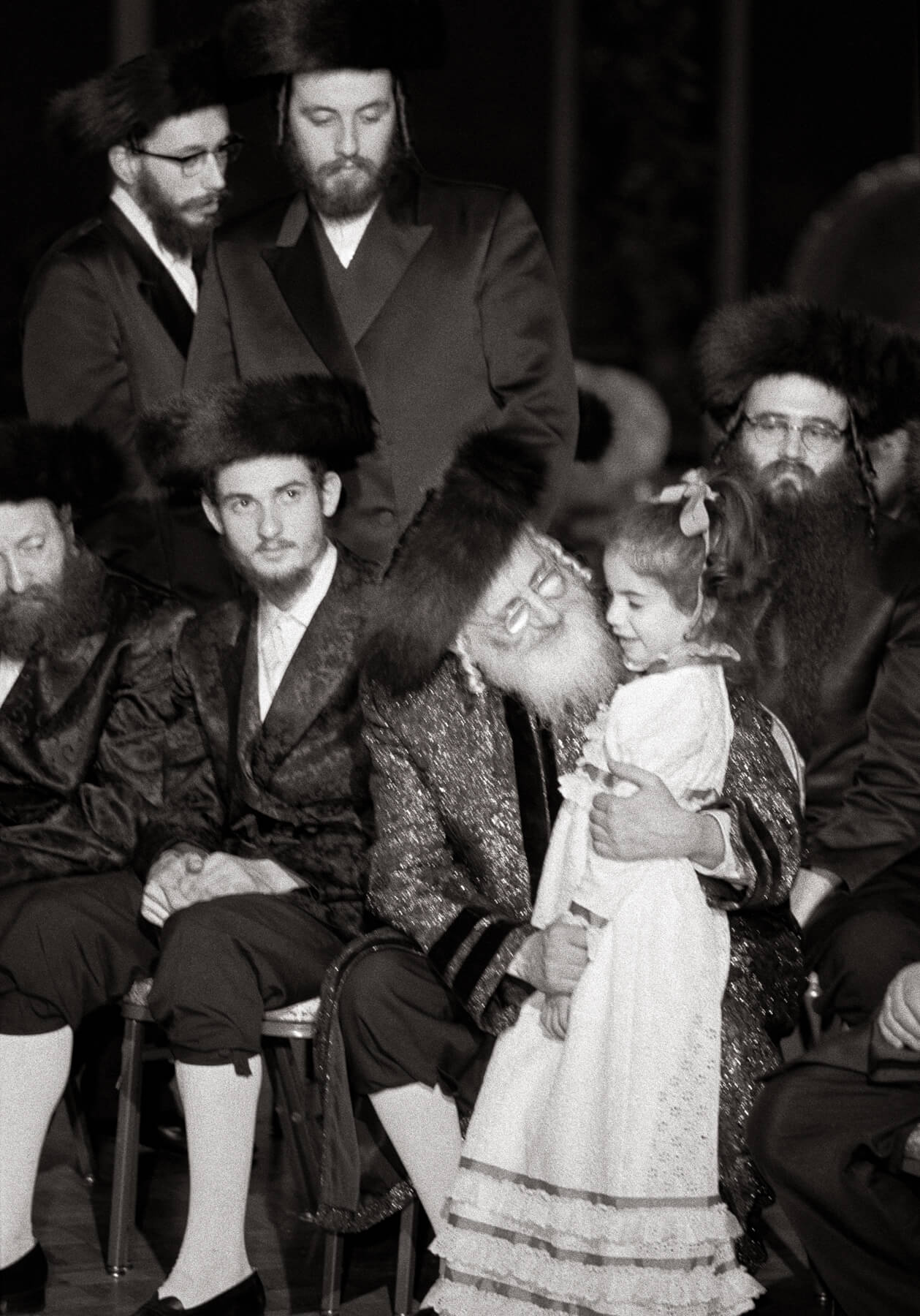 The Bobover Rebbe at the wedding of his daughter to the son of the Cheshinover Rebbe, in Borough Park, Brooklyn in 1975. Aron was invited to the wedding after photographing the rebbe buying an etrog and sending him the print. Photo by Bill Aron
Aron has become known for his work documenting Jewish communities around the world — his first book, From the Corners of the Earth, shows Jewish life in New York, Los Angeles, Cuba and the then-Soviet Union. His next, Shalom Y’all, was the result of a decade spent in the lesser-known Jewish communities of the American South.
His images are joyous and warm, portraits of resilience and invention, not dour investigations of poverty and antisemitism, offering respect to each subject he was able to meet through his work.
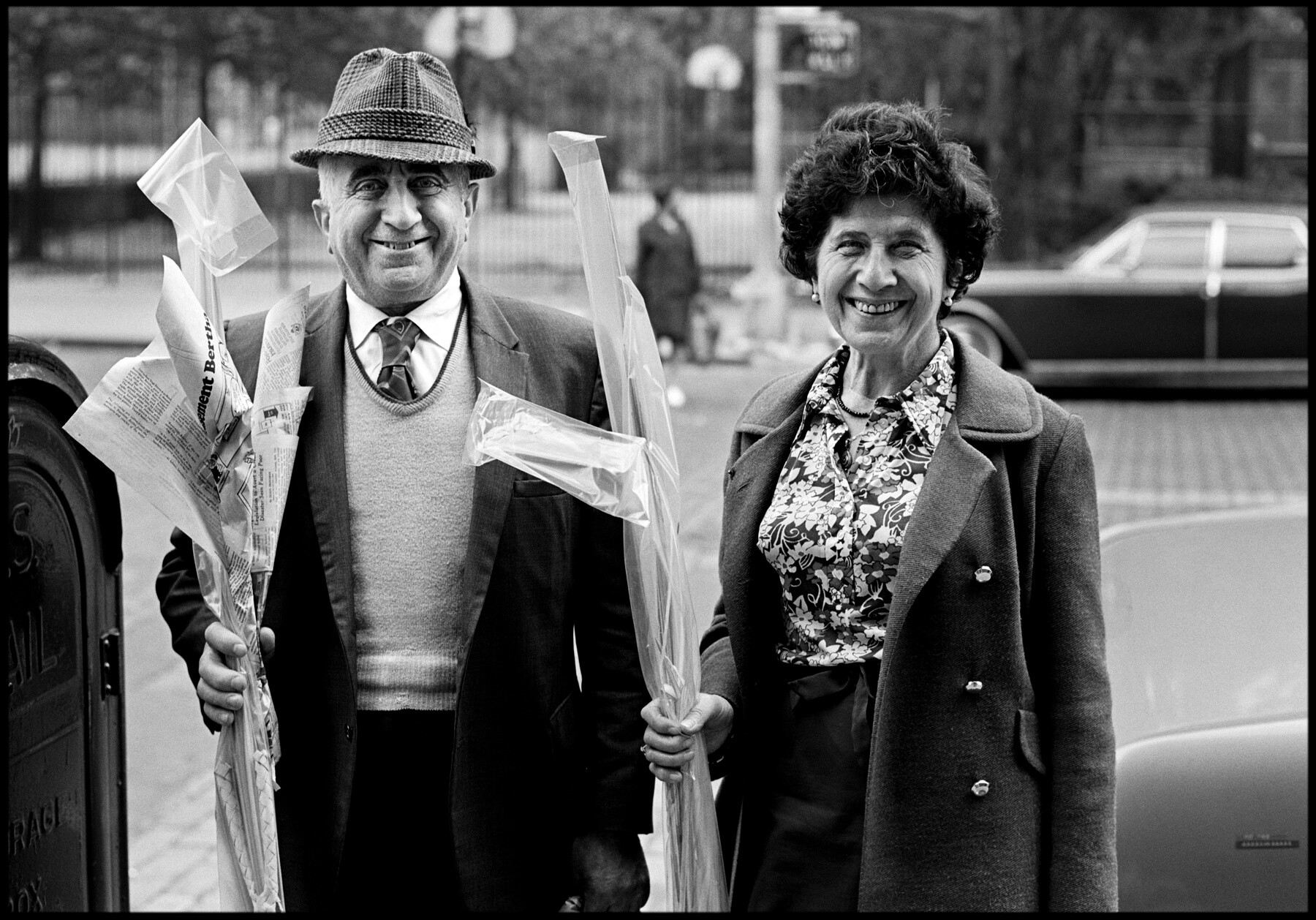 “American Jewish Gothic” by Bill Aron, shot on the Lower East Side in 1975. Photo by Bill Aron
But his camera didn’t just change his access to the communities he documented; it changed Aron’s own experience of his Judaism.
A series of photographs shows scenes from the New York Havurah, a lay-led, egalitarian Jewish religious movement: A rabbi stands in reverent contemplation under his tallit in a misty forest; a child smiles from her father’s shoulders during a Shabbaton. Aron was a member in the ’70s, which is how he found himself in the middle of those scenes. But, he said, he didn’t grow up observant, and without his camera, while he might have been a member, he would have been “a much more passive one,” he said.
 Judi Samuels Meirowitz dancing with the Torah on Simchat Torah in 1976, at the Havurah. Photo by Bill Aron
These photos are anything but passive. People smile or glower directly into the camera, and proudly present their life to the lens — a handful of shrimp from a Jewish man who built a business selling the shellfish to New Orleans restaurants, a woman showing off a bowl full of her famous chopped liver, a woman grinning as she carries a Torah on Simchat Torah. There is a clear symbiosis between Aron and his subjects, in which they each shaped and enlivened each other.
This, Aron said, was not the style of street photography at the time he came up. People were not supposed to document their own communities, nor were they supposed to engage with their subjects.
“It was frowned upon to study your own community — you were supposed to go out,” he said. “Street photography was supposed to be dispassionate.”
But of course people saw the camera and reacted to it, so he embraced that fact, spending hours talking to his subjects and learning their stories. Now that he has bequeathed his work to the AJHS, those stories are preserved not only in images but also in a podcast accompanying the exhibit, in which Aron is able to preserve the memories behind each photograph.
 New Orleans, Louisiana, Michael Shackleton, Shrimper, 1989. Aron said Shackleton found New York too crowded when he immigrated, so he ended up in New Orleans, where he set up a business selling shrimp to restaurants from the docks. Photo by Bill Aron
The stories come through in the images alone, too; each shot is redolent of Aron’s affection for his subjects. An Israeli soldier in Jerusalem’s Old City makes flirtatious eye contact with a woman as his companions smirk. An elderly man on a bench dives in to kiss his wife on the cheek. Holocaust survivors beam out from full-color photos, not reduced to the numbers on their arms but presented as “people who lived lives, lived beyond their nightmares, had families where they could, given back to their communities,” Aron said.
 “Border Patrol Flirt Squadron,” taken in Jerusalem’s Old City in 1980. “I wish I knew whether they ever got together,” Aron said. Photo by Bill Aron
Not every image, on its surface, seems Jewish — there isn’t always a yarmulke or a lulav or a Torah scroll in frame. Nevertheless, Aron manages to find the sense of Jewishness that knits these images into the tapestry of Jewish life.
In a photo of a couple embracing at the liquor store they ran in Arkansas as part of the Shalom, Y’all series, Aron told me that only the husband was planning to be photographed, because his wife wasn’t Jewish. The photographer invited her anyway, and the couple ended up explaining that an Orthodox rabbi had performed their marriage ceremony. This seemed wrong to Aron — Orthodox rabbis don’t perform intermarriages — so they produced their marriage certificate to show him. As they pulled it out of the envelope, he recounted, another slip of paper fell out in which the rabbi had written that the wife had consented to become a member of the people of Israel and was now a Jew, a fact she was unaware of but delighted, Aron recalled, to discover.
“I loved interacting with people while I was photographing,” he said, “and the people became part of the portrait.” Aron did too.
The exhibit The World in Front of Me is showing now through June 4 at the American Jewish Historical Society.
The post He documented a changing Jewish world, and the Jewish world changed him appeared first on The Forward.
Prosecutors charge Capital Jewish Museum shooter with terrorism
Federal prosecutors added two terrorism charges to the indictment against Elias Rodriguez, the Chicago man accused of killing two Israeli embassy employees outside a networking event held at the Capital Jewish Museum last May.
The new indictment, filed on Wednesday, claims that Rodriguez murdered Yaron Lischinsky, 30, and Sarah Milgrim, 26, with the intent to both influence government policy through “intimidation” and that he sought to “coerce a significant portion of the civilian population” of the United States.
“These additional terrorism-related charges carry a mandatory life sentence under D.C. Code, while also reflecting the reality that this act was in fact an act of terror,” U.S. Attorney Jeanine Pirro said in a statement.
Rodriguez, 31, who prosecutors say flew from Chicago to carry out the attack, allegedly shot Lischinsky and Milgrim repeatedly after they left a Jewish young professionals reception at the museum, hosted by the American Jewish Committee.
Related- Sarah Milgrim was ‘very Jewishly involved’ in Chabad, Hillel, Birthright, Israel before shooting outside Capital Jewish Museum
- ‘He was a mensch’: Slain Messianic Jew remembered as bridge-builder
He then entered the museum and shouted, “I did it for Palestine, I did it for Gaza.”
While prosecutors previously charged Rodriguez with national origin-based hate crimes, they have focused on the political dimension of the attack and the indictment quotes at length from social media posts and a manifesto that law enforcement sources attribute to Rodriguez.
“I am glad that today at least there are many Americans for which the action will be highly legible and, in some funny way, the only sane thing to do,” the manifesto stated. “Free Palestine.”
Lischinsky, a German-born Israeli, worked as a research assistant at the Israeli embassy while Milgrim, who was American, worked in its department of public diplomacy.
It remains unclear whether Rodriguez, who has pleaded not guilty, intentionally targeted the young couple, who were planning to get engaged on an upcoming trip to Israel. Israeli Ambassador Yechiel Leiter initially said that Rodriguez had identified Milgrim and Lischinsky as embassy employees while mingling with attendees at the event and then waited outside for them to leave.
But other accounts say Rodriguez never made it inside the event prior to the shooting, and the Israeli Embassy later said that Leiter was merely floating “a theory that law enforcement officials are investigating.”
Prosecutors said at a September hearing that they had more than 1.5 million pages of evidence against Rodriguez, while one of his defense attorneys described receiving “trillions of gigabytes” of data from the government.
The post Prosecutors charge Capital Jewish Museum shooter with terrorism appeared first on The Forward.
For Israel’s foremost chiropterologist, every bat is a mitzvah
Bats get bad press. Short-sighted and cave-dwelling, they generally make the news only when carrying disease, transfiguring into vampires, or else lending their name to paranoiac military commanders (e.g. Colonel ‘Bat’ Guano, in Dr. Strangelove).
All of which is grossly unfair — at least according to Yossi Yovel, a professor of zoology at Tel Aviv University, and author of The Genius Bat, recently named a ‘Book of the Year’ by the science journal Nature.
“Usually, bats are very nice,” said Yovel.
Indeed, the flying mammals have been remarkably tolerant towards Yovel and his small team of researchers, who’ve studied bat echolocation for the better part of a decade, and have proved that bats are smarter creatures than previously thought. And only rarely, Yovel said, has he gotten bitten. “But you can’t blame them,” he added. “Because you’re holding them in your hand, and you’re a big creature.”
Yovel first encountered the study of bats, or chiropterology, as an undergraduate at Tel Aviv University, where he took a course on bat echolocation, the first ever held in Israel. He was immediately hooked. “Suddenly, I discovered this new world! Of using sound for vision, basically,” he said.
Sensory zoology, as the broader research field is known, meant Yovel could combine two of his abiding interests: animals and physics. The ways in which animals used sound to get around provoked mathematical questions, not just biological ones.
When Yovel started his research in the late 2000s, he was the first Israeli zoologist to focus explicitly on bats’ sensory behavior. Previously, researchers had only explored bat physiology: how they maintained heat, how they hibernated, what they ate, and so forth. Yovel, by contrast, was “all about sound.”
His most important contribution to the field to date, one described in detail in The Genius Bat, is using GPS devices to track bats and show that they are, in fact, thinking, feeling creatures.
To create the gadgets, Yovel approached an Israeli startup that specialized in manufacturing minuscule GPS instruments — the company had initially designed them in the early aughts, intending to put them inside cameras — with an unusual request: Could they make one that Yovel could stick, using biological glue, to bats?
 A bat refuels Photo by Omer Yinon
“So they developed it for me,” Yovel said. “And though the main thing is the GPS, there’s also a microphone in there. And that combination is what’s so unique, because we wanted to record sound echolocation as the bats are flying.”
The research can be hands-on (Yovel attaches the trackers himself) and not without its challenges — chief among them retrieving the devices, which by design fall off the bats within a few days.
Yovel and his team wear antennae, which pick up signals from a “small pinger” attached to the GPS, but still can spend hours searching.
“It’s a huge bottleneck that people are not aware of,” he said. “It’s like a treasure hunt, and often we climb mountains or have to go through thick vegetation.”
To tackle this problem, Yovel and his team constructed a lab — “our own bat colony,” he calls it — at Tel Aviv University, where dozens of bats roost. But the bats are allowed to roam free, so they “go out and come back,” Yovel said.
Thanks to the facility, Yovel can track bats for months, even years, though they haven’t exactly gone undetected. “Sometimes, people complain to me about bats pooping on their cars and on their houses,” he said. “I say to them, ‘tell me where you live, and I can check if our bat visited your backyard or not!”
By studying the bats’ sonar activity, Yovel and his team have shown that bats possess what he describes as a “cognitive map in their brain.” They’ve demonstrated, for instance, that bats can map time, avoiding objects — a tree, say — that they’ve previously visited. “They know that a long time has passed,” said Yovel, “and so they will not return to this tree, because they assume that there’s no more fruit on it.”
Bats even respond to illness in a fairly recognizable manner, often deciding simply to stay at home. “Sick bats will usually avoid any contact, and will not fly out, just like we prefer to be in bed when we’re sick,” Yovel said.
Whether this rises to the level of full-on consciousness is a matter of some debate, though Yovel believes that bats — indeed, most animals — have at least some degree of consciousness. The challenge, then, is finding “sophisticated ways to probe these degrees.” After all, how do you measure such a thing without language as a guide?
He reaches for an unusual comparison to emphasize the dilemma: toddlers. “Pre-lingual toddlers are obviously conscious, right? But we need to find ways to examine this using behavioral experiments, because we can’t ask them,” he said. Artificial Intelligence will certainly play an important role. “That’s the future,” Yovel said. “Using AI models to simulate bat behavior.”
So Yovel will continue to use bats to explore what he calls the “consciousness-gap” between humans and animals. “Or,” he added, grinning a little, “the lack of a gap.”
Related- What a lion, a rabbi, and a dog taught me about grief
The post For Israel’s foremost chiropterologist, every bat is a mitzvah appeared first on The Forward.
Tucker Carlson to interview Mike Huckabee, U.S. Ambassador to Israel
(JTA) — Right-wing pundit Tucker Carlson and Mike Huckabee, the U.S. Ambassador to Israel, said they will conduct an interview after Carlson published a video from the Middle East that included harsh criticism of Huckabee.
The planned sit-down, hashed out over social media, comes as Carlson has troubled the Jewish world and fractured the conservative movement by using his influential podcast to increasingly entertain antisemites and conspiracy theories about Israel. He has reserved his particular ire for “Christian Zionists,” of which Huckabee, a Baptist minister who aligns himself with the pro-Israel hard right, is a leading figurehead.
“Instead of talking ABOUT me, why don’t you come talk TO me?” the ambassador, and Carlson’s former Fox News colleague, wrote on X early Thursday in response to a Carlson video filmed in Israel and Jordan that purports to reveal how Israel treats Christians and declares that “Huckabee fails Jerusalem’s Christians.”
Huckabee added, “You seem to be generating a lot of heat about the Middle East. Why be afraid of the light?”
When Carlson agreed to an interview an hour later (“I’d love to”), Huckabee responded, “Look forward to the conversation[.]”
Huckabee, a key evangelical Trump ally and stalwart Israel backer, is reaching out to Carlson at a notable moment. Carlson has recently emerged both as the right’s harshest Israel critic and as the source of its larger divide over antisemitism, particularly since his friendly interview last fall with avowed white nationalist and Holocaust denier Nick Fuentes.
Many conservative leaders, including Sen. Ted Cruz (who’s faced harsh grilling from Carlson over his own support for Israel) and Orthodox Jewish pundit Ben Shapiro, have called on the GOP to distance itself from Carlson. Yet he maintains good relationships with President Donald Trump and Vice President JD Vance, and has sway over right-wing powerbrokers such as the Heritage Foundation and Turning Point USA. He has also forged close ties with Qatar.
Carlson’s latest video, framed around the treatment of Christians in Israel, calls for American Christians — long a key pro-Israel constituency — to stop supporting Israel. He also accuses Huckabee of ignoring such concerns.
“Why not go ahead and talk to Christians and find out their side of the story?” Carlson muses. “Why aren’t American Christian leaders like Mike Huckabee or Ted Cruz, people who invoke the Christian Bible to justify what they’re doing, why haven’t they done this?”
Huckabee has in fact spoken out against what he says is persecution of Christians in Israel since his appointment.
Carlson then interviews the Anglican archbishop of Jerusalem, who suggests that Christian Zionism is “a trap” for Jews “because they’re all supposed to convert to Christianity or die.” Much of Carlson’s report focuses on the treatment of Palestinian Christians by Israelis, including settlers who have raided Christian villages in the occupied West Bank. He also mentions Israeli military strikes on Christian holy sites and a Christian hospital in Gaza. (Palestinian Christians remain a minority in the heavily Muslim territories, and the brunt of Israeli attacks have fallen on Muslim residents and sites.)
“It’s a story of Christians being oppressed in Jerusalem by a government that American Christians pay for,” Carlson says. His report is heavily sympathetic to Jordan, where he claims Christians live more freely than in Israel.
If the interview goes through, Huckabee would be the first sitting member of the Trump administration to appear on Carlson’s show since the controversy over his Fuentes interview. He has visited the White House multiple times so far this year.
var theUrl = document.URL;var theUrlArray = theUrl.split("//");var theUrlpre = theUrlArray[1];var theUrlpostArray = theUrlpre.split("/");var theUrlpost = theUrlpostArray[0];(function(i,s,o,g,r,a,m){i['GoogleAnalyticsObject']=r;i[r]=i[r]||function(){(i[r].q=i[r].q||[]).push(arguments)},i[r].l=1*new Date();a=s.createElement(o),m=s.getElementsByTagName(o)[0];a.async=1;a.src=g;m.parentNode.insertBefore(a,m)})(window,document,'script','//www.google-analytics.com/analytics.js','ga');ga('create', 'UA-2449829-1', theUrlpost, {'name':'uniqueTrackerName'});ga('uniqueTrackerName.send', 'pageview');
The post Tucker Carlson to interview Mike Huckabee, U.S. Ambassador to Israel appeared first on The Forward.
Canadian Jewish groups decry axing of antisemitism envoy in favor of ‘rights, equality and inclusion’ advisory council
(JTA) — Canadian Jewish groups are denouncing a government decision to replace the country’s antisemitism and Islamophobia envoys with a new “Rights, Equality and Inclusion” council.
The new advisory council, announced by the Canadian government on Wednesday, is billed in a press release as aiming to “foster social cohesion, rally Canadians around shared identity, combat racism and hate in all their forms, and help guide the efforts of the Government of Canada.”
The press release said appointees would be “prominent Canadians from academia as well as experts and community leaders” named at some point in the future.
“The new Advisory Council on Rights, Equality and Inclusion will help build a more inclusive and united Canada; one grounded in our shared values, with a strong focus on community involvement, and rooted in the belief that far more unites us than divides us,” Marc Miller, the Canadian minister of identity and culture, said in a statement.
The announcement comes more than six months after the country’s last antisemitism envoy, Deborah Lyons, resigned abruptly, saying she was exhausted by “the fact that it was hard to get people to speak up” about antisemitism in Canada. The antisemitism role also included responsibility for Canada’s official Holocaust remembrance.
Last month, Simon Wolle, the CEO of B’nai Brith Canada, called for the position to be filled immediately amid rising antisemitism, telling reporters, “The absence of the position undermines Canada’s international reputation and signals a lack of commitment to fighting antisemitism.”
Richard Robertson, B’nai Brith Canada’s director of research and advocacy, said in a statement that the new advisory council “must prioritize combating antisemitism,” adding that “urgent action is required to confront the problem head-on and without delay.”
In 2024, B’nai Brith Canada reported that there had been 6,219 reported cases of antisemitic incidents in Canada, an all-time record for the country. Canada is home to approximately 393,000 Jews with the majority residing in Toronto, according to the 2022 American Jewish Year Book.
Noah Shack, the CEO of the Centre for Israel and Jewish Affairs, said in a statement that his organization expected “immediate concrete action on solutions that the Jewish community has long advocated for, including support for security and addressing the sources of hate.”
“It is crucial that the government’s new approach and the composition of the advisory council are designed to achieve meaningful outcomes in combatting the unprecedented wave of antisemitism and extremism in Canada,” continued Shack.
The restructuring comes nearly a year into the tenure of Prime Minister Mark Carney, a liberal elected amid a backlash against U.S. President Donald Trump. It comes amid broad concerns about whether Jewish interests can be accommodated adequately within a general inclusion framework.
Other Canadian Jewish groups offered stronger denunciations of the new approach. The Jewish Heritage Centre of Western Canada wrote in a post on Facebook that it had received the news that the antisemitism envoy role would be slashed with “tremendous disappointment and concern.”
The Abraham Global Peace Initiative similarly decried the decision, writing in a post on X that the “outright deletion of the office raises fundamental questions about how Canada intends to meet its international obligations to preserve Holocaust memory and combat antisemitism.
“With the office now abolished, it is unclear who will be responsible for implementing this mandate, ensuring accountability, or coordinating national policy at a time of unprecedented antisemitism,” the post continued. “The absence of a dedicated body also brings into question how the memory of the Holocaust will be preserved in Canada.”
The U.S. antisemitism envoy under Trump, Yehuda Kaploun, has used his role to promote Trump’s immigration crackdown.
var theUrl = document.URL;var theUrlArray = theUrl.split("//");var theUrlpre = theUrlArray[1];var theUrlpostArray = theUrlpre.split("/");var theUrlpost = theUrlpostArray[0];(function(i,s,o,g,r,a,m){i['GoogleAnalyticsObject']=r;i[r]=i[r]||function(){(i[r].q=i[r].q||[]).push(arguments)},i[r].l=1*new Date();a=s.createElement(o),m=s.getElementsByTagName(o)[0];a.async=1;a.src=g;m.parentNode.insertBefore(a,m)})(window,document,'script','//www.google-analytics.com/analytics.js','ga');ga('create', 'UA-2449829-1', theUrlpost, {'name':'uniqueTrackerName'});ga('uniqueTrackerName.send', 'pageview');
The post Canadian Jewish groups decry axing of antisemitism envoy in favor of ‘rights, equality and inclusion’ advisory council appeared first on The Forward.
These major Jewish groups have sponsored the NYC mayor’s interfaith breakfast before. Not this year.
(JTA) — Zohran Mamdani is set to host the mayor’s interfaith breakfast on Friday, keeping alive an annual tradition that brings together hundreds of religious leaders — but Jewish involvement in the event will look different this time around.
That’s because at least three groups who’ve sponsored the last few editions of the event — UJA-Federation of New York, the New York Board of Rabbis and the Anti-Defamation League — are not sponsoring this year’s.
UJA and the New York Board of Rabbis did not confirm why they are not sponsoring, nor whether the mayor’s office reached out about sponsoring; a City Hall spokesperson did not respond to requests for comment.
But a local ADL director said that the group was not given a choice.
“For years, ADL has proudly sponsored the NYC Mayor’s annual Interfaith Breakfast as a vital opportunity to build bridges and foster understanding across New York City’s diverse faith communities. This year, ADL was not invited to attend,” said Scott Richman, regional director of ADL New York and New Jersey.
He continued, “While a breakfast itself does not ultimately matter, protecting every Jewish New Yorker does. We call on Mayor Mamdani to serve the entire Jewish community, especially in this time when violent antisemitism is surging.”
After this story was first published, the ADL clarified that it had declined to sponsor the event before failing to receive an invitation.
Mamdani has had a contentious relationship with the ADL, which established a “Mamdani monitor” that would serve as a public tracker of his policies and personnel appointments, and whose leader, Jonathan Greenblatt, inaccurately accused Mamdani of having never visited a synagogue.
While it’s unclear whether Mamdani’s team invited other groups like UJA and NYBR, what is apparent is that the event, and the Jewish groups involved in it, reflect a broader shift in which progressive-leaning Jewish organizations have a greater role in New York City politics than they did under Adams.
Left-wing group Jews for Racial and Economic Justice confirmed that it will co-sponsor the event, which it has never previously done. New York Jewish Agenda, a progressive advocacy group, is also sponsoring — and its outgoing leader, Phylisa Wisdom, is expected to make her first public appearance as executive director of the Mayor’s Office to Combat Antisemitism.
Rabbi Marc Schneier, a vocal critic of both Mamdani and his choice of Wisdom, said he is declining the mayor’s invitation to attend.
“I will not attend a public forum in support of a mayor who continues to bifurcate Israel from the Jewish community,” he said, adding that he would be “aghast” if groups like the UJA, NYBR and ADL “were to support this interfaith breakfast” because of Mamdani’s anti-Zionism.
Others who have been critical of Mamdani are still planning to attend.
Elliot Cosgrove, the senior rabbi of Park Avenue Synagogue who spoke out against Mamdani and endorsed Andrew Cuomo during the election, said he intends to go. He said he was unaware of the event’s past or present sponsorship.
The Jewish Community Relations Council of New York and Sephardic Community Federation have been among the sponsoring groups in past years. Neither organization responded to questions about whether they were involved this year, nor did a Mamdani spokesperson.
The mayor’s interfaith breakfast, which was established as an annual tradition by Mike Bloomberg in 2002, usually draws more than 300 religious leaders from around the city. It’s been the subject of political dissent in the past, such as when about a dozen Muslim leaders boycotted Bloomberg’s breakfast amid accusations of police surveillance of Muslim communities.
Adams made headlines at the breakfast in 2023 when he dismissed the need to separate church and state. He gave a “campaign-style speech” last year that focused on his upbringing and ability to face criticism as mayor.
A press release from City Hall for this year’s event did not include a list of sponsoring organizations or speakers but said that the breakfast, held at the New York Public Library’s flagship building, would “bring together faith leaders from across the five boroughs to honor the city’s religious, spiritual, and cultural diversity.”
This story was updated after publication with new information about the ADL’s lack of participation.
var theUrl = document.URL;var theUrlArray = theUrl.split("//");var theUrlpre = theUrlArray[1];var theUrlpostArray = theUrlpre.split("/");var theUrlpost = theUrlpostArray[0];(function(i,s,o,g,r,a,m){i['GoogleAnalyticsObject']=r;i[r]=i[r]||function(){(i[r].q=i[r].q||[]).push(arguments)},i[r].l=1*new Date();a=s.createElement(o),m=s.getElementsByTagName(o)[0];a.async=1;a.src=g;m.parentNode.insertBefore(a,m)})(window,document,'script','//www.google-analytics.com/analytics.js','ga');ga('create', 'UA-2449829-1', theUrlpost, {'name':'uniqueTrackerName'});ga('uniqueTrackerName.send', 'pageview');
The post These major Jewish groups have sponsored the NYC mayor’s interfaith breakfast before. Not this year. appeared first on The Forward.
-idf-humanitarian-missions_1.jpg)
-idf-counterterrorism-efforts_1.jpg)
-idf-training-programs_1.jpg)
-idf-technological-advancements_1.jpg)
-idf-military-operations_1.jpg)


